
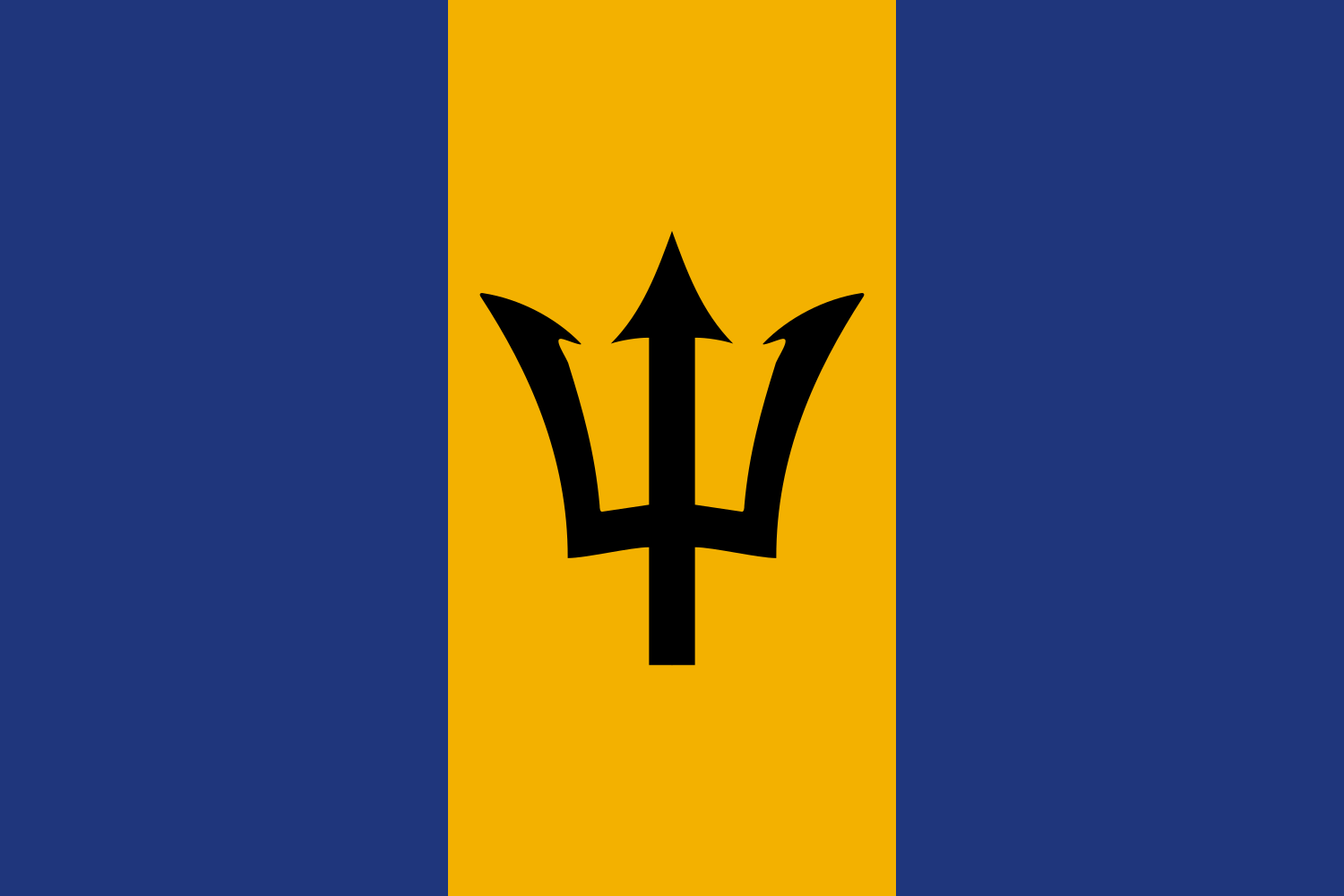
Barbados
15 topics answered, 3 policies that cut across several of them, and 4 recorded exceptions that depend on where you are coming from.
- Region
- Caribbean
- Currency
- BBD
- Language
- English
- Policies
- 3 active
- Last checked
- 2026-10-05
Where are you a citizen of?
Most rules on this page are the same for everyone. The ones that are not get marked for you.
Policy that cuts across topics
Affects 15 of the 15 topics on this page
Barbados publishes its law in three places that do not agree with each other about how current it is, and none of them says so on its face. The Supreme Court's statute library carries the Chapters, printed by the Government Printer, with a Law Revision Order year in the running head of each page - 2007 on the newest pages of the Immigration Act and the Income Tax Act, 1997 on the Income Tax pages that carry the residence and domicile rules. The Attorney General's Office carries annual Acts and statutory instruments, and its series of annual Acts stops at 2020. The Government Printing Department publishes the Official Gazette, which is where an Act of 2021 or later is actually found. A reader looking for the law in force has to use all three, and an amendment made between 2021 and today is invisible in the first two.
Affects 4 of the 15 topics on this page
The Exchange Control Act, Chapter 71, is in force, and it works the way exchange control always has: a general prohibition, with permission from the Authority as the exception. Only an authorised dealer may buy, borrow, sell or lend foreign currency. Payments to or for the credit of a person resident outside Barbados need permission. Securities denominated in Barbados dollars cannot be transferred between a resident and a non-resident without the Central Bank's permission. The Authority is the Minister of Finance, who has delegated most of the work to the Central Bank, which in turn delegates to authorised dealers and depositaries. For a person moving to Barbados the practical consequence is that "resident" means something different here than it does for tax: three years of continuous residence, and never if you are on a work permit.
Affects 7 of the 15 topics on this page
On 21 April 2026 the Government laid the Immigration Bill, 2026 and the Barbados Citizenship Bill, 2026. The Immigration Bill would repeal Chapter 190 outright and replace it: a points test for permanent residence, an express route for the spouse of a citizen and for a retired person with sufficient financial resources, a right for a direct descendant of a citizen to be registered as a permanent resident, automated passport control kiosks, advance passenger information shared with intelligence agencies, and a lengthening of the long-stay permit from three years to five. Both Bills were still before the House of Assembly when this was written and neither has commenced. Nothing in this record is law. It is here because the Act they would replace is the Act every other Barbados record rests on, and because what the Bills do not contain is itself a finding: neither of them implements the 2025 free movement arrangement.
Topics
all 15 answered- Entering Barbados as a Visitor
Barbados sorts arrivals into two lists in the Second Schedule to the Immigration Act. A visitor belongs to Part II, with passengers in transit and people entering for medical treatment, and an immigration officer may permit any period up to six months on whatever conditions the officer thinks fit. Part I is the longer-stay list - students, people entering for employment, trade or business, diplomats and anyone else the Minister approves - and there the ceiling is three years. Extending a permit is not a renewal at a counter: the holder applies to the Chief Immigration Officer in the prescribed form and may be made to report in person and submit to an examination under the Act even though they are already in Barbados. Whether a visa is needed first is set out in one table published by the Ministry of Foreign Affairs covering every country, and the fee is charged in United States dollars.
Verified with official sourceMonitor - can change - Living in Barbados on Income from Abroad: the Welcome Stamp
The Barbados Welcome Stamp is the one remote-work route in this comparison that has a statute of its own. It was created by the Remote Employment Act, 2020-23, which commenced on the day after assent, and extended by the Remote Employment (Amendment) Act, 2021-11, which added renewal. The Act does the work in nine short sections: a non-national employed in a country other than Barbados may be granted a stamp to work here for twelve months on proof of annual income of $100,000 or more generated outside Barbados, a valid passport and valid health insurance; the fee is $4,000 for an individual and $6,000 with family; a renewal costs $3,000 and $4,500 and runs another twelve months. The holder is deemed not resident for the purposes of the Income Tax Act residence test, and income received by a stamp holder is not income derived from Barbados. They may not take any other employment in Barbados.
Verified with official sourceMonitor - can change - Retiring to Barbados
Barbados has no retirement visa and no retiree programme with a name. What it has is one paragraph of the Immigration Act: a permitted entrant who desires to reside in retirement in Barbados and has sufficient means of support to maintain himself and his dependants may, on application to the Minister, be granted permission to become an immigrant. Immigrant status is the strong status - the Immigration Department describes it as the equivalent of a permanent visa, allowing a person to live and work in Barbados indefinitely - and it is granted by the Minister on an open test with no stated income figure, no stated asset figure and no stated age. The only numbers published are fees, and the Department's figures are not the figures in the Regulations.
Verified with official sourceStable - Working in Barbados
Section 17 of the Immigration Act is the work permit rule, and the interesting part of it is who it does not apply to. As it stands since 2020 it bites on everyone except a citizen, a permanent resident, an immigrant, and a national of a CARICOM Member State to whom the Revised Treaty's right of establishment, provision of services or free movement articles apply. That exemption is not aspirational: it was written into the Immigration Act by the schedule of consequential amendments to the Caribbean Community (Movement of Skilled Nationals) (Amendment) Act, 2020-3, which commenced on the day it was assented. Everyone else needs a permit from the Minister. The Department grants short-term permits up to eleven months and long-term permits up to three years, charges a $300 application fee, and sets the final fee by a monthly scale in the Regulations that prices a job differently depending on whether the holder is a Caribbean national or a citizen of another country.
Verified with official sourceMonitor - can change - Investing Your Way into Barbados
Barbados has no citizenship by investment programme, and the statute book says so by omission: the Constitution lists the ways a person becomes or may be registered as a citizen, and investment is not among them. What it has instead is two things. The Immigration Act lets the Minister grant immigrant status to a permitted entrant who has established himself successfully in Barbados in a profession, trade, business or agricultural enterprise, or is likely to and has the means to live on until he does. And section 13(7) gives the Minister an unbounded power to grant special permission to remain on such terms and conditions as he thinks fit - which is the whole legal foundation of the Special Entry and Reside Permit marketed to property owners and people of high net worth. The permit's published criteria and fees are not in any instrument we could find, and are not published by any Barbados government page we could reach.
Verified with official sourceMonitor - can change - Studying in Barbados
A student must obtain a student visa before entering Barbados, not after arriving. The Immigration (Students) Regulations, 1979 require an application in Form H-2 accompanied by a certificate from the head of the institution and written evidence that the student can pay the tuition and keep himself. The visa runs for one year and is renewed annually on a progress report from the institution. Changing course or institution needs permission first, and failing to ask can cost the visa. The regulation that matters most is the last substantive one: time spent in Barbados studying must not be taken into consideration when the student later applies for citizenship or permanent resident status. A degree in Barbados does not shorten the road to staying in Barbados.
Verified with official sourceStable - Barbadian Ancestry: One Generation Down, Two Generations Up
Barbadian descent runs one generation and no further, and it runs in an asymmetric way. Under the Constitution a person born outside Barbados is a citizen at birth if their father was a citizen otherwise than by descent, and - by an amendment of 2000 - if at least one parent was a citizen who was born in Barbados. A grandchild of a Barbadian is not a citizen by descent on either limb. The Immigration Act runs the relationship the other way: a person who is the parent or grandparent of a citizen residing in Barbados, and for whom that citizen is willing and able to provide, may be granted immigrant status. So a Barbadian can bring a parent or a grandparent, but a Barbadian's grandchild abroad has no claim. Those are two different rules pointing in opposite directions, and they are often described as one.
Verified with official sourceStable - Marrying a Citizen of Barbados
The Constitution gives a spouse a right to be registered as a citizen, but the length of marriage that earns it is not in the Constitution. Section 3A(1)(b), inserted in 2000, gives the right to a person who has been married to a citizen of Barbados and has cohabited with that citizen for such period as may be prescribed - and "prescribed" means prescribed by or under an Act of Parliament. The period is therefore in the Barbados Citizenship Act or in regulations under it, and the published copy of that Act is a scan we could not read. Two things the Constitution does say are worth knowing: the right survives the death of the citizen spouse before the period runs out, and it survives divorce or annulment once registration has happened. There is also an older provision, section 6, under which a woman who marries a citizen is entitled to be registered, which the Immigration Department still names on its forms.
Verified with official sourceStable - CARICOM Movement into Barbados: the Skills Certificate, and the Protocol That Has No Statute
Barbados runs two things at once, and only one of them is in an Act. The statute is the Caribbean Community (Movement of Skilled Nationals) Act, Chapter 186A, rewritten by the amending Act of 2020 which commenced on the day it was assented. Under it a skilled community national who presents a qualifying certificate issued by a competent authority or Minister of any Member State is admitted for six months and may work in those six months without a work permit. For an indefinite stay the Barbados Accreditation Council verifies the certificate with the authority that issued it, tells the Chief Immigration Officer, and the Chief Immigration Officer stamps the words indefinite entry in the passport. The other thing is enhanced cooperation in free movement with Belize, Dominica and Saint Vincent and the Grenadines, running since 1 October 2025. The Ministry of Foreign Affairs, asked on its own page what laws govern free movement, lists four existing Acts and no new one. There is no Barbadian equivalent of Belize's Caribbean Community (Free Movement and Contingent Rights) Act 2026.
Depends on your citizenship
3 recorded exceptions change this rule for some nationalities.
Verified with official sourceActively changing right now - Becoming a Citizen of Barbados
Citizenship is in the Constitution, not in an immigration act, and that is the structural fact to start from. Birth in Barbados makes you a citizen outright. Birth abroad makes you one only through a parent, and only one generation. For everyone else Chapter II gives a right to be registered after ordinary residence in Barbados throughout ten years, or after marriage to a citizen for a period left to be prescribed. Both rights are expressed as entitlements rather than discretions, subject only to exceptions prescribed in the interests of national security or public policy, and both require the oath of allegiance taken before an immigration officer sitting as a Justice of the Peace. Parliament may provide for further routes under section 9, and the Barbados Citizenship Act is that Act - but the Government's published copy of it is an unreadable scan, so the registration and naturalisation detail is not stated here.
Verified with official sourceMonitor - can change - Tax Residence and Domicile in Barbados
Barbados runs two tests, not one, and almost every secondary account merges them. Residence is a day count or an election: a person is resident in an income year if they spend more than 182 days in Barbados in that year, or if they are ordinarily resident, which the Act defines as having a permanent home here and having told the Commissioner they intend to reside for at least two consecutive income years. Domicile is separate and the Income Tax Act does not define it. The two combine into three positions. Resident and domiciled means worldwide income. Resident but not domiciled means Barbadian income plus foreign income only to the extent a benefit is obtained in Barbados from it - a remittance basis written into section 17. Not resident means Barbadian income only. Getting out of residence is not automatic either: section 85(5)(b) requires the days, the absence of domicile and a written notice to the Commissioner.
Verified with official sourceMonitor - can change - Opening a Bank Account in Barbados
Barbados still has exchange control, and that - not anti-money-laundering paperwork - is what decides how a newcomer's account works. The Exchange Control Act makes it unlawful for anyone but an authorised dealer to buy, borrow, sell or lend foreign currency without permission, and the authority is the Minister of Finance, who has delegated most of it to the Central Bank. The rule that matters to a new arrival is the Central Bank's definition of residence for exchange control, which is nothing like the tax definition: a national of another country counts as resident only after continuously residing in Barbados for at least three years and only if not on a work permit. Until then their Barbados dollar account is an External Account, their foreign currency account is a non-resident one, and the Central Bank has given general permission for their net salary to be credited to it.
Verified with official sourceMonitor - can change - Healthcare in Barbados
Barbados runs its public health system through the Health Services Act, and the Act does not make access depend on immigration status. What it does is let the Minister establish health services institutions and make regulations prescribing the fees to be paid for services provided at them and the terms on which those fees are to be paid. Charges are therefore a matter of subsidiary legislation, and section 10A refers to recovery of unpaid fees under the Hospital (Fees) Regulations, 1970. Separately, every person employed in insurable employment is insured under the National Insurance and Social Security Act, with no nationality condition, and a Health Service contribution sits inside that Act. For CARICOM nationals from the three enhanced cooperation partner states the Ministry of Foreign Affairs says access to primary healthcare is on the same basis as for nationals.
Depends on your citizenship
1 recorded exception change this rule for some nationalities.
Verified with official sourceMonitor - can change - Driving in Barbados on a Foreign Licence
This is the clearest divergence we found in Barbados between what the statute says and what the agency charges for. Since 2017 the Road Traffic Act has defined a driving licence to include a licence or other authorisation granted to a person of another jurisdiction authorising that person to drive, and section 61 forbids driving only without a valid driving licence authorising that class of vehicle. On the face of the Act, as consolidated to 2022, a visitor holding a valid licence from home is already the holder of a valid driving licence and needs nothing else. The Barbados Licensing Authority nevertheless publishes a Visitor Permit, states that a visitor is legally required to apply for one before driving on public roads, and charges $10 for stays under two months and $100 for longer. The Ministry of Foreign Affairs repeats the requirement on its visitor page. We could not find the provision that creates it.
Verified with official sourceActively changing right now - Bringing Your Belongings to Barbados
The Customs Act handles a person's own things through the definition of passengers' baggage: commercial travellers' samples, and otherwise the personal or household effects of the passenger and his family plus small articles brought as declared gifts, but nothing intended for sale or exchange. Baggage so defined is kept outside several of the Act's ordinary requirements - it need not be entered before export, it is not caught by the rules on goods not reported on arrival, and the loading of it is permitted at the proper officer's discretion. For a vehicle or other goods brought temporarily, section 111 allows importation against a deposit or security, and section 112 requires export within three months unless the proper officer is satisfied the goods are the bona fide property or in the bona fide use of a person on a temporary visit, in which case he may allow longer.
Verified with official sourceStable