
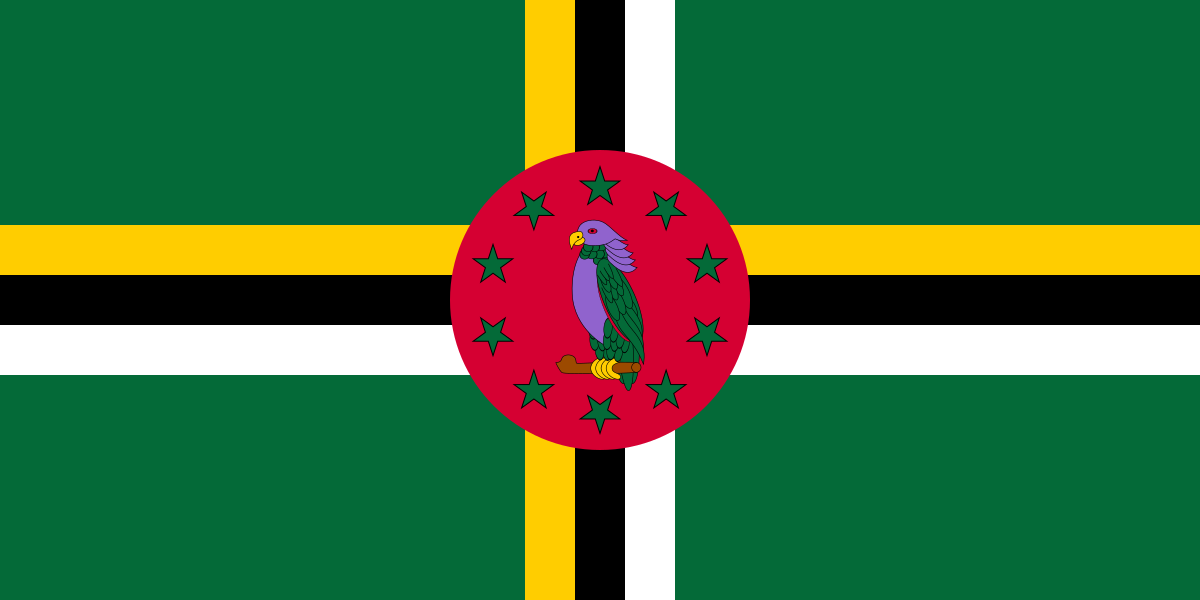
Dominica
15 topics answered, 3 policies that cut across several of them, and 8 recorded exceptions that depend on where you are coming from.
- Region
- Caribbean
- Currency
- XCD
- Language
- English
- Policies
- 3 active
- Last checked
- 2026-10-05
Where are you a citizen of?
Most rules on this page are the same for everyone. The ones that are not get marked for you.
Policy that cuts across topics
Affects 3 of the 15 topics on this page
Dominica charges a person who bought citizenship more for ordinary civil documents than it charges anyone else, and it does so by name. In November 2024 the Passport Regulations gained a line for "a person who acquired citizenship by investment" at US$300 for a passport, against EC$150 for an adult citizen in Dominica, and US$2,000 for a replacement against EC$500. The same month the fee schedule to the Vehicles and Road Traffic Act gained a private driver's licence at US$300 for the same class of person, against EC$100 for everybody else. Both are the same idea: an investor citizen holds the same certificate of naturalisation as any other naturalised citizen, and pays a different price at the counter. The instruments define the class rather than leaving it to practice, which is what makes this a policy and not a rumour.
Affects 3 of the 15 topics on this page
Land in Dominica held by an unlicensed alien is forfeited to the State. The Aliens Land Holding Regulation Act 1995 is a separate statute from everything else in the relocation picture and it is the one most likely to catch a newcomer, because it bites on ownership rather than on status. What makes Dominica's version different from the Kittitian one is who counts as an alien: the definition excludes citizens of the OECS Member States, so an Antiguan, Grenadian, Kittitian, Saint Lucian or Vincentian buys land here on the same footing as a Dominican. Everyone else may hold one acre for residence or three for trade or business without a licence, on paying the Accountant General ten per cent of the market value, and needs a licence beyond that.
Affects 2 of the 15 topics on this page
Printed as live subsidiary legislation to the Income Tax Act is a rule that no person shall leave or attempt to leave Dominica without a certificate from the Comptroller of Inland Revenue saying he owes no tax, that nobody may issue him a ticket without one, and that it is an immigration officer's duty to stop him boarding. The Regulations date from 1984 and carry a long list of exemptions, the widest of which covers any person temporarily resident in Dominica who has not carried on a business or exercised any employment here - which is to say, an ordinary visitor. The rule matters for anybody who does work or trade in Dominica and then wants to leave, and it is the kind of provision that is invisible until it is not.
Topics
all 15 answered- Entering Dominica as a Visitor
Twelve months is the figure in the statute, and it is the longest single visitor permit of any country in this comparison. Section 19 of the Immigration and Passport Act lets an immigration officer grant a visitor or a passenger in transit a permit for up to twelve months, and a shorter permit may be extended by the Commissioner of Police up to that same twelve-month ceiling counted from the date of entry. Whether you need a visa first turns on a distinction the Act draws and most guides miss: only an alien needs one, and an alien is defined as a person who is not a Commonwealth citizen. The list of non-Commonwealth nationalities that are nevertheless exempt is set by the Aliens (Visa Exemption) Regulations - and the version in force is S.R.O. 37 of 2019, which the Government's own law collection does not publish.
Depends on your citizenship
4 recorded exceptions change this rule for some nationalities.
Verified with official sourceActively changing right now - Living in Dominica on Income from Elsewhere
There is no rentier visa, no passive-income category and no published income threshold. Dominica's Immigration and Passport Act contains exactly one residence instrument - a permit under section 9, granted by the Minister on any conditions he thinks expedient - and it is not divided into categories at all. Having an income from abroad helps in one specific way: section 5(1)(a) makes a person without sufficient means to support himself a prohibited immigrant, so means are what keep you out of the prohibited class rather than what qualify you for a route. The practical consequence is that a person of independent means applies on the same form as everyone else, and the decision is discretionary from beginning to end.
Verified with official sourceMonitor - can change - Retiring to Dominica
No retirement visa exists, and the one scheme Dominica does run for people coming back to live is open only to its own nationals. A foreign retiree applies for the same discretionary section 9 permit as everybody else, with no pension threshold, no age rule and no concession. A Dominican national who has lived abroad for at least seven years and is returning for good is a different case: the Returning Resident scheme admits household and personal effects, tools of trade and one motor vehicle free of import duty and VAT, administered by the Customs and Excise Department. The dividing line is nationality, not age - the scheme turns on a Dominican passport going back seven years, and a retiree without one gets none of it.
Verified with official sourceMonitor - can change - Working in Dominica
A work permit is required and the statute that is supposed to create it does not. The Immigration and Passport Act as consolidated contains no work permit provision at all: the only hook is section 9(1), which lets the Minister attach conditions as to occupation to a residence permit. The Act's own subsidiary regulations go further in a different direction, letting an officer accept a job offer as proof that an immigrant will not become a public charge, provided the employer undertakes to repatriate him if the engagement ends within two years. The only group with a statutory exemption from the permit requirement is CARICOM skilled nationals, and that exemption is granted by an Order whose recital cites a section of the Immigration and Passport Act that does not confer the power.
Verified with official sourceMonitor - can change - Investing Your Way into Dominica
Money does not buy residence in Dominica; it buys citizenship, and it does so through a door the Citizenship Act opens for an entirely different purpose. The Citizenship by Investment Regulations say in terms that an investor applies "pursuant to section 8 of the Act" - the ordinary naturalisation section, which requires twelve months' residence immediately before the application and seven years in all - and the application pack includes a waiver of residence requirements form, because section 8(2)(c) lets the Minister waive the residence requirement in special circumstances. There is no investor residence permit between the two. Buying land is a separate statute again: an alien who holds land without a licence forfeits it to the State, though an OECS citizen is not an alien for that purpose and may buy freely.
Verified with official sourceActively changing right now - Studying in Dominica
There is no student permit in Dominican immigration law. The Immigration and Passport Act has one residence instrument, the section 9 permit, and the only place in the whole statute where study is mentioned is a form: the declaration a visitor signs to be exempted from the passport requirement, in which he promises not to remain beyond six months and not to accept employment. A student therefore arrives as a visitor - which in Dominica means up to twelve months on a single permit, longer than most countries give a student visa in one grant - and converts to a section 9 permit if he needs to stay beyond that. Where study does appear with precision is in the citizenship by investment Regulations, which treat a child between eighteen and thirty in full-time higher education as a dependant.
Verified with official sourceMonitor - can change - Dominican Descent and the Right to Come
Descent reaches citizenship here, not residence - and for the generation after that, it reaches citizenship only while the child is under eighteen. There is no ancestry visa and no grandparent rule we could find. The Constitution makes every person born in Dominica a citizen, subject to two narrow exceptions, so a parent born on the island passes something on; but the provision that says what, section 99 of the Constitution, is missing from the stored reading of the published text and we do not state its terms. What we can state is the route for a minor: section 100(1)(c) of the Constitution entitles a child under eighteen who is the child, stepchild or adopted child of a Dominican citizen by birth to be registered, and section 6(b) of the Citizenship Act gives the Minister a parallel power where the constitutional entitlement does not apply, on three years' residence.
Verified with official sourceMonitor - can change - Marrying a Dominican
Marriage to a Dominican is a route to citizenship, not to residence, and it is a slow one. Section 6(a) of the Citizenship Act lets the Minister register the spouse of a citizen after three years of residence or government service immediately before the application, with good character, adequate English, knowledge of a citizen's responsibilities and an intention to go on living here. Three years is a year less than Dominica asks of nobody else and four less than the seven the Constitution asks of a Commonwealth citizen - but it is discretionary throughout: the section says the Minister "may" register, and lets him accept a shorter period in the special circumstances of a case. While the three years run, the spouse has no status of his own: he holds a visitor permit or a section 9 permit like any other foreigner.
Verified with official sourceMonitor - can change - Moving to Dominica Under the OECS, CARICOM or Full Free Movement
Three regimes overlap here and they confer three different things. The CARICOM skills regime, enacted in 1995, gives a certificate holder from a qualifying member state entry for an indefinite period and the same freedom as a Dominican to move, work and buy property - but only if he holds one of the recognised qualifications, which in Dominica still means graduates, artistes, musicians, media workers and sports persons. The OECS Economic Union is different in kind: Dominica gave the Revised Treaty of Basseterre and its Protocol the force of law in 2013, so Article 12's freedom of movement for citizens of Protocol Member States is Dominican law directly, without being transposed into the Immigration Act. And since 1 October 2025 Dominica, Barbados, Belize and Saint Vincent and the Grenadines have operated full free movement among themselves - a fourth thing again, which we can describe from CARICOM and from Belize's implementing Act but not from any Dominican instrument, because none has been published.
Depends on your citizenship
3 recorded exceptions change this rule for some nationalities.
Verified with official sourceActively changing right now - Becoming a Citizen of Dominica
Four doors, and they are not equally open. A Commonwealth citizen who has been ordinarily resident for seven years is entitled by the Constitution to be registered - an entitlement, not a favour. A spouse may be registered at the Minister's discretion after three years, a Commonwealth citizen after five. Everyone else naturalises under section 8 of the Citizenship Act: good character, adequate English, twelve months' residence immediately before the application and seven years in all. And then there is the fifth door, which is the one the world knows Dominica for: the Minister's power in section 8(2)(c) to waive the residence requirement in special circumstances, which is what the citizenship by investment programme runs on. Every naturalised citizen, however arrived, can be deprived of citizenship by Order of the Minister on grounds the Act lists.
Verified with official sourceActively changing right now - Tax Residency in Dominica
There are three ways to become tax resident in Dominica and only one of them is the 183-day test everybody quotes. The Income Tax Act's definition catches you if your permanent place of abode is here and you are physically present for any period at all in the year; or if you are present for at least 183 days; or if a shorter presence is continuous with a qualifying presence in the year before or after. Residence brings worldwide income into charge. The Inland Revenue Division's own page states the test as "physically present in Dominica for more than 183 days continuously" - which adds a word the Act does not have and drops the abode limb entirely, and is the kind of difference that decides a case. The rates the Division publishes are not the rates in the consolidated Act either, and we did not find the instrument that changed them.
Verified with official sourceMonitor - can change - Opening a Bank Account in Dominica
Dominica uses the Eastern Caribbean dollar, which has been pegged to the United States dollar at 2.70 since before most of its residents were born, and its commercial banks are licensed under the Banking Act 2015 - the harmonised statute the Eastern Caribbean Central Bank's members enacted together. What Dominican law adds for a foreigner is one thing in particular: a foreign currency account is not an ordinary retail product but something allowed on application to the Financial Services Unit of the Ministry of Finance, made through the bank, and the Ministry's stated test is whether the applicant has a source of foreign earnings. We did not find an instrument prescribing the identification a bank must take, so nothing is stated about documents.
Single source - verify before relying on thisMonitor - can change - Healthcare in Dominica
Dominica's social security scheme does not reimburse you for medical care; it pays the Government to provide it. Section 27(1)(g) of the Social Security Act describes medical benefit as a periodical payment to Government for the provision of medical services and supplies for insured persons - a block grant, not an individual entitlement - and no other healthcare record here holds a scheme built that way. Who is insured turns on work, not on nationality or status: everyone over sixteen and under sixty gainfully occupied in an insurable employment is insured, and the Act says nothing about citizenship or residence permits. Contributions earned in other CARICOM states count, because the CARICOM Agreement on Social Security has the force of law here. For a national of Barbados, Belize or Saint Vincent and the Grenadines, full free movement since October 2025 adds a right of access to emergency and primary health care.
Depends on your citizenship
1 recorded exception change this rule for some nationalities.
Verified with official sourceMonitor - can change - Driving in Dominica
A visitor drives on a temporary licence of up to three months, which the Licensing Authority may grant without a test and without photographs, or on an international driving licence, which exempts the holder from needing a Dominican one at all for as long as it is valid. An OECS citizen needs neither, by the Commission's account: driving licences are mutually recognised across the Economic Union. What is unusual here is the fee. In November 2024 the First Schedule to the Vehicles and Road Traffic Act gained a new line for a private driver's licence issued to a person who got citizenship by investment, and the figure is US$300 - against EC$100 in the consolidated Schedule for everybody else. The 2024 instrument drafted it so badly that it reads as a US$300 investment rather than a US$300 fee, and a second instrument replaced the paragraph in January 2025 to fix it.
Verified with official sourceMonitor - can change - Bringing Your Belongings to Dominica
There is a generous duty-free concession on household effects, tools of trade and a motor vehicle, and it is for Dominicans coming home. Eligibility turns on a Dominican passport going back at least seven years and documentary proof of more than seven years' residence abroad - not on age, not on investment, and not on a residence permit. A foreign national moving to Dominica falls back on the Customs Act 2010, which does not itself grant personal-effects relief: section 78(2) lets the Minister exempt goods by regulation "for the purposes and in the circumstances specified in the List of Conditional Duty Exemptions set out in the Common External Tariff", so the relief, if any, is in the CARICOM tariff rather than in a Dominican statute. We did not read that List, and nothing is stated about what it allows.
Corroborated by multiple sourcesMonitor - can change