
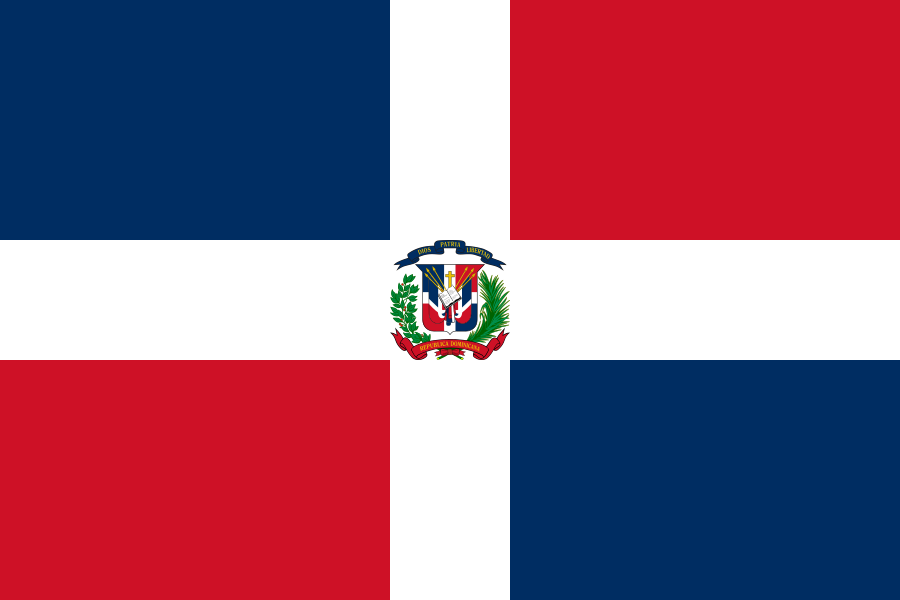
Dominican Republic
15 topics answered, 3 policies that cut across several of them, and 2 recorded exceptions that depend on where you are coming from.
- Region
- Caribbean
- Currency
- DOP
- Language
- Spanish
- Policies
- 3 active
- Last checked
- 2026-10-06
Where are you a citizen of?
Most rules on this page are the same for everyone. The ones that are not get marked for you.
Policy that cuts across topics
Affects 15 of the 15 topics on this page
The authentic text of a Dominican law or decree is the one printed in the Gaceta Oficial, and the Gaceta is published by the Consultoría Jurídica del Poder Ejecutivo - the legal office of the presidency, whose head signs the gazette as its administrative director. The Constitution promulgated in 2024 closes with that officer certifying that the publication is official. The Consultoría also runs the public register of laws and decrees, and serves each instrument as the pages of the gazette issue it appeared in. That is the good news. The bad news is physical: issues from before roughly 2012 are page images carrying a recognition so poor that words like "año" come out as "aiio" and "los" as "10s", and some issues from 2010 and 2011 carry a broken font encoding that turns "República" into "Repflblica". For those instruments the authentic text exists and cannot be quoted from, and what is quotable is a transcription published by a ministry or an agency.
Affects 7 of the 15 topics on this page
In most countries a migration category decides what you may do. In the Dominican Republic it also decides something about your children. The Constitution excludes from birthright nationality the children of foreigners in transit or residing illegally, and then sends the meaning of "in transit" out to ordinary legislation. Ordinary legislation has answered twice. The migration law of 2004 ends its list of non-resident categories by declaring that non-residents are persons in transit for the purposes of the constitutional article - which puts tourists, business visitors, seasonal workers, border habitants and students in the same box. The regulation of 2011 goes further and treats as in transit anyone who resides, or has resided, without a lawful migration status. Reading a Dominican residence category is therefore never only about the permit.
Affects 6 of the 15 topics on this page
Three of the numbers a reader most wants from this country are published twice, differently, by the Dominican state. A tourist stay is sixty days in the migration regulation and thirty on the tax agency's tourist-card page. The wait for permanent residence is five years of temporary residence in the regulation and "one year of residence" in the first paragraph of the migration service's own page - which then, four lines later, asks for the first card plus four renewals. And the famous forty-five-day residence for pensioners and investors is forty-five days in a recital of the 2007 statute and forty-five working days in the article that actually sets the deadline, with the regulation starting the clock later still. None of these is a rule that changed. They are the same rules written twice.
Topics
all 15 answered- Entering the Dominican Republic as a Tourist
Three different Dominican authorities publish three different lengths for the same holiday. The migration law and its regulation both say sixty days, and the regulation says it in a single sentence that admits of no reading but one. The tax agency that sells the tourist card says thirty. The migration service, taking the thirty as its starting point, sells extensions in bands that run to a hundred and twenty days in total. Nobody has reconciled them, so a traveller plans around the smaller number and pays to get back to the larger one. The card itself costs ten dollars, is good for one entry, and since April 2018 has been built into the price of air tickets issued outside the country, which is why most arrivals never see it charged.
Depends on your citizenship
2 recorded exceptions change this rule for some nationalities.
Verified with official sourceMonitor - can change - Residence on Income From Abroad: the Rentista Route
The Dominican Republic has a living-on-income route and it is unusually generous about what counts. A rentista is someone with stable income generated abroad, and the law lists seven sources that qualify - foreign bank deposits, remittances from foreign financial institutions, investments in foreign companies, rental income from property abroad, interest on foreign-currency securities, returns on government paper where the capital came from abroad, and even income from Dominican property if the principal behind it was earned abroad. The threshold is two thousand dollars a month, there is no minimum age, and the application goes through the migration service's foreign-investment window rather than the ordinary residence queue, which is why it skips the temporary-residence stage entirely. The holder may also take a paid job; the salary is taxed like anyone else's.
Verified with official sourceStable - Residence as a Pensioner: Ley 171-07 and What It Does Not Say
Fifteen hundred dollars a month from a pension, and the file goes through the migration service's foreign-investment window rather than the ordinary residence queue - which is the whole of the advantage, because that window skips the five-year temporary-residence stage every other applicant serves. The statute is specific about what a pension is: a monthly payment from a government, an official body or a private company of foreign origin, evidenced by a certificate from the payer naming the post held, the time served and the amount. There is no minimum age. The law also carries a bundle of tax reliefs that have nothing to do with migration - no transfer tax on a first property, half the mortgage and property taxes, no tax on the declared pension - and those, rather than the residence, are what the law was passed for. The much-repeated 'residence in 45 days' is in the law, but the article that actually sets the deadline says forty-five working days.
Verified with official sourceStable - Working in the Dominican Republic: the RT-3 Labour Residence
Work residence here is a one-year temporary permit tied to a contract, and the contract has to exist before the permit does: the migration service wants it notarised and stamped by the labour ministry, and the consulate wants a multiple-entry business visa before any of it. The permit renews annually. What it does not do is accumulate into permanence quickly - the regulation says permanent residence is applied for after five years of temporary residence renewed each year, which is also what the migration service's own page says when it lists the documents, even though the same page's summary says one year. Permanent residents may do any paid work; temporary residents may work within the terms of their admission; non-residents may not work at all, with four narrow exceptions. A professional qualification is a separate problem: practising a regulated profession needs an exequátur, and the migration permit does not supply one.
Verified with official sourceStable - Residence by Investment: US$200,000 and a Certificate
Two hundred thousand dollars, certified by the investment-promotion agency, buys permanent residence straight away rather than after five years of temporary cards - and that, rather than any tax break, is what the Dominican investor route is. The threshold is not in the migration law: the law says only that the minimum will be fixed by regulation, and the 2011 regulation fixes it. The investment has to take one of the forms the foreign-investment statute recognises, or be a contribution to the capital of an existing Dominican company, and it has to be registered. Designated investment projects are a separate case with a figure set by the executive instead. The application goes to the migration service's foreign-investment window, direct family may be included on the same file, and renewal after the first year runs in four-year blocks against proof that the investment is still there.
Verified with official sourceStable - Studying Here Is Not Residence
A foreign student in the Dominican Republic is a non-resident, and the distinction is not bookkeeping. The migration law puts students in its non-resident list alongside tourists and ship's crew; the regulation gives them a one-year stay, extendable; the migration service issues a one-year student permit renewable to a maximum of six. Years spent on it do not count towards permanent residence, because permanent residence is reached from temporary residence and the student never holds one. A student may not take paid work beyond the activity he was admitted for. What the permit does require, uniquely among the short-stay categories, is medical insurance valid in the Dominican Republic approved by the migration service and lasting the whole course.
Verified with official sourceStable - Marriage to a Dominican: a Short Path to Nationality, a Slow One to Residence
Dominican law treats marriage as a question about nationality first and about residence second, and it is much more generous on the first than on the second. The Constitution makes a foreign spouse of a Dominican eligible for Dominican nationality outright, provided they opt for it and meet the conditions the law sets; the 1948 naturalisation statute cuts the ordinary two years of residence down to six months for someone married to a Dominican. Residence itself has no marriage category of its own: the migration law admits relatives of Dominicans as permanent residents under the family limb of article 33, and the regulation runs that through the same documentary process as every other residence. The naturalisation provisions are written in the language of 1948 and are expressly gendered; we quote them as they stand.
Verified with official sourceStable - No Residence by Descent, Because Descent Gives Nationality Instead
There is no Dominican residence category for someone with a Dominican parent or grandparent, and the reason is that the Constitution hands that person nationality rather than a permit. A child of a Dominican mother or father is Dominican, wherever born. So is a direct descendant of a Dominican living abroad - a clause with no stated generational limit, which on its face reaches a grandchild. Anyone in either position does not need residence; anyone outside them has no ancestry route at all, because the permanent-resident list has four entries and the temporary-resident list has nine, the regulation says in terms that the temporary list is closed, and none of the thirteen is descent. The nearest thing is the family limb, which reaches the spouse and the minor or unmarried children of a Dominican and stops there.
Verified with official sourceStable - No Free Movement: the Caribbean Country Outside the Caribbean Scheme
The Dominican Republic is not in CARICOM, so none of the Caribbean free-movement arrangements reaches it: no skilled-national certificate, no six-month automatic stay for fellow nationals, no community right of establishment. Nor does any other arrangement substitute. The migration law's list of people exempt from its regime names diplomats, international organisations, technical experts on inter-governmental programmes and their families, and nobody else; the permanent and temporary residence lists are closed and contain no nationality-based category. The only movement arrangement in the law that singles out a neighbour is the border-habitant card, and that is unilateral, limited to Haitians living in the strip opposite five named provinces, confined to those provinces, and valid for a single day at a time.
Verified with official sourceStable - Dominican Nationality: Two Years for a Resident, and a Contested Birthright
For a foreigner who has got permanent residence, naturalisation is close: two years of continuous permanent residence under the migration regulation, or two years of uninterrupted residence under the 1948 statute, reduced to six months for someone who has founded and sustained an industry here or owns property, and six months for marriage to a Dominican. The executive may still refuse, and the grant is a decree published in the official gazette. Birthright is the harder question. The Constitution proclaimed on 26 January 2010 excludes from birthright nationality the children of foreigners in transit or residing illegally; the migration law of 2004 had already declared every non-resident a person in transit, and the 2011 regulation extended that to anyone residing without a lawful migration status. In 2013 the Constitutional Court applied the exclusion to a woman born here in 1984 and ordered an audit of the civil registry back to 1929. Ley 169-14 followed in 2014. We quote these and leave the characterising to the reader.
Verified with official sourceMonitor - can change - Tax Residence: Territorial, With a Limb That Just Got Wider
The Dominican Republic taxes residents on Dominican-source income and on one slice of their foreign income. Until June 2026 that slice was income from investments and financial gains; a law promulgated on 18 June 2026 added income from technical-assistance services to it and then defined technical assistance so broadly that it covers consultancy, software, cloud services, artificial intelligence and data work. Residence itself is a day count: more than 182 days in the fiscal year, continuous or not. And there is a rule about newcomers that is constantly misstated - a person who becomes resident is subject to tax on foreign-source income only from the third tax year counted from the one in which they became resident. That is not three tax-free years and it does not exempt Dominican-source income for a day.
Verified with official sourceActively changing right now - Health Cover: the Public System Follows Legal Residence, and Migration Asks for Private Insurance First
Two systems, and which one you are in depends on a piece of paper. The social-security law opens the Dominican system to all Dominicans and to legal residents, and makes the family health insurance available to Dominicans and to foreigners who have established their residence here - so lawful residence is the gate, and illegal residence is outside it. But nobody reaches that gate on arrival, because the migration regulation requires a residence applicant to buy a private policy covering health costs and repatriation before the residence exists, and requires a student to hold private insurance approved by the migration service for the whole of the course. The practical sequence is therefore private cover first, residence second, affiliation third. Contributions in the employed scheme are split seventy-thirty between employer and worker, with occupational risks wholly on the employer.
Verified with official sourceStable - Banking: Free Convertibility, and a Due-Diligence Rule That Does the Gatekeeping
Dominican monetary law is permissive. The exchange regime is built on free convertibility of the peso, parties may transact in foreign currency on terms they freely agree, and the central bank is forbidden from requiring international exchange operations to pass through it. Nothing in the monetary statute conditions a bank account on residence or nationality. What does the gatekeeping is the anti-money-laundering law of 2017, which requires every obliged institution to identify the client and verify the identity from reliable and independent documents, to identify the beneficial owner, to understand the purpose of the relationship, and to keep doing so for as long as the relationship lasts. That is the rule a foreigner meets at the counter, and the document it is usually satisfied with is the identity card a resident gets - which is why residence and banking are linked in practice and not in law.
Verified with official sourceStable - Driving: One Article for Foreign Licences, and Nothing for Visitors
The 2017 mobility law deals with foreign driving licences in a single sentence: a holder who resides in the country may apply for a national accreditation while the foreign document is still valid, on the formalities the transport institute sets by regulation. That is the whole of it. There is no provision in the law for a visitor driving on a foreign licence, no mention of an international driving permit, and no reciprocity list - while driving without a valid licence is an offence carrying a fine of one to five minimum salaries and a loss of points. The ordinary route to a Dominican licence requires an identity card, which a foreigner obtains as a resident, so the licence follows the residence as a matter of sequence. Licences run four years and expire on the holder's birthday.
Verified with official sourceMonitor - can change - Bringing Your Things: Baggage Is Free, Household Goods Are Not Baggage
The 2021 customs law is generous about baggage and explicit about what baggage is not. Anyone arriving at a port, airport or land crossing may bring in their baggage free of duties and taxes, baggage may follow them for up to three months after arrival, and a family may make one declaration between them. Then a single sentence closes the door: household effects are not part of a traveller's baggage. Moving a home is therefore a separate exercise, and the relief for it does not live in the customs law at all - it comes through the pensioner and rentista statute, which routes its beneficiaries into a 1993 tariff law exempting household goods and personal effects, and into a 1967 law partially exempting one motor vehicle. Both reliefs are conditional on the residence approval and neither extends to the spouse or dependants on the household-goods side.
Verified with official sourceStable