
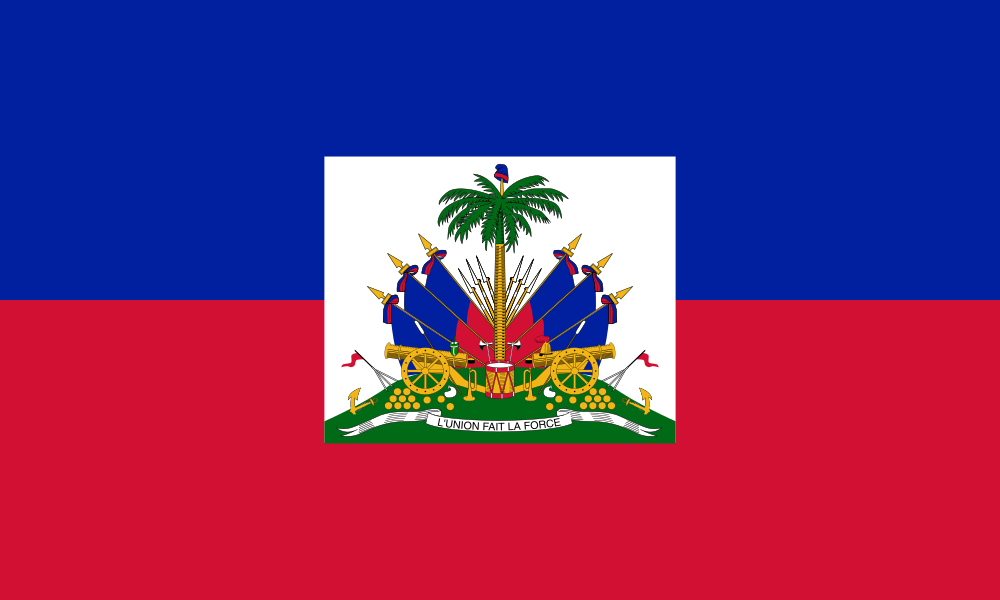
Haiti
12 topics answered, 3 policies that cut across several of them, and 2 recorded exceptions that depend on where you are coming from.
- Region
- Caribbean
- Currency
- HTG
- Language
- Haitian Creole, French
- Policies
- 3 active
- Last checked
- 2026-10-06
Where are you a citizen of?
Most rules on this page are the same for everyone. The ones that are not get marked for you.
Policy that cuts across topics
Affects 15 of the 12 topics on this page
On 17 September 2026 Le Moniteur published, as Special No. 47 of its 181st year, a decree of the Council of Ministers instituting a state of emergency over the departments of the Ouest, the Artibonite and the Centre for three months. The Ouest is the department that contains Port-au-Prince, and with it the Direction de l'Immigration et de l'Émigration on Avenue John Brown, where residence permits are applied for. The decree's recitals describe a multiform crisis producing a situation of extreme urgency, marked by increased violence from armed gangs and a worrying humanitarian situation threatening the existence of the population and the foundations of the Republic. An earlier decree to the same effect had been published on 2 June 2026, so this is a renewal rather than a first measure. What we hold of the decree is its opening: the copy we could read carries the gazette heading, the title and the recitals and stops before the operative articles, so we cannot say what powers it confers or what it suspends.
Affects 8 of the 12 topics on this page
A Haitian residence permit is not granted for twelve months from the day it is issued. It is granted for a fiscal year, 1 October to 30 September, which means a permit obtained in August expires six weeks later. Renewal is annual and the application must be accompanied by the slip attesting payment of income tax for the fiscal year just ended. The permit therefore sits downstream of the revenue directorate: a foreigner who has not settled with the Direction Générale des Impôts cannot complete the immigration file. The same coupling appears from the other end in the immigration law, where the exit visa a departing foreigner needs is issued only on a certificate from the revenue administration that he is square with the tax authorities. Dominica's record holds the same coupling at one end - an exit certificate required by its Income Tax Regulations - and no record here holds it at both.
Affects 15 of the 12 topics on this page
Haiti's official journal, Le Moniteur, is still publishing - its Special No. 47 of 17 September 2026 is in these records - but it has no reachable archive of its own, and the Secrétariat Général du Conseil des Ministres, which hosts the government's collection of laws, did not answer a single request from here. The consequence is specific rather than general. Four instruments between them decide most of what a person moving to Haiti needs to know, and none of them could be read. The decree-law of 26 December 1978 on immigration and emigration is the one the immigration directorate itself cites by article number for the residence permit, and the one the law of 2002 names as imposing that permit at its article 30. The decree of 6 November 1984 on Haitian nationality is where the Constitution has pointed since 2011 for the conditions of naturalisation. The Code Fiscal enacted by decree of 20 January 2023 brings the whole tax code together and is published by the Ministry of Economy and Finance as a 244-page image whose only machine-readable text is a watermark reading "ne pas reproduire". And the decree of 13 March 1963 defines which new undertakings give a foreign shareholder an exemption from the work permit.
Topics
12 of 15 answered- Entering Haiti as a Visitor: a Thirty-Day Card in the Statute, Ninety Days at the Border
The instrument still on the books gives a visitor thirty days. Haiti's missions tell travellers ninety. The Loi du 8 décembre 1959 sur l'immigration et l'émigration rewrote article 16 of the immigration law so that American and Canadian tourists, and nationals of countries that have an agreement with Haiti waiving passport or visa formalities, may enter on a simple card and stay thirty days; everyone else buys a visa from a Haitian consulate. Haiti's own embassy in Canada describes something different and larger: no prior visa for a Canadian staying under ninety days, entry formalities settled on arrival at any international airport or land border, and a ninety-day "séjour de courtoisie" after which a residence permit becomes compulsory. Both are Haitian government statements and they do not say the same thing. The statute also makes leaving a formality: article 43 requires an exit visa of any foreigner subject to an entry visa who has been in the country more than seventy-two hours.
Depends on your citizenship
2 recorded exceptions change this rule for some nationalities.
Verified with official sourceActively changing right now - Living in Haiti on Income from Elsewhere: One Permit, and a Means Test That Shrank by Fifty Times
Haiti has no rentier visa and no passive-income category. There is one residence instrument for everybody, the permis de séjour, and the only financial test attached to it is a bank attestation. What makes Haiti worth reading is the size of the gap between the instrument and the counter. The immigration law as rewritten in 1959 requires an applicant for a non-immigrant or resident visa to show a minimum deposit of ten thousand United States dollars in a bank established in Haiti, or an affidavit from a Haitian citizen willing to take responsibility for him, and repeats the ten thousand dollars in the documents list for the residence permit itself. The procedure the Direction de l'Immigration et de l'Émigration publishes through Haiti's embassy in Canada asks for a bank attestation from a bank sitting in Haiti of a minimum of 7,500 gourdes or US$200. Nothing we read bridges the two figures.
Verified with official sourceMonitor - can change - Retiring to Haiti: No Pensioner Route, the Same Permit as Everyone Else
Haiti has no retirement visa, no pension threshold and no concession for a retired applicant. A retiree is named in the Haitian procedure only as one of the kinds of person who must obtain the ordinary residence permit: the United States embassy's description of the Direction de l'Immigration et de l'Émigration's requirements lists missionaries, teachers, businessmen, retirees and students together, as people who need the same permis de séjour on the same documents. The immigration law behind it creates one permit and no categories, so there is nothing for a pension to qualify for. The one thing that does change with time is the residence tax in article 31, which falls as the years in the country accumulate - two hundred gourdes in the first five years, a hundred and fifty from five to ten, a hundred after ten.
Verified with official sourceMonitor - can change - Working in Haiti: Two Permits, a Five Per Cent Cap and a Duty to Train Your Replacement
Haiti separates the right to be in the country from the right to work in it, and the second is governed by the Labour Code rather than by the immigration law. A foreigner who works for an employer needs a permis d'emploi; a foreigner working on his own account needs a permis de travail. Both come from the Direction de la main-d'œuvre, neither can be granted for more than a year at a time, and renewal stops at five consecutive years. Two conditions make this one of the tightest work-permit regimes in the comparison. The permit may only be granted where no Haitian with the required competence or training can be recruited locally, and the foreign worker must undertake to train one or more Haitians to do the job, on pain of having the permit withdrawn. On top of that, article 315 caps foreign workers at five per cent of the staff of any establishment and requires seventy per cent of the total payroll to go to Haitian labour. The permis de séjour is a document in the work permit file, so the immigration permit comes first.
Verified with official sourceMonitor - can change - Investing in Haiti: No Residence by Investment, but Shares Buy an Exemption from the Work Permit
Nothing we read creates a residence permit obtainable by investing. The immigration law has one permis de séjour and does not divide applicants by what they bring. What investment does buy is narrower and concrete: article 312 of the Labour Code lifts the work permit requirement from holders of shares in new undertakings as defined by the decree of 13 March 1963. So a foreign shareholder in a qualifying new company does not need a permis de travail or a permis d'emploi to be active in it - but still needs the ordinary residence permit to be in the country, because the Labour Code exemption touches the work permit only. The constitutional backdrop is restrictive in its own way: a resident foreigner may own one dwelling house per arrondissement, may not deal in rented property, and loses the ownership right five years after ceasing to reside in the country.
Verified with official sourceMonitor - can change - Studying in Haiti: No Student Permit, a Student Price
There is no student residence category in Haitian law as we read it, and there is a student fee. The immigration law creates a single permis de séjour without categories; students are named only among the kinds of people who have to get it. But the fee table the United States embassy publishes for the Direction de l'Immigration et de l'Émigration charges a student 1,250 gourdes where a first issue costs 5,000 and a renewal 2,500 - a quarter of the ordinary first-issue price. So the agency recognises a student as a kind of applicant for pricing while the law does not recognise studying as a route. Nothing we read sets out what proof of enrolment is required, which institution must issue it, or whether a student permit allows any work; the Labour Code's foreign labour chapter has no student exemption.
Corroborated by multiple sourcesMonitor - can change - Haitian by Origin, Foreign by Passport: the 2002 Law That Removes the Permit Instead of Granting One
Haiti's ancestry route is not a residence permit. It is a statutory exemption from needing one. The law of 12 August 2002 on privileges granted to Haitians of origin enjoying another nationality and to their descendants dispenses them from the Haitian visa to enter or leave, from the formalities and taxes of the residence permit, from the work permit and the employment permit and their taxes, and from the foreigners' licence; makes them eligible for the public service and the employment market except where the Constitution expressly forbids it; removes the Ministry of Justice authorisation otherwise needed to acquire immovable property; and allows them to acquire urban property up to 3 ha 87, which the law itself glosses as three carreaux of land. The exemption reaches descendants, not only the person who left. It is the widest ancestry provision in this comparison and it was passed because, as its own recitals say, Haitians who had fled in the sixties, seventies and eighties were on return being made to obtain the residence permit required of any foreigner.
Verified with official sourceStable - Married to a Haitian: No Spouse Permit, and a Work Permit Exemption That Takes Three Years
Haitian law as we read it gives the spouse of a Haitian national no residence category and no shortened route. The immigration law has one permis de séjour and does not ask who an applicant is married to. The only concession we found anywhere is in the Labour Code: article 312(b) exempts from the work permit and the employment permit a foreigner of either sex married to a Haitian national who can show at least three years of uninterrupted residence in the country. The condition is residence, not marriage: three years of living in Haiti, not three years of being married. What we could not establish is the nationality side. The Constitution as amended in 2011 abrogated its own naturalisation articles and left acquisition of Haitian nationality to be settled by law, and the law in question - the decree of 6 November 1984 - is one we could not obtain, so we cannot say what marriage does for nationality.
Verified with official sourceMonitor - can change - CARICOM and Haiti: Three Member States Name It in Their Schedules, Four Do Not, and Haiti Names Nobody
Haiti signed the Revised Treaty of Chaguaramas in 2002 and the question of what that is worth has to be asked twice, because the answer is different in each direction. Going out, it depends entirely on which member state you arrive in: the schedules of qualifying Caribbean Community states that carry the skills certificate regime do not agree. Barbados lists thirteen states and Haiti is the seventh. Trinidad and Tobago lists fourteen and Haiti is the seventh. Belize's schedule includes Haiti. The schedules of Saint Lucia, Grenada, Saint Kitts and Nevis and Dominica each list thirteen states, the same thirteen, and Haiti is in none of them; Guyana's lists twelve and Haiti is not there either. Coming in, we found nothing. No Haitian instrument we read gives a Community national anything: the Labour Code requires the work permit of every foreigner and its five exemptions do not mention CARICOM, and the immigration law's only nationality-based concession is for Americans, Canadians and nationals of states with a waiver agreement. Article 46 of the Revised Treaty requires member states to eliminate work permits for approved categories of Community nationals, and on the face of the Haitian statutes we could read, Haiti has not.
Verified with official sourceMonitor - can change - Haitian Nationality After 2011: the Constitution Stopped Saying How, and Dual Nationality Is No Longer Forbidden
This is the most widely misreported rule in Haitian law and the amendment that changed it is easy to check. The 1987 Constitution said at article 12-1 that any foreigner could obtain Haitian nationality by naturalisation after five years of continuous residence, and at article 15 that dual Haitian and foreign nationality was not admitted in any case. The constitutional law of 9 May 2011, published 19 June 2012, abrogated articles 12-1, 12-2, 13, 14 and 15. In their place it inserted article 11-1, saying only that the law establishes the conditions in which an individual may acquire Haitian nationality, and rewrote article 12 to say that every Haitian, apart from the privileges reserved to Haitians of origin, is subject to all the rights, duties and obligations attached to his Haitian nationality, and that no Haitian may make his foreign nationality prevail on the territory of the Republic. So the blanket prohibition is gone and what replaced it is a rule of precedence, not of exclusivity. The five-year naturalisation rule is also gone from the Constitution - and the law it was handed to, the decree of 6 November 1984 on Haitian nationality, is one we could not read, so this record does not state the conditions of naturalisation.
Verified with official sourceMonitor - can change - Haitian Tax Residence: Four Tests, Any One of Which Is Enough, and 183 Days Is Only the First
The decree of 29 September 2005 on income tax sets out who is taxed and then, in the next article, who counts as domiciled in Haiti. The list has four limbs and they are alternatives: having your home in Haiti or staying there more than a hundred and eighty-three days in a tax year; carrying on a professional activity in Haiti, employed or not; having the centre of your economic interests in Haiti; or being a Haitian state official posted abroad and not personally taxed there on your worldwide income. Anybody inside any one of them is taxed on their worldwide income; anybody outside all of them is taxed on Haitian-source income only. The second limb matters more than the day count: working in Haiti makes you tax-domiciled there from the first day, with no threshold at all. Separately, a client who uses a service provider domiciled outside Haiti during a temporary stay must withhold twenty per cent and pay it to the revenue directorate within fifteen days, in final discharge of the tax.
Verified with official sourceMonitor - can change - Health Care in Haiti: a Constitutional Duty Owed to Citizens, and an Employer-Paid Health Card for Workers
Haiti has no residents' health insurance scheme that a foreigner joins. What the law we read provides is two different things. The Constitution obliges the State to guarantee the right to life and health to all citizens, and separately to provide the means of protecting, maintaining and restoring their health by creating hospitals, health centres and dispensaries; article 54 then says that foreigners on Haitian territory enjoy the same protection as is accorded to Haitians, in accordance with the law. And the Labour Code attaches health provision to employment rather than to residence: every worker must hold a health card within three months of being hired, at the employer's exclusive expense, with the annual examinations carried out by the medical service of OFATMA, the office for work accident, sickness and maternity insurance; and every worker has fifteen days of paid sick leave a year on a medical certificate from the company doctor or a public health service. Access for a foreigner who is not employed is not something we could establish from any document.
Verified with official sourceActively changing right now