
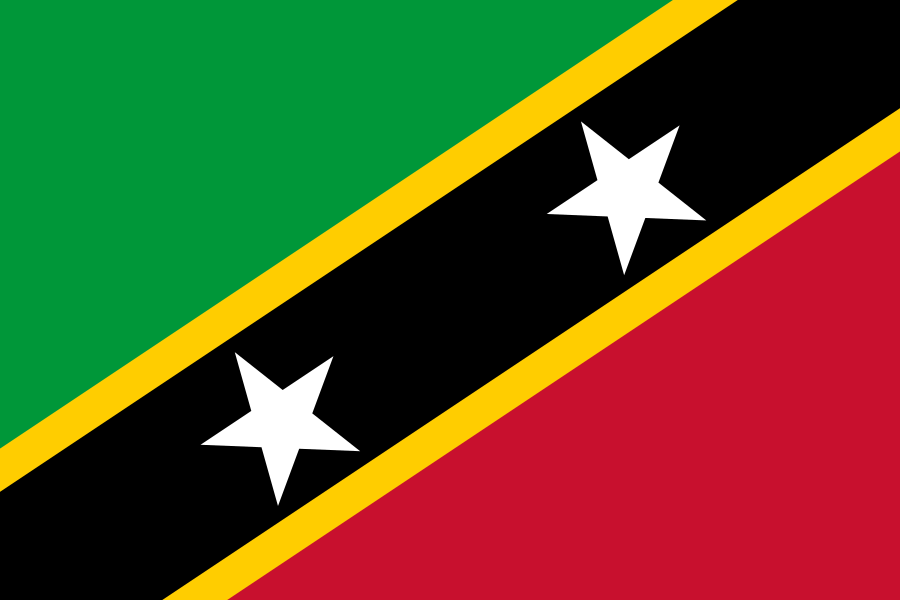
Saint Kitts and Nevis
15 topics answered, 3 policies that cut across several of them, and 10 recorded exceptions that depend on where you are coming from.
- Region
- Caribbean
- Currency
- XCD
- Language
- English
- Policies
- 3 active
- Last checked
- 2026-10-05
Where are you a citizen of?
Most rules on this page are the same for everyone. The ones that are not get marked for you.
Policy that cuts across topics
Affects 3 of the 15 topics on this page
A separate statute from everything else in this country's relocation law, and the one most likely to catch a newcomer out. Land in Saint Christopher and Nevis held by an unlicensed alien is forfeited to the Crown. An alien is anyone not deemed to belong to the Federation under the Immigration Act, which includes every CARICOM and OECS national, and the licence is granted by the Governor-General, is specific to the land and the interest described in it, and has no effect until registered in the Record Office of the Circuit where the land lies. The only thing an unlicensed alien may hold is an annual tenancy or less, for their own residence, trade or business, and not more than five acres in all.
Affects 3 of the 15 topics on this page
Saint Kitts and Nevis stopped charging individuals income tax on 1 May 1980 and has taxed wages ever since under a different statute. The Housing and Social Development Levy is imposed on the wages of every person employed in the Federation, at nothing up to the first band, then three and a half, ten and twelve per cent, with the employer paying a flat three per cent of all wages on top. It is deducted at source by the employer and paid monthly to the Comptroller of Inland Revenue, and the Social Security Board collects it on his behalf. Nothing in it turns on nationality or residence: it follows employment.
Affects 2 of the 15 topics on this page
Since 2025 the Federation has operated an Electronic Travel Authorisation alongside an online immigration and customs form, through a portal the Ministry of National Security runs. The government announced it in January 2025 as a requirement for every traveller with visa-free access to apply for authorisation before entering, and presented it as both a security measure and a revenue stream. What we could not find is the instrument. The Immigration Act as consolidated to 31 December 2020 provides for permits granted by officers at the border and says nothing about pre-authorisation, and no later Act or Statutory Rule and Order creating the eTA was retrievable. The fee, the validity and the exemptions are therefore not stated here.
Topics
all 15 answered- Entering Saint Kitts and Nevis as a Visitor
A visitor is admitted for whatever period the immigration officer thinks appropriate, up to a ceiling of six months - twice what most of Latin America allows on a single admission - and the ceiling is not the end of it: the Chief Immigration Officer may, with the Minister's approval, extend a permit up to six years from the date of entry. Citizens of the European Union countries named in the Act's Sixth Schedule need no visa for ninety days. Citizens of any Organisation of Eastern Caribbean States member get six months as of right rather than at discretion. Since 2025 a traveller who needs no visa has had to obtain an Electronic Travel Authorisation before arriving, through a portal run by the Ministry of National Security - a requirement that does not appear anywhere in the Immigration Act as consolidated to 2020.
Depends on your citizenship
5 recorded exceptions change this rule for some nationalities.
Verified with official sourceMonitor - can change - Living on Foreign Income in Saint Kitts and Nevis
There is no income visa. The Immigration Act lists six classes of resident and none of them is granted on the strength of money arriving from abroad. Means appear twice in the Act, but never on their own: once as part of the test for someone who is likely to establish himself in a profession, trade, business or agricultural enterprise, and once in the permanent-residence route for someone who intends to retire here. A person with a remote salary and no Kittitian employer, no business here and no intention to retire falls outside both. What such a person actually has is the visitor permit, which runs to six months and can be extended to six years from entry - long enough that the question rarely gets asked.
Verified with official sourceStable - Retiring to Saint Kitts and Nevis
Retirement is one of only two ways into permanent residence that the Immigration Act names, and it is the shorter one: a person who wants to live here in retirement and has sufficient assets and means of support for themselves and their dependants may be granted permanent residence, with no qualifying period of prior residence at all. The other route needs seven years. The Act sets no figure for what sufficient means, and the price of the concession is written into the work-permit section: a retiree admitted on this ground is expressly carved out of the word "resident" for the purposes of section 19, so unlike every other resident they still need a permit before taking any employment.
Verified with official sourceStable - Working in Saint Kitts and Nevis
Work is permit-first and employer-led, and the Act puts a condition on it that most countries put in guidance: the application must be made while the prospective employee is outside the Federation. You cannot arrive as a visitor, find a job and regularise - except on renewal, or where the Minister directs otherwise by Order. The permit itself carries the status: holders are entitled to a work permit holder's residency, and their spouses and minor children can be granted temporary residence. The Minister may also require the employer to post security sufficient to repatriate the worker and the family, and until that security is furnished the permit has no effect at all.
Depends on your citizenship
5 recorded exceptions change this rule for some nationalities.
Verified with official sourceMonitor - can change - Investing Your Way into Saint Kitts and Nevis
There is no investor residence permit. Money buys citizenship here, directly and by statute, and it buys nothing in between: section 3(5) of the Citizenship Act entitles a person who has invested substantially to be registered as a citizen, and the Immigration Act's list of resident classes contains nothing an investor can apply under. The only investment-flavoured residence route is the seven-year one in section 6(2)(a), which asks for seven years of residence first and substantial assets inside the Federation second - the time comes before the money, not instead of it. An investor who buys property without taking citizenship runs into a separate statute: an unlicensed alien who holds land here forfeits it to the Crown.
Verified with official sourceMonitor - can change - Becoming a Citizen of Saint Kitts and Nevis
Two doors, and they could hardly be further apart. The ordinary door asks for fourteen years: fourteen of ordinary residence for a Commonwealth citizen registering under the Constitution, and fourteen for an alien naturalising under the Citizenship Act, which also wants the final twelve months to be unbroken. That is the longest residence requirement of any country in this comparison. The other door is section 3(5) of the Citizenship Act, which entitles a person who has invested substantially to be registered, with no residence requirement at all - and the whole of what "substantially" means sits in a Statutory Rule and Order that has been replaced three times and amended twice since 2023. The figure in force today is set by the 2024 Regulations as amended in October 2024 and again in January 2026.
Verified with official sourceActively changing right now - Studying in Saint Kitts and Nevis
A student is not a resident here: the Immigration Act handles study through the permitted-entrant machinery rather than through a status. Paragraph 2 of Part I of the Second Schedule names people entering to attend an approved educational or training institution, or a university or college authorised by law to confer degrees, and section 14 lets an officer admit them for up to six months at a time. That is shorter than a degree, so study depends entirely on extension - which section 14(4) allows, with the Minister's approval, up to six years from the date of entry. Six years is almost exactly a medical degree, and Saint Kitts hosts one of the Caribbean's larger offshore medical schools, so the ceiling is not accidental.
Verified with official sourceStable - Claiming Saint Kitts and Nevis Through a Parent or Grandparent
Descent reaches exactly one generation outside the Federation and then stops. A person born abroad is a citizen at birth only if a parent was, at the date of that birth, a citizen by having been born in Saint Christopher and Nevis - or a citizen serving the Government abroad. A grandchild has nothing: the grandparent provision in section 90(f) of the Constitution applied only to people who were already British citizens or British Dependent Territories citizens immediately before 19 September 1983, and that cohort closed on independence day. There is no residence category for a descendant either. What an adult grandchild of a Kittitian actually has is the ordinary route: fourteen years.
Verified with official sourceStable - Marrying a Citizen of Saint Kitts and Nevis
Marriage does not get you residence here. It gets you citizenship. Section 92(1)(a) of the Constitution entitles any person married to a citizen to be registered as a citizen on application, with no qualifying period of marriage, no residence requirement and no language or civics test - the shortest route to citizenship in this entire comparison, and a constitutional entitlement rather than a Ministerial discretion. What stands between the entitlement and the certificate is the Citizenship Act's list of grounds on which the Minister may refuse, and seven of its fourteen paragraphs are about marriages: entered into primarily to get citizenship, no longer subsisting, annulled, under divorce proceedings, under a deed of separation, or where the parties have stopped living together.
Verified with official sourceStable - Moving to Saint Kitts and Nevis Under CARICOM or the OECS
Two blocs, two entirely different answers, and the Immigration Act names both. A citizen of one of the six other Eastern Caribbean states that are party to the Protocol of the Eastern Caribbean Economic Union is granted, by statute, a permit to enter and remain for a stay of indefinite duration, needs no passport to prove who they are, and needs no work permit - and none of that depends on their qualifications. A citizen of the wider Caribbean Community gets much less: the Caribbean Community Skilled Nationals Act admits graduates, media workers, sportspersons, artistes, musicians, nurses and teachers from twelve named states, on a certificate, and gives them six months followed by an indefinite period. Everyone else from CARICOM is an ordinary visitor.
Verified with official sourceMonitor - can change - Tax Residency in Saint Kitts and Nevis
There is no personal income tax, and the provision that abolished it is datable to the day: section 3(3) of the Income Tax Act, inserted by Act 14 of 1980, disapplies the charging section to income accruing on or after 1 May 1980 to any person other than a company. The Act's residence test survives around it - six months in the basic year, which is the calendar year - and still matters for the handful of charges that remain. What does not disappear is the deduction from wages. The Housing and Social Development Levy taxes employment income on a progressive scale reaching twelve per cent, collected by the Social Security Board for the Comptroller of Inland Revenue, and anyone describing this country as having no tax on earnings is describing one statute and ignoring another.
Verified with official sourceMonitor - can change - Healthcare in Saint Kitts and Nevis
The Federation's Social Security scheme is an income-replacement scheme, not a health scheme. It covers everyone between sixteen and sixty-two in gainful employment, with no nationality test anywhere in what the Board publishes, and what it pays when you fall ill is cash: sixty-five per cent of average weekly wages for up to twenty-six weeks, on a contribution record of at least twenty-six contributions with eight of them in the thirteen weeks before the illness. It does not pay for treatment. There is no national health insurance here, and we could not retrieve a published schedule of what a non-national pays at a public hospital - so this record says what the scheme does and stops where the evidence stops.
Verified with official sourceMonitor - can change - Opening a Bank Account in Saint Kitts and Nevis
What a bank asks a newcomer for is not set by banking law here but by the Anti-Money Laundering Regulations made under the Proceeds of Crime Act. They require identification procedures before a business relationship is established, define identification as establishing a person's true identity and obtaining conclusive evidence supported by independent documentation from a reliable source, and let the bank finish the verification afterwards only where the business is not urgent and the money-laundering risk is small. Nothing in them lists documents. The reason a Kittitian bank asks for a reference, a utility bill and a source-of-funds explanation is this regulation, and the specific list is the bank's own policy rather than law.
Verified with official sourceMonitor - can change - Driving in Saint Kitts and Nevis
A visitor buys a temporary licence rather than relying on a foreign one, and the Act is unusually relaxed about how: a Licensing Officer may grant it with or without a driving test, and may entrust blank licences to companies and people named in the Fourth Schedule - car hire firms - who sell them and account for the money monthly. It runs for up to a year, and the fee schedule prices it at fifty dollars for three months or a hundred for twelve. What the Act does not contain is any way to exchange a foreign licence for a Kittitian one: section 31 requires every applicant for a driver's licence to produce a certificate of having passed a test, with no exception for an experienced foreign driver.
Verified with official sourceStable - Bringing Your Belongings to Saint Kitts and Nevis
The Customs Act sets out the duty and the penalty and delegates the allowance. Every person disembarking must present their accompanying baggage for examination, comply with customs directions and answer the officer's questions, and the Act opens that duty with the words "subject to any exemptions as may be prescribed" - so what you may bring free of duty is in subsidiary legislation, not in the Act. The penalty for knowingly failing to comply is severe and formula-driven: twenty-five thousand dollars, or three times the value of what was not declared or produced, whichever is greater. We did not find a published allowance schedule and this record states none.
Verified with official sourceStable