Where you can go as a visitor if your passport is from Grenada
One question, every country, with your nationality already applied. In 9 of them something is written that changes the answer for you; in the other 23 the general rule is what you get, and that is the answer rather than a gap. Every line is that country’s own record.
Where it changes for you
9
Where it does not
23
Blocs you are in
3
Where your nationality changes the answer
Antigua and BarbudaVerified with official sourceMonitor - can change2026-10-05
Entry from Grenada: no limit as to time
written for your nationality by name
The general rule it sits on
Six months, and it is the statute that says so rather than an officer. The Immigration and Passport Act 2014 defines a bona fide visitor as a person arriving for a period of not more than six months, and section 24 requires the visitor to hold an onward ticket, to take no gainful occupation, to behave and to be able to maintain themselves and their dependants throughout. Beyond that the Act splits travellers into classes: a citizen of any member state of the Organisation of Eastern Caribbean States gets six months as of right, a citizen of an OECS Protocol state enters with no limit on time at all, a national of a CARICOM member state named in Schedule 1 gets six months, and an EU service provider gets a period that depends on what kind of service provider they are. An extension is a separate application to the Chief Immigration Officer, and since 2023 a visitor who intends to stay on for work, study, marriage or retirement must formally change status instead.
DominicaVerified with official sourceActively changing right nowlast checked 2026-10-05
Citizens of Grenada: free movement under the OECS Protocol
written for your nationality by name
The general rule it sits on
Twelve months is the figure in the statute, and it is the longest single visitor permit of any country in this comparison. Section 19 of the Immigration and Passport Act lets an immigration officer grant a visitor or a passenger in transit a permit for up to twelve months, and a shorter permit may be extended by the Commissioner of Police up to that same twelve-month ceiling counted from the date of entry. Whether you need a visa first turns on a distinction the Act draws and most guides miss: only an alien needs one, and an alien is defined as a person who is not a Commonwealth citizen. The list of non-Commonwealth nationalities that are nevertheless exempt is set by the Aliens (Visa Exemption) Regulations - and the version in force is S.R.O. 37 of 2019, which the Government's own law collection does not publish.
GuyanaVerified with official sourceMonitor - can change2026-10-06
CARICOM nationals: six months at the border, and you may arrive without a passport
reaches you through CARICOM skills certificate
The general rule it sits on
The Immigration Act gives an immigration officer two lengths and nothing in between: a permit of up to three months for most nationalities, and six months for a national of one of the thirteen countries in Part B of its Schedule I - the Commonwealth Caribbean plus Suriname and Montserrat, and without Haiti. Either can be extended, but only up to three years from the date of entry. The Ministry of Foreign Affairs works to shorter numbers than the Act allows: a visa issued on arrival runs one month and may be extended twice by a month each, at US$25 a time. Which passports need a visa is published as a numbered list of 71 countries and territories, which is a real list rather than a search box; the trap is that the same page carries a second list, for where Guyanese may travel without a visa, and losing the headings turns the two into one. Separately, every alien aged sixteen or over who enters must register with the police within three days.
JamaicaVerified with official sourceMonitor - can change2026-10-06
Arriving on a Caribbean Community skills certificate
reaches you through CARICOM skills certificate
The general rule it sits on
Jamaica runs two entry statutes side by side, and which one you meet depends on whether your country is in the Commonwealth. A Commonwealth citizen is dealt with under the Immigration Restriction (Commonwealth Citizens) Act, which lets an immigration officer grant leave for up to twelve months and caps extensions at twelve months from the date of entry. Everyone else is an alien under the Aliens Act, which sets conditions for being let in at all - support for yourself, a work permit if you mean to work, a visa unless there is a mutual abolition agreement - and then leaves the length of stay entirely to whatever conditions the officer attaches. There is no six-month ceiling for aliens in the Aliens Act. The Agency publishes one anyway: it tells travellers that non-Commonwealth citizens get a maximum of six months, and that figure has no counterpart in the statute, where the twelve-month Commonwealth figure does. Whether you need a visa is answered by a full country-by-country table, dated entry by entry, which is more than most of the region publishes. One entry on it is worth reading twice: Haiti is a member of the Caribbean Community and its ordinary passport holders need a Jamaican visa.
Entry from Grenada: indefinite stay, not a visitor permit
written for your nationality by name
The general rule it sits on
A visitor is admitted for whatever period the immigration officer thinks appropriate, up to a ceiling of six months - twice what most of Latin America allows on a single admission - and the ceiling is not the end of it: the Chief Immigration Officer may, with the Minister's approval, extend a permit up to six years from the date of entry. Citizens of the European Union countries named in the Act's Sixth Schedule need no visa for ninety days. Citizens of any Organisation of Eastern Caribbean States member get six months as of right rather than at discretion. Since 2025 a traveller who needs no visa has had to obtain an Electronic Travel Authorisation before arriving, through a portal run by the Ministry of National Security - a requirement that does not appear anywhere in the Immigration Act as consolidated to 2020.
Saint LuciaVerified with official sourceMonitor - can change2026-10-05
Entry from Grenada: freedom of movement, and an identity card is enough
written for your nationality by name
The general rule it sits on
An immigration officer may grant a permit to enter and remain for any period up to six months, and the purpose is written on the permit: transit, medical treatment, visiting, employment, trade or business, a yacht, or anything else temporary and in good faith. Six months is the officer's ceiling; the Chief Immigration Officer can extend a permit afterwards, but only up to one year from the date of entry, so the clock runs from when you landed and not from when the extension was granted. Beyond a year there is no extension at all - only a grant by Cabinet of permission to remain, or of permanent residence. The visa question is answered by an Order with four lists: one of countries whose citizens need a visa, one of those who may buy it on arrival, one of those who must hold it before they travel, and one of those who need none. No other country in the records here publishes all four: Barbados runs two lists and the Bahamas two. A citizen of the United States, France, Canada or an Eastern Caribbean Protocol state may land on a national identity card or a driving licence rather than a passport.
Entry from Grenada: indefinite stay, not a visitor's permit
written for your nationality by name
The general rule it sits on
An entry permit is granted at the desk and how long it runs depends on where the passport is from: six months for CARICOM, British, Schengen and United States citizens, three months for everyone else. Citizens of the other Organisation of Eastern Caribbean States are not visitors at all - they are given indefinite stay - and since 1 October 2025 nationals of Barbados, Belize and Dominica are given it too. A short permit can be extended at EC$75 a month at the Immigration head office in Kingstown or at the ports in Bequia, Mustique, Canouan and Union Island. A visa is required in advance from citizens of ten named countries and from no one else, at EC$200. The Immigration (Restriction) Act, Chapter 114, is the statute behind all of it, and it is not published.
SurinameVerified with official sourceMonitor - can change2026-10-06
CARICOM nationals: no entry fee, no authorisation for short stay, and six months at the border that no instrument provides
reaches you through CARICOM skills certificate
The general rule it sits on
The Vreemdelingenwet 1991 gives a visitor who needs no visa three months, and everyone else eight days unless a visa says otherwise. The Vreemdelingenbesluit 1995 then requires a valid passport carrying a transit visa, a travel visa for a stay of up to three months, or an authorisation for short stay for anything longer. The Act itself names no country: who needs a visa is a ministerial matter, and since 1 July 2022 the Ministry of Foreign Affairs has published a unilateral waiver for tourism and family visits up to ninety days, with a named list of twenty-one countries it does not apply to. The waiver is not free. Every traveller it covers pays an entry fee of USD 50 or EUR 50, plus a USD 8 or EUR 8 service fee to the contractor that collects it, and pays it again on every entry. Holders of a CARICOM passport are among the ten groups exempt from the fee.
Trinidad and TobagoVerified with official sourceMonitor - can change2026-10-06
CARICOM nationals: no visa, and six months as a visitor
reaches you through CARICOM skills certificate
The general rule it sits on
Trinidad and Tobago answers the visa question by rule rather than by list. Regulation 13(5) of the Immigration Regulations requires a visa in the passport of everyone seeking to enter; regulation 13(8) then takes the requirement away from citizens of Commonwealth countries, from nationals of countries with which Trinidad and Tobago has concluded Visa Abolition Agreements, and from two classes of transit passenger. Regulation 13(11) puts it back for the countries in the Second Schedule, and that Schedule names four: Cuba, Macedonia, North Korea and Vietnam. There is no statutory period of stay for a visitor. Section 9(1) of the Immigration Act lets an immigration officer admit tourists or visitors on such conditions and for such periods as may be fit and proper in the particular case, and the certificate the officer issues carries whatever period he wrote on it. Extending it means submitting to a fresh examination even though you are already in the country. A stay longer than one year requires a medical certificate on Form 40 before entry. Visas are now bought online: the Immigration Division charges TT$800 for a multiple-entry visa, which is the figure the Seventh Schedule to the Regulations has prescribed since 1 January 2026.
Where the general rule applies to you unchanged
Nothing is recorded in these that treats a citizen of Grenada differently on this question, so what follows is what everyone gets.

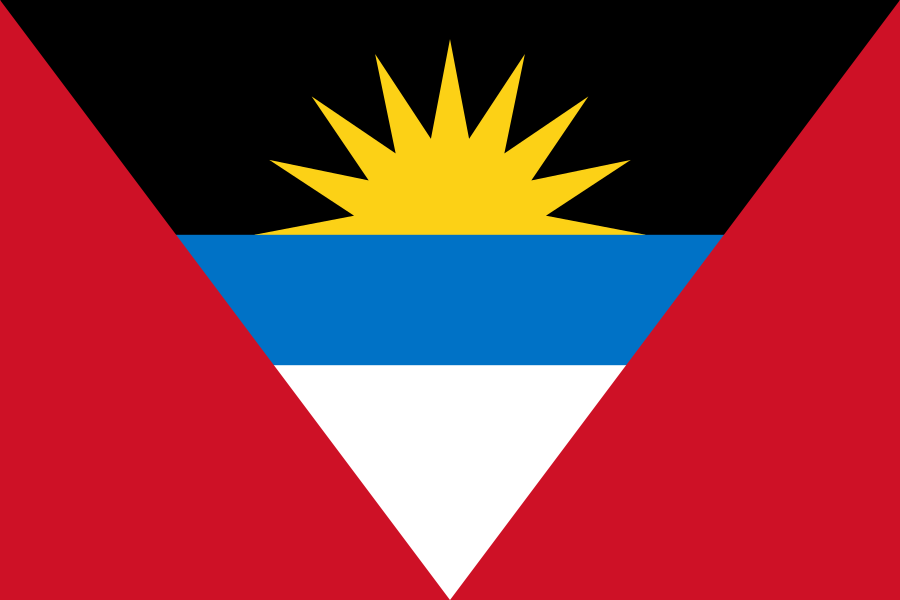 Antigua and BarbudaVerified with official sourceMonitor - can change2026-10-05
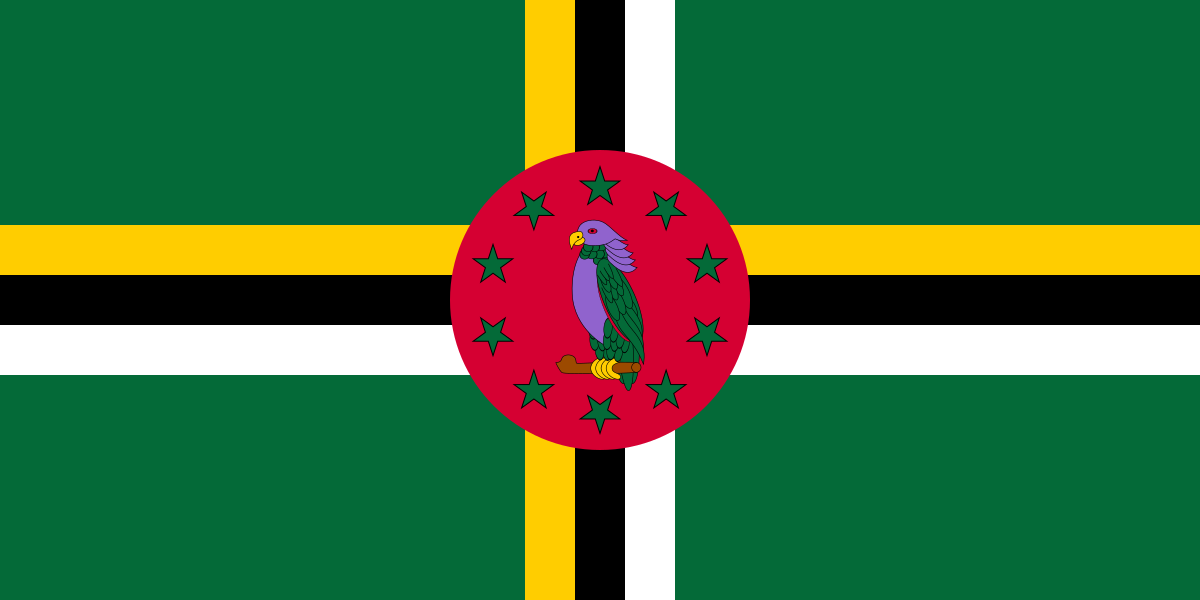 Dominica
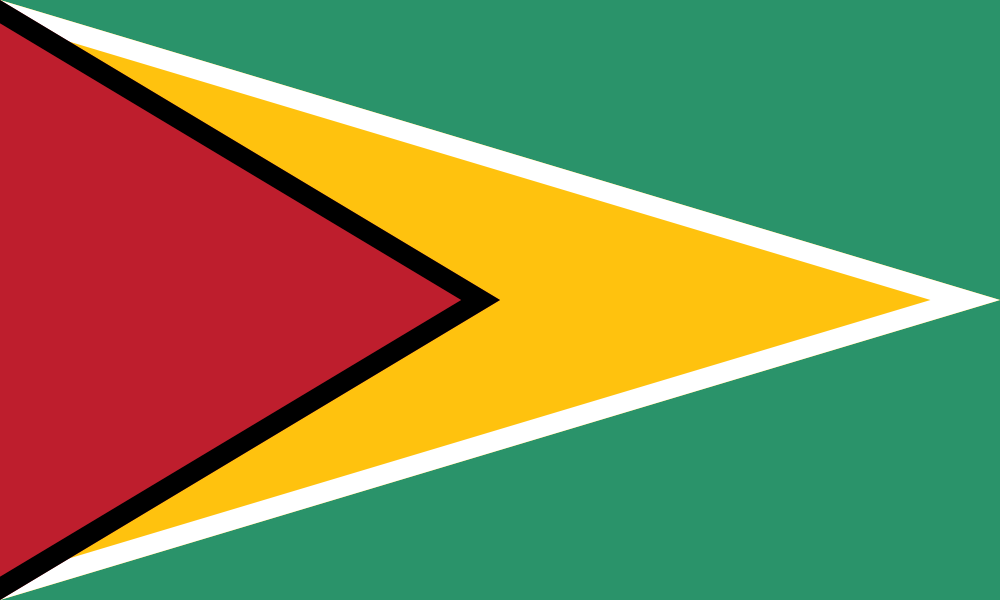 Guyana
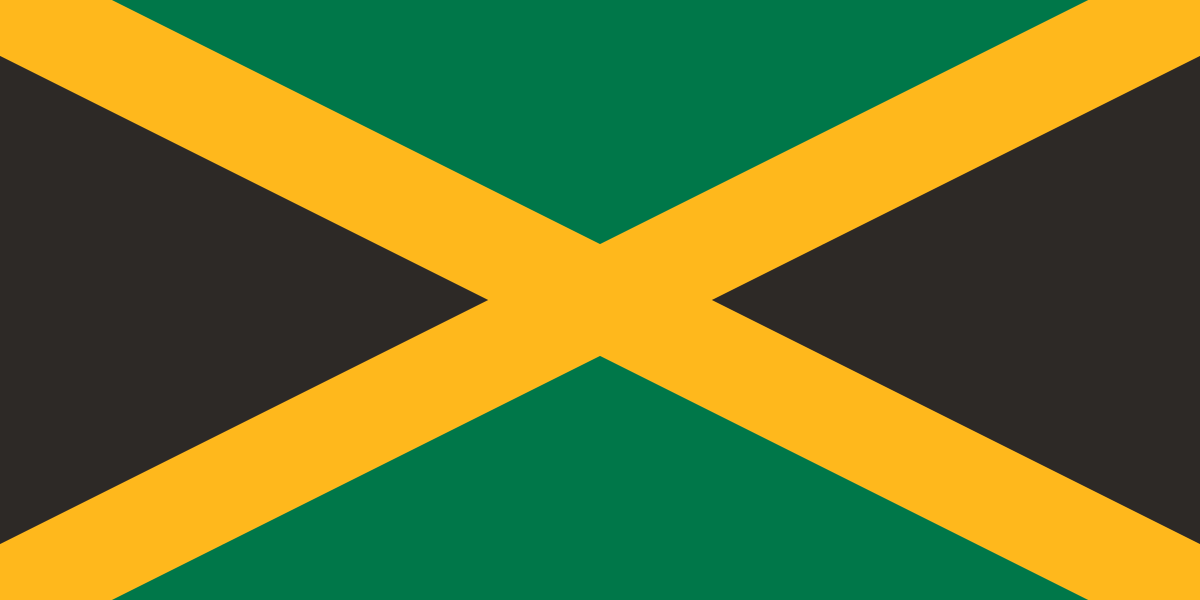 Jamaica
 Saint Kitts and Nevis
 Saint Lucia
 Saint Vincent and the Grenadines
 Suriname
 Trinidad and Tobago
 Argentina
 Barbados
 Belize
 Bolivia
 Brazil
 Chile
Chile Colombia
 Costa Rica
 Cuba
Cuba Dominican Republic
 Ecuador
 El Salvador
 Guatemala
 Haiti
Haiti Honduras
 Mexico
 Nicaragua
 Panama
 Paraguay
 Peru
Peru The Bahamas
 Uruguay
 Venezuela