Where you can move for work if your passport is from Lithuania
One question, every country, with your nationality already applied. In 18 of them something is written that changes the answer for you; in the other 44 the general rule is what you get, and that is the answer rather than a gap. Every line is that country’s own record.
Where it changes for you
18
Where it does not
44
Blocs you are in
2
Where your nationality changes the answer
BulgariaVerified with official sourceMonitor - can change2026-10-10
No Permit, No Employer Ratio, No Employment Agency: a Union Citizen Is Not in the Aliens Act at All
reaches you through Nationals of the Union and the wider Economic Area
The general rule it sits on
Bulgaria does not run a labour-market test for the main employment route; it runs a headcount ratio inside the employer. Article 7(1)(1) of the Zakon za trudovata migratsiya i trudovata mobilnost lets a third-country national be employed only if the total number of third-country nationals the local employer has had on contracts of employment in the preceding 12 months does not exceed 20 per cent of its average payroll, or 35 per cent for a small or medium enterprise within the meaning of the Small and Medium Enterprises Act. ДВ бр. 52 от 2025 г. is the amendment that put the ratio in that form. The conditions of work and pay must be no worse than for Bulgarians doing the same category of work, and the worker must have the specialised knowledge, skills and experience the post requires. The ordinary permit is the Single Permit for residence and work: article 15(1) makes it a Ministry of the Interior decision taken after a positive written opinion from the executive director of the Employment Agency, and article 15(2) lifts the ratio for four classes - people employed under an international treaty, guest lecturers and teachers, performers with confirmed professional competence, and athletes and coaches. The EU Blue Card does not meet the ratio at all: article 17(1) disapplies it, and in exchange article 17(2) asks for a gross salary at least 1.5 times the national average published by the statistical institute for the 12 months before the contract, and a contract of at least six months.
CroatiaVerified with official sourceMonitor - can change2026-10-10
No Permit, No Labour Market Test, and None of the Employer Arithmetic That Decides Everybody Else
reaches you through Nationals of the Union and the wider Economic Area
The general rule it sits on
Croatia abolished its annual quota and replaced it with a labour market test, and the test the applicant meets is almost trivial next to the test the employer meets. Under article 97 the Ministry issues the residence and work permit on a positive opinion from the Croatian Employment Service, and article 98 makes the employer ask for a labour market test first: the Service checks the unemployment register and tries to place a domestic worker. The real gate is article 99, and it has been rewritten twice in fourteen months. Since NN 55/2026 the Service may only give a positive opinion if the employer has had the same Croatian, EEA or Swiss worker on an indefinite full-time contract continuously for the past year; if at least 100,000 euros (a company) or 40,000 euros (a sole trader) has come through its account in the past twelve months; if the account has not been blocked for more than 30 continuous days in the past six; and if its Croatian and EEA full-time staff are at least 20 per cent of the number of third-country nationals it employs, or 10 per cent in a shortage occupation. The ratio was a quarter of all staff in 2020, 16 per cent of the third-country headcount in 2025 and 20 per cent in 2026. The one group that softens it is the Croatian diaspora: article 99(13) counts a returning emigrant or their descendant on the article 79.a permit as a Croatian worker for the purposes of the ratio.
CyprusVerified with official sourceMonitor - can change2026-10-11
No Permit, No Labour Market Test, and None of the Four-Year Ceiling
reaches you through Nationals of the Union and the wider Economic Area
The general rule it sits on
A third-country national who wants to work in Cyprus needs a single administrative act combining a residence permit and a work permit. Article 18ΥΕ of the Aliens and Immigration Law puts the application through one procedure, lodged by the worker if he is already lawfully in the Republic and by the employer if he is not, and article 18ΥΣΤ lists twelve cumulative conditions for issuing it: a passport valid six months beyond the permit, a residence address in the areas controlled by the Government of the Republic, an employment contract certified by the Department of Labour, the qualifications for the occupation, accommodation that meets general safety and hygiene standards, sickness insurance covering what Cypriot citizens are normally covered for, no threat to public order, security or health, residence not obtained by fraud, and both worker and employer square with the Social Insurance Services and the Tax Department. Highly skilled work has its own route: the EU Blue Card under article 18ΣΕ needs a contract or binding offer of at least six months and a gross annual salary at or above a floor the Minister of Labour fixes, which the Act requires to be at least once and at most 1.6 times the average gross annual salary in the Republic, reduced to 80 per cent of that floor for shortage occupations in ISCO-08 classes 1 and 2 and for graduates of the last three years. The figures a worker actually meets are not in the Act at all. Neither is the limit that ends most careers here: the Migration Department states a maximum period of stay for employment purposes of four years, with five categories exempt from it, and no such ceiling appears in the articles of Cap. 105 read for this record.
CzechiaVerified with official sourceMonitor - can change2026-10-10
No Card, No Vacancy Register, No Quota: a Union Citizen Is Simply Not a Foreign National for Employment
reaches you through Nationals of the Union and the wider Economic Area
The general rule it sits on
Employment is the one route Czech law builds out in detail. The employee card under section 42g of Act No. 326/1999 Sb. is a long-term residence permit that also authorises the work, for the position it was issued for; the blue card does the same for high qualifications, and two further cards cover intra-corporate transfers. Section 89 of Act No. 435/2004 Sb. puts it the other way round - a foreign national may be taken into employment if they hold a valid employee card, intra-corporate transfer card or blue card - so the two Acts meet at the same document. The conditions are concrete: the job must be one of the vacancies in the central register open to employee-card holders, the contract must pay at least the monthly minimum wage whatever the hours, and weekly working time in each basic employment relationship must be at least fifteen hours. What is unusual is above all of that. Section 181b lets the government cap, by regulation, how many applications may be lodged at a given embassy in a year, spread evenly across the calendar months; Government Regulation No. 220/2019 Sb. sets those caps embassy by embassy, and at Dresden the number is zero unless the applicant falls inside a carve-out. An application made once the month's allocation is gone is not refused - it is inadmissible, the proceedings never start, and the papers and the fee come back.
DenmarkVerified with official sourceActively changing right nowlast checked 2026-10-10
The Pay Limits Are Not Your Problem: the Act's Own Restrictions Yield to the Union's Rules
reaches you through Nationals of the Union and the wider Economic Area
The general rule it sits on
Danish work permits are a closed list: section 9 a(2) of the Aliens Act numbers fourteen grounds, and everything the schemes are popularly called - the Pay Limit Scheme, the Positive List, the Fast-Track Scheme, Startup Denmark - is one of those numbers. Two are bare salary tests with no occupation attached: 400,000 kroner a year under number 3, and 375,000 kroner a year under number 13, which adds a condition nothing else in the subsection has - the seasonally adjusted gross unemployment rate over the preceding three months must not have exceeded a level the minister sets, and the post must have been advertised on Jobnet and the EURES portal for at least two weeks. Both figures are adjusted every year by the rate-adjustment percentage, so the number printed in the Act is the number as it stood when the Act was consolidated.
EstoniaVerified with official sourceMonitor - can change2026-10-10
None of It Applies: No Quota, No Salary Floor, No Unemployment Fund Permission
reaches you through Nationals of the Union and the wider Economic Area
The general rule it sits on
A work permit in Estonia is built out of four things the Act states and one it does not. The employer must be entered in the Estonian commercial register and must have had real economic activity in Estonia for at least six consecutive months immediately before the application. The Estonian Unemployment Insurance Fund must have given permission for the post, on the ground that it cannot be filled by an Estonian, a Union citizen or a foreigner already resident here, and that filling it with a foreigner is justified by the labour market - a permission that is attached to the job rather than to the person, and that is not required again when the permit is extended. The employer must pay at least the annual average gross wage last published by Statistics Estonia, regardless of the hours agreed, with 1.5 times that for a top specialist and 80 per cent of it for an employee of a growth company. And the Act never says what that wage is. The figure lives on a table published by the Police and Border Guard Board, which puts the rate at 2,092 euros a month for applications taken into proceedings between 5 March 2026 and March 2027. Every multiplier in the Act checks out against that table to the euro. On extension, the applicant must have reached A2 Estonian, with four exceptions and a permanent carve-out for anyone who held a work permit on 15 July 2018.
FinlandVerified with official sourceActively changing right nowlast checked 2026-10-10
Neither Salary Floor Is Your Problem: the Right of Residence Carries an Unrestricted Right to Work
reaches you through Nationals of the Union and the wider Economic Area
The general rule it sits on
Every work-based permit must clear section 71(1)(3): the pay must be at least the euro amount laid down in chapter 5, section 4(2) of the Unemployment Security Act, which is 1,134 euros a month. That is a cross-reference into a statute about something else entirely - how much a month of work has to pay before it counts towards unemployment benefit - and the figure it lands on is the only one in that subsection. On top of it, the ordinary employee permit under section 72 carries a second floor set by government decree, which Decree 860/2024 fixes at 1,600 euros a month gross. The specialist permit under section 73 escapes both: it asks instead for at least the average gross wage of a wage earner, a figure the Act does not state and does not say who publishes. Labour market testing applies only to the section 72 permit, and falls away on a renewal in the same occupation or after nine months' work. Every application in the chapter carries a two-month decision deadline written into section 84.
FranceVerified with official sourceActively changing right nowlast checked 2026-10-10
No Card, No Work Authorisation, and the Employer Does Not Pay the Tax Either
reaches you through Nationals of the Union and the wider Economic Area
The general rule it sits on
A foreigner coming to France to work needs two things and the CESEDA only supplies one of them. The card follows the contract: an open-ended contract gets the carte de séjour temporaire "salarié" under article L. 421-1, a fixed-term contract or a posting gets "travailleur temporaire" under article L. 421-3, and both say in their second sentence that issue depends on holding a work authorisation first, under articles L. 5221-2 and following of the code du travail. That authorisation is where the labour market enters. Article L. 414-13 makes the state of the employment market opposable to the applicant unless the code says otherwise, and the exception is a list of occupations and geographical areas with recruitment difficulties, drawn up and updated at least once a year. Above that sit the talent cards, four years each: talent-salarié qualifié for a master's-level graduate or a hire into an innovative company, talent-carte bleue européenne for a highly qualified job at a salary no lower than 1.5 times the average gross annual wage, talent-chercheur on a hosting agreement, and talent for a legal representative, an artist or someone of established renown. And the employer pays: article L. 436-10 charges a tax of 55 % of the worker's gross monthly salary, counted up to 2.5 times the gross monthly minimum wage, on a hire of twelve months or more.
GreeceVerified with official sourceActively changing right nowlast checked 2026-10-10
No Quota, No Employer Application, No Permit: Work Itself Is the Ground of Residence
reaches you through Nationals of the Union and the wider Economic Area
The general rule it sits on
The ordinary way to work in Greece as a third-country national is μετάκληση - being called over by a named employer - and it is capped before anyone applies. Article 26 of Law 5038/2023 has the Cabinet issue an Act in the last quarter of each year fixing the maximum number of posts for employment and seasonal work, broken down by occupation under the European ESCO classification, with a discretionary ten per cent on top for unforeseen needs. The same Act may suspend calls from a particular third country for reasons of national interest, the national economy or bilateral relations, and names returns cooperation as the example. The employer then applies to the Decentralised Administration under article 61 with a contract and evidence that it can pay. Law 5275/2026 reworked that article in February 2026: the contract that had to run for at least a year now has to run for at least six months, the pay benchmark moved from the unskilled worker's wage to the minimum rates in articles 141 and 141A of the Labour Code, and a temporary employment agency may now make the application as direct employer. Outside the quota there are the EU Blue Card for highly qualified work, the intra-corporate transfer permit, special-purpose employment, and, new in 2026, a twelve-month Talent Visa for holders of a foreign postgraduate degree who want to come and look.
HungaryVerified with official sourceActively changing right nowlast checked 2026-10-10
None of the Guest Worker Apparatus Reaches a Union Citizen: a Different Act, No Permit, No Cap and No Employer Liability
reaches you through Nationals of the Union and the wider Economic Area
The general rule it sits on
The 2023 Act renamed the ordinary foreign worker a vendegmunkas, a guest worker, and the word is doing legal work rather than rhetorical. Two permits carry it. The residence permit for employment under section 28 is the general one: two years, extendable once by one year, and section 28(6) forbids extension past three years from first issue. The guest worker residence permit under section 30 has the same arithmetic and a narrower gate - the employer must be a registered preferential employer or qualified temporary-work agency, the applicant must be a national of a third country named in a government decree, and the occupation must not be one the minister has excluded in a communication. Both are capped collectively by a permit number the minister for employment policy fixes each year. What happens at the end of the job is the part nothing else in this corpus matches. Section 33(1) makes the employment relationship with the named employer the legal basis of the stay; section 33(2) provides that where it ends, no individual immigration procedure takes place at all and the permit becomes invalid on the sixth day after the employer reports it; and section 33(3) requires the applicant, at the time of applying, to sign an undertaking to leave the territory of the Union and the other Schengen states voluntarily within eight days of that invalidity, naming the country they will go to. Section 29(1) puts the duty to see them out on the employer, and section 29(2) fines an employer who fails 5,000,000 forint. Guest workers cannot bring family (section 71(4)), cannot obtain a national residence card (sections 28(10) and 31(6)), and cannot apply inside Hungary for a permit on any other ground either during the permit or after it expires.
IrelandVerified with official sourceMonitor - can change2026-10-10
The Employment Permits Act Does Not Apply to You
reaches you through Nationals of the Union and the wider Economic Area
The general rule it sits on
Working in Ireland without an employment permit is prohibited twice over by section 7 of the Employment Permits Act 2024: the foreign national may not enter the employment and the employer may not provide it. Section 8 lists who the prohibition does not reach, and the limb that matters most here is nationality - anyone entitled to work in the State under the European Union treaties is outside the Act entirely. For everyone else the 2024 Regulations set what the job must pay: 34,000 euro a year for a general employment permit in most employments, 38,000 for a critical skills permit, 64,000 for the critical skills employments on the wider list. And for a general permit the employer must first have advertised the job to Irish citizens and to the exempt classes, and be able to satisfy the Minister that it did.
LatviaVerified with official sourceActively changing right nowlast checked 2026-10-11
None Of It Applies: No Permit, No Vacancy Registration, No Employment Agency Opinion, And No Immigration Act At All
reaches you through Nationals of the Union and the wider Economic Area
The general rule it sits on
A work permit in Latvia is a residence permit with an employment endorsement written into it. Article 27(1)(12) gives a permit of up to one year for employment, and expressly not where the employer is a micro-enterprise taxpayer; the EU Blue Card under point 13 runs for two. Article 42(2) puts the employment right inside the residence decision rather than in a separate document, and article 42(1) grades it: restricted to a named employer and occupation, or for company office, or unrestricted. The hard part of the process is not the applicant's. Article 21(1)(5) refuses to confirm the employer's invitation if the vacancy was not registered with the State Employment Agency, or if the Agency has not given an opinion that recruiting the foreigner is necessary, or if the applicant's qualification does not match the registered vacancy, or if the requirements written into the vacancy materially exceed the competences in the occupational standard. Article 21(1)(7) refuses it where the inviting party owes more than 150 EUR in tax, and points 8 and 9 refuse it where a labour-supply company is an inactive taxpayer, was founded in the last six months, or has a State Revenue Service rating showing breaches.
LuxembourgVerified with official sourceMonitor - can change2026-10-10
No Work Authorisation, No Ministerial File: Work Itself Is the Ground of Residence
reaches you through Nationals of the Union and the wider Economic Area
The general rule it sits on
A third-country national needs a work authorisation to take paid employment, and for most people it arrives inside the residence permit rather than beside it. Article 42 makes the minister grant the residence authorisation and the work authorisation together, after checking four things: that the priority of certain workers under the Labour Code is not prejudiced, that the activity serves the country's economic interests, that the applicant has the professional qualifications, and that there is a contract for a post declared vacant with the employment agency. The resulting card is a single permit valid for at most a year, and article 43 then limits it: for the first year of legal employment the holder may work in one sector and one profession only, with any employer. After that year the renewed permit opens the whole labour market. The application is made from abroad and has to be granted before the applicant enters.
PanamaVerified with official sourceMonitor - can change2026-10-04
Países Amigos: a Named List of Nationalities With Their Own Route to Residence
reaches you through Panama's Friendly Nations list
The general rule it sits on
Two permissions, two ministries, and you need both. The Servicio Nacional de Migración grants the residence; the Ministerio de Trabajo y Desarrollo Laboral grants the work permit, and the migration file will not move without a copy of it. What constrains the whole thing is a quota written into the labour law and carried into the migration regulation: a company may fill 10% of its ordinary payroll with foreigners and 15% of its specialist payroll, and the two migration subcategories ordinary employees actually use are named after those percentages. The salary floor in both is B/.850 a month. Labour permits are issued for one year at a time up to a total of six years.
RomaniaVerified with official sourceActively changing right nowlast checked 2026-10-10
None of the New Labour Regime Applies: No Shortage List, No Placement Agency, No Quota, and Six Months to Look for Work
reaches you through Nationals of the Union and the wider Economic Area
The general rule it sits on
Emergency Ordinance 32/2026 rebuilt Romanian labour migration on 27 April 2026, and it split third-country workers in two. The employment visa now comes in two kinds. D/AM1 is for a closed list of five categories - the highly qualified, people on activities requested by ministries, academic and artistic staff, professional sportspeople, and citizens of Moldova, Ukraine and Serbia on a full-time contract - and for those the employer files the single application itself, through a state platform called WorkinRomania.gov.ro. Everybody else needs D/AM2, and for D/AM2 the application is filed not by the employer and not by the worker but by a licensed placement agency, on a tripartite placement contract. Two further gates sit on top: the occupation has to be on a Shortage Occupations List approved by order of the labour minister, and the D/AM2 visa is issued only while the annual quota of newly admitted workers has not been exhausted. The transition is not over. Until 7 August 2026 the new Title I runs only so employers can register, agencies can be licensed and the platform can be tested; and a separate window, open until 31 December 2026, lets foreigners who overstayed an employment visa or single permit extend their residence without obtaining a new visa at all.
SlovakiaVerified with official sourceMonitor - can change2026-10-10
No Vacancy Confirmation, No Labour-Market Test, No Forty-Five Per Cent: a Union Citizen Is Not a Third-Country National Here
reaches you through Nationals of the Union and the wider Economic Area
The general rule it sits on
Employment residence rests on a document issued by a different authority before the police see the file. Section 23(1) of Act No. 404/2011 Z. z. grants temporary residence for the purpose of employment on the basis of a confirmation of the possibility of filling a vacancy, and Act No. 5/2004 Z. z. is where that confirmation lives. Section 21b(1) gives the labour office 15 working days to issue it with a yes or a no. Section 21b(4)(b)(1) requires the employer to have notified the vacancy at least 20 working days before applying, and section 21b(6) says the confirmation is given only where the vacancy cannot be filled from the register of jobseekers - a labour-market test in terms. Section 21b(7) then lists the cases where the test is skipped, and the last of them is the figure that matters: a shortage occupation in the region qualifies only where the employer, on the day of the application, employs fewer than 45 per cent third-country nationals out of its total staff. That is Slovakia's quota, and it is counted inside the employer rather than at an embassy. The residence itself runs for the expected duration of the employment and at most five years; seasonal work is capped at 240 days in any twelve months. The police decide in 90 days as a rule, 60 for employment, and 30 for a short list that includes shortage occupations and work for a significant foreign investor. The fee is 250 EUR.
SloveniaVerified with official sourceMonitor - can change2026-10-10
No Permit and No Consent: a Union Citizen Registers, and the Employment Service Is Never Asked
reaches you through Nationals of the Union and the wider Economic Area
The general rule it sits on
Work residence in Slovenia is a single document. Article 37 of ZTuj-2 issues an enotno dovoljenje za prebivanje in delo that lets the holder enter, live and work, and it is granted where the applicant meets the conditions every permit shares and where the employment service consents under the Act on the employment of foreign nationals. The first permit runs for the term of the contract and never more than two years; a renewal may run to three. The consent is where the real test sits, and it is a labour-market test with a solvency test attached: article 17(1) of ZZSDT asks that there be no suitable unemployed person on the register, that the employer be properly registered, not in liquidation or bankruptcy, and actively trading - which means either a full-time employee insured for six months, or the employer insured as a sole trader for six months, or receipts of at least 10,000 EUR in each of the last six months into a Slovene account - that the employer's withholding returns be filed and its tax paid, that the quota not be used up, and that a signed contract of employment be attached. ZZSDT-E added a ninth condition in 2025: no dismissals for business reasons in the last six months, waived if the employer pays at least last year's average gross wage. An employer registered for less than six months may qualify instead by having invested at least 50,000 EUR, and a graduate-level applicant escapes the trading test altogether.
SwedenVerified with official sourceMonitor - can change2026-10-10
The Salary Requirement Is Not Your Problem; You Need No Work Permit at All
reaches you through Nationals of the Union and the wider Economic Area
The general rule it sits on
Sweden's work permit turns on a salary figure that the Aliens Act states as a formula rather than an amount. Chapter 6, section 2 requires an employment contract, pay of at least 90 per cent of the median wage in Sweden at the time of the application, terms no worse than a Swedish collective agreement or the practice of the trade, and, for a stay of up to a year, comprehensive health insurance. Two things sit beside that. The Aliens Ordinance names occupations where the salary requirement does not apply and 75 per cent of the median applies instead - a list of twenty-four codes running from IT support technicians to assistant nurses, welders and forestry workers - and a separate rule for young technology and life-science companies. The same Ordinance bans work permits outright for two occupations: personal assistants and forest berry pickers. The permit must be applied for and granted before entry, runs for at most two years at a time, and is tied to one employer for the first two years and to one kind of work after that.
Where the general rule applies to you unchanged
Nothing is recorded in these that treats a citizen of Lithuania differently on this question, so what follows is what everyone gets.
£41,700 per year, and at least the going rate for the occupation code - both, not either
The lower floor of £31,300:
Option F, available only for a Health and Care ASHE salary job or to someone granted Skilled Worker permission under the rules in place before 4 April 2024 who has held it continuously since
Points needed:
50 mandatory points: 20 for sponsorship, 20 for skill level, 10 for English

 BulgariaVerified with official sourceMonitor - can change2026-10-10
 Croatia
 Cyprus
 Czechia
 Denmark
 Estonia
 Finland
 France
 Greece
 Hungary
 Ireland
 Latvia
 Luxembourg
 Panama
 Romania
 Slovakia
 Slovenia
 Sweden
 Antigua and Barbuda
 Argentina
 Austria
 Barbados
 Belgium
 Belize
 Bolivia
 Brazil
 Canada
 Chile
Chile Colombia
 Costa Rica
 Cuba
Cuba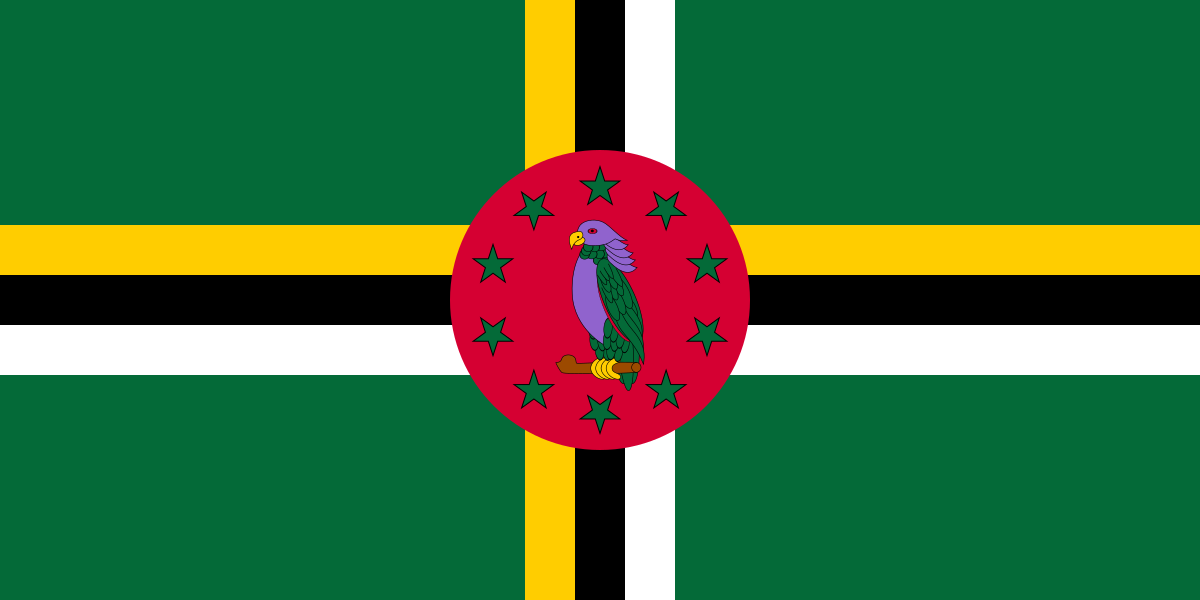 Dominica
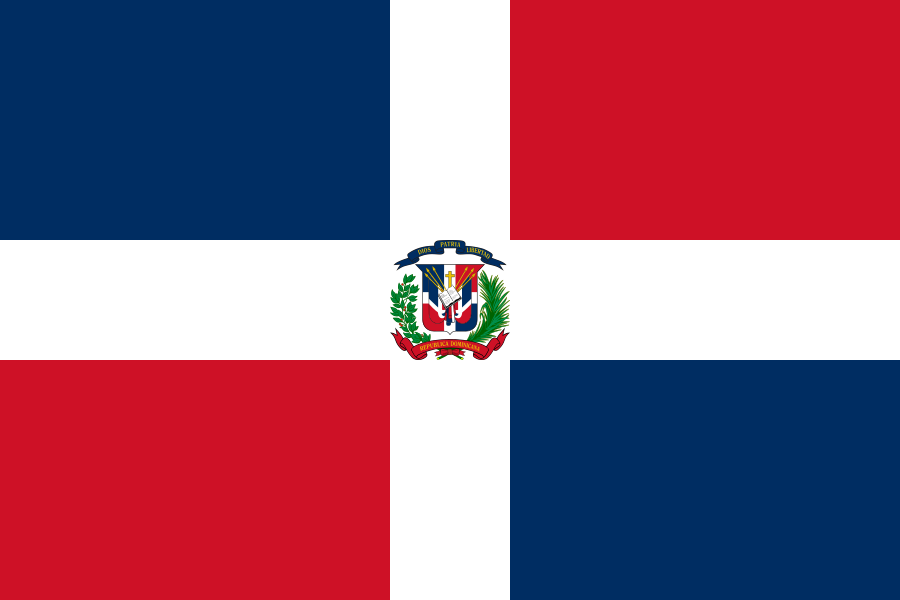 Dominican Republic
 Ecuador
 El Salvador
 Germany
 Grenada
 Guatemala
 Guyana
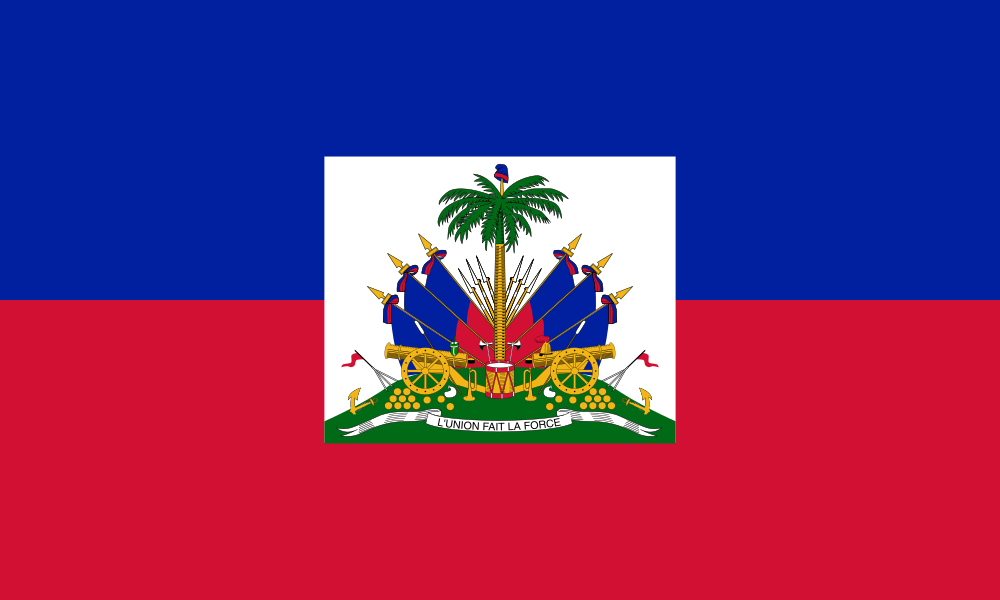 Haiti
Haiti Honduras
 Italy
Italy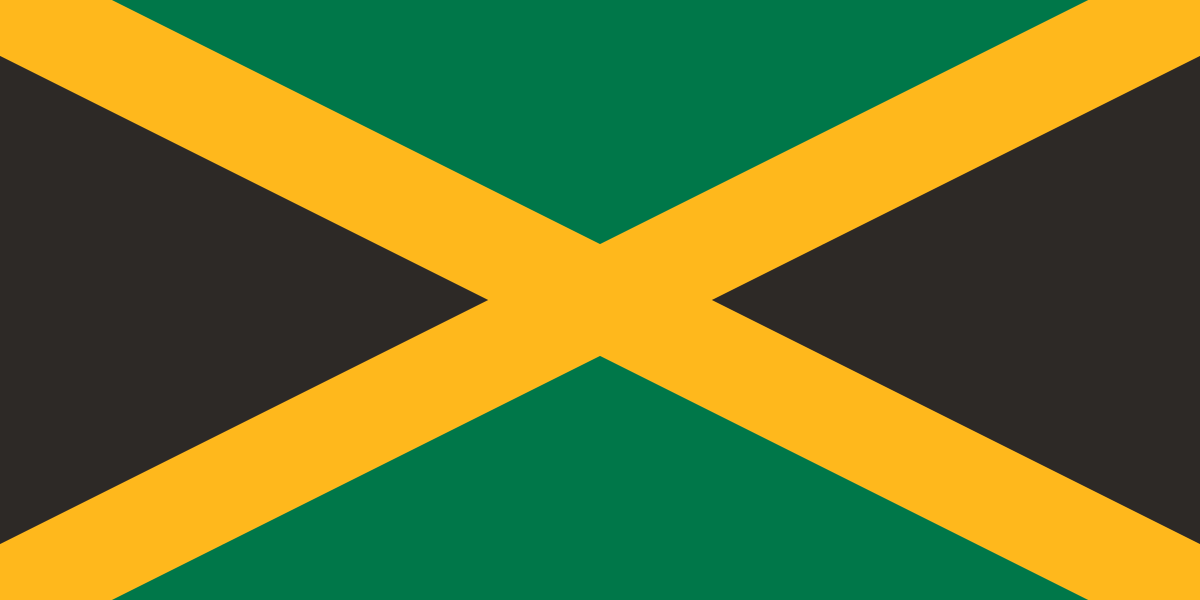 Jamaica
 Malta
Malta Mexico
 Netherlands
 Nicaragua
 Paraguay
 Peru
Peru Poland
 Portugal
 Saint Kitts and Nevis
 Saint Lucia
 Saint Vincent and the Grenadines
 Spain
Spain Suriname
 The Bahamas
 Trinidad and Tobago
 United Kingdom
 United States
 Uruguay
 Venezuela