
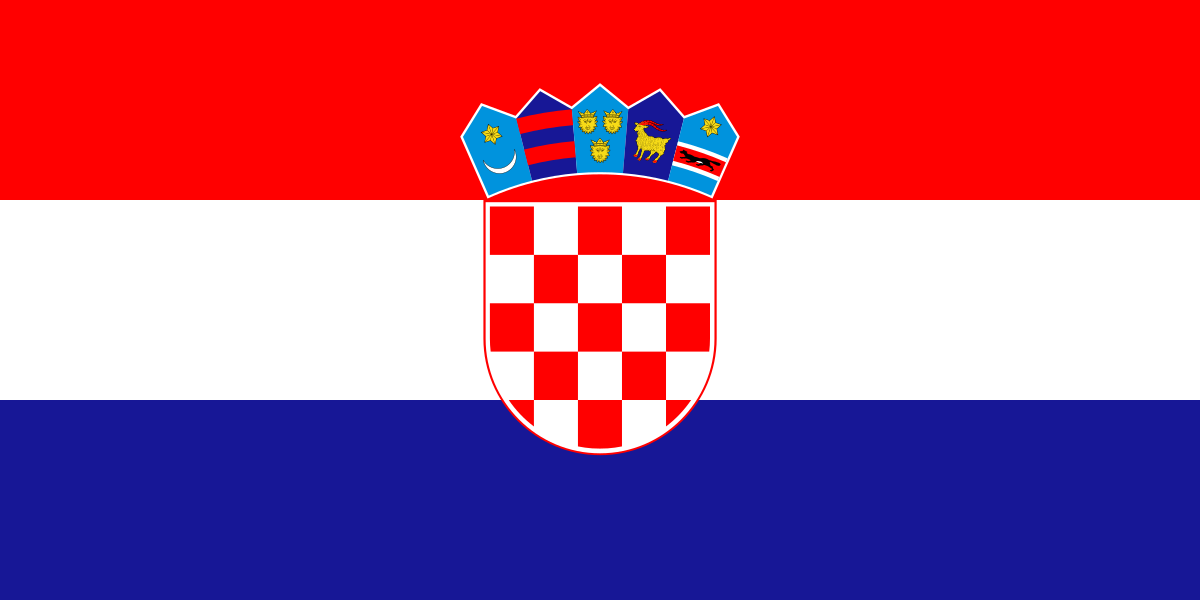
Croatia
15 topics answered, 2 policies that cut across several of them, and 4 recorded exceptions that depend on where you are coming from.
Part of The European Union - some of the answer below is decided there rather than here.
- Region
- Southern Europe
- Currency
- Euro (EUR)
- Language
- Croatian
- Policies
- 2 active
- Last checked
- 2026-10-10
Where are you a citizen of?
Most rules on this page are the same for everyone. The ones that are not get marked for you.
Policy that cuts across topics
Affects 3 of the 15 topics on this page
Since 15 March 2025 a single document issued by the ministry competent for demography and emigration does four separate jobs in Croatian immigration law, and the Zakon o strancima does not say what it takes to obtain one. It proves entitlement to temporary residence for the immigration and return of the Croatian emigrant community under article 79.a, which carries no means test and no insurance test. It lets the holder be employed or self-employed with no residence and work permit. After three continuous years it opens permanent residence under article 156(1) point 2. And since 4 June 2026 it does something for the holder's employer as well: article 99(13) counts the holder among the employer's Croatian workers for the ratio that decides whether anybody else can be hired from outside the Union. The statute names the ministry, names the four classes of person the certificate may describe - an emigrant, a family member, a descendant, a family member of a descendant - and leaves everything else to administration.
Affects 5 of the 15 topics on this page
Most countries have one permanent residence. Croatia has two, they sit in adjoining chapters of the Zakon o strancima, and the difference between them decides whether a person ever has to sit a Croatian examination. Dugotrajni boravak, the Union long-term residence of Directive 2003/109, is reached after five continuous years of temporary residence and asks for a travel document, means of support, health insurance, no danger to public order - and knowledge of Croatian and the Latin script. Stalni boravak, the national permanent residence, is not open to everybody: article 156(1) lists the eight classes who may ask for it, among them the spouse of a Croatian citizen after four years, a returning Croatian emigrant or their descendant after three, and a graduate after five of which three were a degree. For those people article 157(4) asks for a valid foreign travel document and that the applicant not be a danger to public order, national security or public health, and nothing else at all. The language examination has fee-paying providers and its own exemptions - preschool children, anyone schooled in Croatia, and anyone over 65 who is not in work - but the simpler fact is that the people the state most wants back never meet it.
Topics
all 15 answered- The Act Never Counts the Ninety Days - It Points at the Borders Code, and Then Makes Your Host Report You Within a Day
Croatia has been inside Schengen since 1 January 2023 and the Zakon o strancima says almost nothing about how long a visit may last. Article 55(1) defines a short stay only by reference to article 6 of the Schengen Borders Code, and the 90-days-in-any-180 measure itself comes from Regulation (EU) 2018/1806, which decides whether a traveller needs a visa at all. What Croatian law adds is a reporting duty that falls on somebody else: under article 177(1) the person or business that gave you a bed - a hotel, a landlord, a friend, a marina - has one day from your arrival to report it to the police. Only where they cannot does the duty fall on the traveller, and then it is two days from entry rather than one from arrival. Article 55(2) also says when a person stops being on a short stay at all, and the list is not only about days: an unlawful entry, a spent or expired visa, an entry ban anywhere in the EEA, or more than 90 days in the previous 180 each end it.
Depends on your citizenship
2 recorded exceptions change this rule for some nationalities.
Verified with official sourceMonitor - can change - Croatia Names the Digital Nomad in the Statute, Then Takes Them Out of Its Income Tax and Out of Its Health Service
The Zakon o strancima is one of the few in Europe that defines a digital nomad in its own glossary and lists their stay as a purpose of temporary residence in its own right. Article 3(1)(43) sets the test by negation: employed or working through communications technology for a company that is not registered in Croatia, and not providing services to employers in Croatia. Article 57(1) point 11 makes that a purpose of residence. The money is high and it is written as a multiple rather than a sum: the government's Uredba asks a digital nomad for at least 2.5 times the average monthly net salary paid in Croatia the previous year, against 57 per cent for an ordinary temporary residence. Since NN 40/2025 the permit runs up to 18 months and may be extended once inside that window, and when it ends the applicant waits six months before asking again. The two consequences nobody puts beside the permit are what make it unusual: the Zakon o porezu na dohodak exempts the receipts a digital nomad earns from a foreign employer, and the health insurance Act releases them from the duty to join the compulsory scheme and leaves them paying their own medical bills. A person on this permit is inside the country and outside both systems.
Depends on your citizenship
1 recorded exception change this rule for some nationalities.
Verified with official sourceMonitor - can change - Croatia Has No Retirement Visa. It Has a Sentence That Lets a Retired Owner of a Croatian Flat Keep Renewing the Catch-All Permit
Search the Zakon o strancima for a pension and you find one provision, and it is not a route. Article 57(1) lists twelve purposes of temporary residence and retirement is not among them, so a pensioner applies under point 10, "other purposes" - the catch-all. The sting is article 57(4): a person who has held the other-purposes permit must wait six months after it expires before applying again, which makes the category useless for settling. NN 40/2025 added article 57(6), and that is where retirement appears: by way of exception, the other-purposes permit may be extended for a retired third-country national over 60 who owns property in Croatia, and for their spouse or partner. The same amendment added article 151(4), which counts the time that person spends on the other-purposes permit towards the five years needed for long-term residence. Two sentences buried in a renewal bar and a counting rule are the whole of Croatia's retirement policy, and neither of them is written as a route.
Verified with official sourceMonitor - can change - The Examination Is of Your Employer: One Croatian on the Books for a Year, a Hundred Thousand Euros Through the Account, and One Croatian for Every Five Foreigners
Croatia abolished its annual quota and replaced it with a labour market test, and the test the applicant meets is almost trivial next to the test the employer meets. Under article 97 the Ministry issues the residence and work permit on a positive opinion from the Croatian Employment Service, and article 98 makes the employer ask for a labour market test first: the Service checks the unemployment register and tries to place a domestic worker. The real gate is article 99, and it has been rewritten twice in fourteen months. Since NN 55/2026 the Service may only give a positive opinion if the employer has had the same Croatian, EEA or Swiss worker on an indefinite full-time contract continuously for the past year; if at least 100,000 euros (a company) or 40,000 euros (a sole trader) has come through its account in the past twelve months; if the account has not been blocked for more than 30 continuous days in the past six; and if its Croatian and EEA full-time staff are at least 20 per cent of the number of third-country nationals it employs, or 10 per cent in a shortage occupation. The ratio was a quarter of all staff in 2020, 16 per cent of the third-country headcount in 2025 and 20 per cent in 2026. The one group that softens it is the Croatian diaspora: article 99(13) counts a returning emigrant or their descendant on the article 79.a permit as a Croatian worker for the purposes of the ratio.
Depends on your citizenship
1 recorded exception change this rule for some nationalities.
Verified with official sourceMonitor - can change - Fifty-One Per Cent of a Croatian Company Gets You Past the Labour Market Test, and Not One Article Prices the Investment
Croatia has no investor visa in the sense of a sum of money bought for a permit. What it has is a list of thirty-two exemptions in article 110 of the Zakon o strancima, and three of them are about owning or running a business: key personnel in a company, branch or representative office; self-employment in a company or a trade in which the applicant holds at least 51 per cent; and work on a strategic investment project or under the investment incentives law. Each of those gets a residence and work permit without a labour market test and without the Croatian Employment Service opinion that decides an ordinary work application - which is to say it escapes the employer tests in article 99 entirely. Article 115 sets the conditions for the strategic-investment permit and gives it a fifteen-day decision deadline, the only deadline of its kind in the chapter. Article 111 asks for an employment contract and proof of an educational qualification, and excuses a person self-employing in their own trade from the contract. Since NN 55/2026 the Act also closes a gap from the other direction: a third-country national who is the only person registered to manage and represent a company must apply for a permit within 30 days of being entered in the court register.
Verified with official sourceMonitor - can change - A Quarter of the Average Salary to Study, Three Fifths of It to Be Sent Home, and Five Years to Permanent Residence if Three of Them Were a Degree
Study is a purpose of temporary residence in its own right under article 57(1) point 3, and article 73 sets the test: the general conditions of article 59, enrolment at a Croatian higher education institution, and enough money to get home again. The two figures are in the government's Uredba and both are multiples of the average monthly net salary - 25 per cent a month to live on, which is less than half what an ordinary applicant must show, and 60 per cent held in reserve for the return journey. A student may be excused from the compulsory health insurance scheme if they hold cover of their own, and then pays their own medical bills. The permit runs a year or to the end of the academic year, two years for a student on a Union mobility programme. What NN 40/2025 added is the end of the path: a person with five continuous years of temporary residence of which at least three were study at degree level, who holds a Croatian higher education qualification and is employed in Croatia, may be granted permanent residence - the national status, which asks for no Croatian language examination at all.
Verified with official sourceMonitor - can change - A Descendant of a Croatian Emigrant Is Asked for No Money, No Insurance and No Permit to Work - and Reaches Permanent Residence in Three Years
On 15 March 2025 Croatia added a twelfth purpose to its list of temporary residences and built an entire route for the descendants of people who left. Article 79.a of the Zakon o strancima grants temporary residence for the immigration and return of the Croatian emigrant community to a Croatian emigrant, a family member of one, a descendant of one, or a family member of a descendant - proved by a certificate of the ministry competent for demography and emigration, which is the only test the Act itself states. Three things follow that no other category gets at once. Paragraph 3 excuses the applicant from proving means of support and from proving health insurance, the two conditions article 59 otherwise applies to everybody. Paragraph 4 gives the right to employment and self-employment with no residence and work permit and no work registration certificate, plus access to education and study. And the permit runs up to two years rather than one, and may be applied for at a police station inside Croatia even by a national who would normally need a visa to get here. After three continuous years of it, article 156(1) point 2 opens permanent residence - the national status, which asks for a valid passport and nothing else. The ministry's certificate is the gate, and the Act does not say what it takes to get one.
Verified with official sourceMonitor - can change - Marry a Croatian and the Means Test Disappears; Marry a Resident and It Does Not, and the Permit Is Only as Long as Theirs
Family reunification is a purpose of temporary residence under article 57(1) point 1, and what you get out of it depends entirely on whom you married. A member of the immediate family of a Croatian citizen does not have to prove means of support at all under article 65(1), and may be excused the passport where a consulate in Croatia will not issue one. The permit runs up to two years. A person reuniting with a third-country national gets the same two-year band only where that person holds long-term or permanent residence, asylum or subsidiary protection, or their own temporary residence - and article 61(5) then caps it at the partner's own expiry date. Several categories cannot bring family at all: a posted worker, a person on the other-purposes permit, a seasonal worker and two classes of service provider are excluded by article 63(4) as NN 40/2025 rewrote it. After three continuous years of family or partnership residence the holder may move to autonomous residence in their own right under article 69, and after four years of it the spouse of a Croatian citizen may ask for permanent residence - which asks for a passport and no Croatian examination.
Verified with official sourceMonitor - can change - Croatia Does Not Offer Registration to a Union Citizen, It Requires It - Within Eight Days of the Third Month
A national of an EEA member state or Switzerland does not enter Croatia under the Zakon o strancima at all: that Act is about third-country nationals, and a separate statute of 2019 carries the Union free movement right. Three months of stay need only a passport or identity card and no report to anybody. Past three months the right continues on the Directive's own grounds - work or self-employment, sufficient means and insurance, study, or joining a family member - but Croatia then does something Czechia does not: article 15(1) makes the person report temporary residence to the police, and gives them eight days from the end of the third month to do it. The certificate is issued without delay once they have. The means test is deliberately soft: article 13(2) forbids the authorities from asking for more than the amount that would qualify a person for social welfare in Croatia, and requires the applicant's personal position to be taken into account. Five years of continuous lawful residence gives permanent residence as of right, evidenced by a card valid for ten years, and absences of up to six months a year do not break the five.
Verified with official sourceMonitor - can change - Eight Years and an Examination for a Stranger; For the Descendant of an Emigrant, No Residence, No Language and No Renunciation
Ordinary naturalisation in Croatia is among the slower routes in the Union. Article 8(1) of the Zakon o hrvatskom državljanstvu asks for eight continuous years of registered residence and the status of a foreigner on permanent residence, release from the former citizenship, knowledge of Croatian, the Latin script, Croatian culture and the social order, and respect for the legal order with public dues paid and no security obstacle. The eight years came in 2011 and replaced five. Beside it sits article 11, which is unlike anything else in the corpus: an emigrant and their descendants may naturalise while exempt from points 2 to 4 - the renunciation, the eight years of residence and the language examination alike - leaving only the age and the good-conduct test. The reach is the point. The 1991 text said "an emigrant and his descendants" with no limit; NN 130/2011 cut it back to descendants within the third degree in the direct line and took away the language exemption; NN 102/2019 removed the degree limit again and restored the exemption, while adding a date: the emigrant must have left the territory of Croatia before 8 October 1991 intending to live permanently abroad. A separate route, article 16, reaches a member of the Croatian people who has never lived in Croatia at all, on proof of belonging and the good-conduct test alone.
Verified with official sourceMonitor - can change - A Flat You Own for 183 Days Makes You Resident Even if You Never Sleep In It
Croatia keeps the test in the Opći porezni zakon and the consequence in the Zakon o porezu na dohodak. A resident is a natural person who has a prebivalište or an uobičajeno boravište in Croatia, and the General Tax Act defines both in article 43. The first is a property test and an unusually blunt one: a taxpayer has a prebivalište where they own or possess a dwelling continuously for at least 183 days in one or two calendar years, and staying in it is not required. The second is the ordinary presence test - a stay of at least 183 days in one or two calendar years, under circumstances showing it is not merely temporary, with short interruptions of up to a year ignored. Where a person has a dwelling here and abroad, the 2018 amendment moved the tie-break from an automatic assumption in Croatia's favour to the family's home, then to where the person leaves for work or mainly stays; but it added a backstop in the opposite direction, so that if the other state does not treat the person as its resident, Croatia does. One category is carved out of the consequence rather than out of the test: the receipts of a person with digital nomad status, earned from an employer not registered in Croatia, are exempt from income tax.
Verified with official sourceMonitor - can change - Eight Days to Join the Compulsory Scheme and Pay Your Own Contributions - Unless You Are a Student or a Digital Nomad, Who Pay Their Own Bills Instead
Croatia regulates the health cover of foreigners in a statute of its own, separate from the Act that covers Croatian citizens. Anyone on permanent or long-term residence must be insured under one of the ordinary grounds and gets the ordinary scope of rights. A third-country national on temporary residence is in a harsher position: whatever the purpose of the residence, if cover does not reach them on some other ground, they must lodge an application with the Croatian Health Insurance Fund within eight days of the residence being granted, and they are themselves the person liable for the contributions. The police must tell the Fund within eight days that a permit has been granted, and the Fund must tell the Tax Administration once the status is settled, so the chain is closed from the state's side. Two groups are released and both of them pay the price in the same way: a secondary school pupil or a student who holds insurance of their own, and - since 2021 - a digital nomad. Neither is in the scheme, and both bear the full cost of any care they use.
Verified with official sourceMonitor - can change - The Same Union Relief Every Member State Applies: Six Months Owned, Twelve Months Away
Croatia does not decide this. Personal property imported by someone moving their normal residence from a third country into the customs territory enters free of import duties on conditions a directly applicable Union regulation sets: six months' possession, and use at the former residence for durable goods; a continuous twelve months of normal residence outside the customs territory; and entry for free circulation within twelve months of the move. Alcohol, tobacco, commercial means of transport and trade equipment other than portable instruments of the applied or liberal arts get no relief at all. Since 1 January 2023 Croatia is also inside the euro area and inside Schengen, so a move from another member state is not an import in the first place.
Verified with official sourceMonitor - can change - Lawful Residence Anywhere in the Union Is Enough, and a Bank Above Two Billion Euros Has No Choice
Croatia transposed the Payment Accounts Directive in 2017 and the entitlement is drawn wide. A consumer with lawful residence in the European Union has the right to open and use a basic payment account, and so does a person who has no residence permit but cannot be removed for legal or practical reasons. The Act defines lawful residence in the Union as the right to be in a member state under Union law or the law of that member state, and names consumers with no fixed address and asylum seekers inside it. Article 21 forbids a credit institution from discriminating on nationality or place of residence when a consumer asks for any payment account, not only a basic one. Not every bank must offer the basic account: the duty falls on institutions whose audited total assets exceed 1.99 billion euros, a figure NN 105/2025 converted and reset from the original 15 billion kuna, and the rest may offer it if they choose. A bank that offers it must open the account or refuse within ten working days, may refuse only where the consumer already has a comparable account in Croatia, must refuse where opening it would breach the money laundering rules, and may not make the account conditional on buying anything else.
Verified with official sourceMonitor - can change - One Year From the Day You Entered, Not From the Day You Got the Permit - and the Medical Certificate Depends on Who Issued the Licence
The Zakon o sigurnosti prometa na cestama makes two separate rules and the second one catches people out. Article 225(1) lets any foreigner staying in Croatia drive on a valid foreign licence, subject to reciprocity. Article 226(1) then puts a limit on the ones who have settled: a foreigner granted temporary or permanent residence may drive on the foreign licence for up to one year from the day of entry into Croatia - not from the day the permit was issued - and after that must exchange it. The exchange is made without a driving test, for the categories the foreign licence covers, and failing to exchange in time is a fine of 60 euros. Where the two systems part company is the paperwork, and that is in the Pravilnik rather than the Act: a licence from an EEA member state is exchanged on the licence, a photograph and proof of identity, while a licence from anywhere else needs a medical certificate no more than six months old, and a translation where the categories or the expiry cannot be read off the document. Croatia returns the surrendered licence to the authority that issued it either way.
Verified with official sourceMonitor - can change