
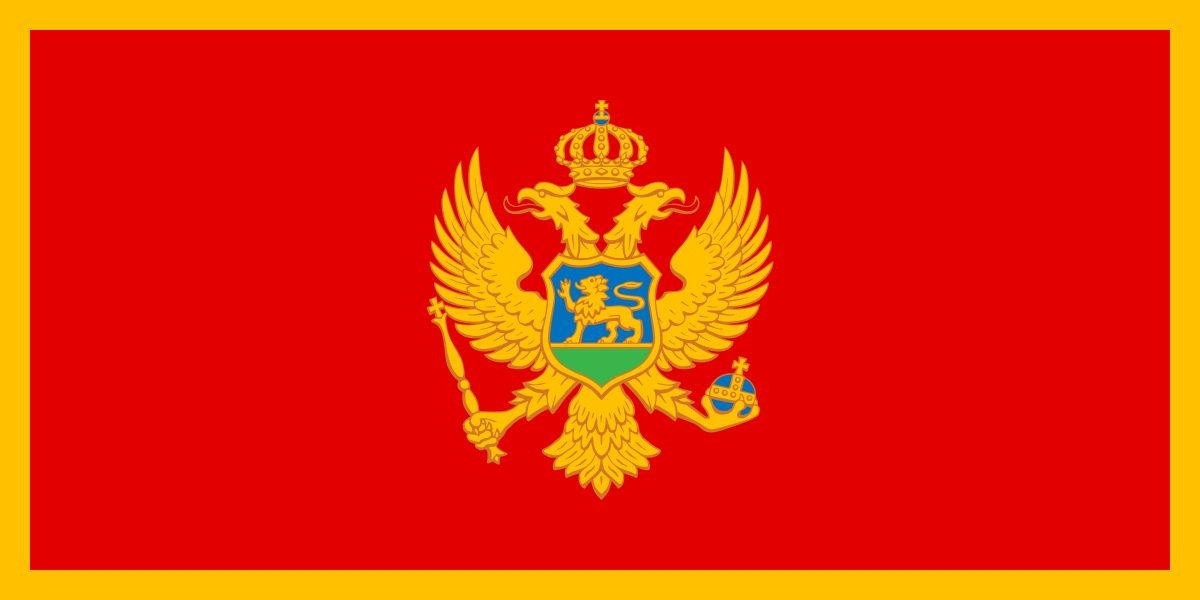
Montenegro
15 topics answered, 3 policies that cut across several of them, and 2 recorded exceptions that depend on where you are coming from.
- Region
- Southern Europe
- Currency
- Euro (EUR), used unilaterally and outside the euro area
- Language
- Montenegrin
- Policies
- 3 active
- Last checked
- 2026-10-11
Where are you a citizen of?
Most rules on this page are the same for everyone. The ones that are not get marked for you.
Policy that cuts across topics
Affects 3 of the 15 topics on this page
Montenegro pays in euros and has done since 2002, but the statute book does not declare it. The Constitution of Montenegro has no currency provision at all. The Zakon o Centralnoj banci Crne Gore of 2010 is drafted the other way round: article 5 gives the Central Bank the exclusive right to issue banknotes and coin 'if Montenegro were to introduce its own currency' - a conditional about a future that has not happened - and lets it issue commemorative notes and coin that are not means of payment. The euro appears in the Act only obliquely, in article 13, which has the Bank keep a revaluation reserve account covering unrealised expenses on currencies that are not the EUR, gold and securities. The one Act that treats the euro as the domestic unit does it by assumption rather than by enactment: article 1 of the Zakon o tekucim i kapitalnim poslovima sa inostranstvom governs payment transactions between residents and non-residents 'in the euro and in a currency which is not the euro', and gives residents the right to hold means of payment in a currency which is not the euro. That is the whole of what we found. For a reader it means the practical answers are simple - thresholds, fees, taxes and bank limits across Montenegrin law are all written in euros with no conversion rule anywhere, because there is nothing to convert from - while the legal answer is that the arrangement rests on practice and on statutes drafted around it rather than on a provision naming a legal tender.
Affects 4 of the 15 topics on this page
Montenegro legislates ahead of its accession to the European Union, and the Zakon o strancima carries the result. Chapter IX, articles 150 to 178b, is a full transposition of the free-movement directive for nationals of EU member states and their family members, rewritten almost entirely by the amending Act of 31 December 2025 and touched again in March 2026. Article 1, as amended in 2026, even says that those articles govern the entry, exit, movement, residence and work of EU nationals and that the rest of the Act applies to them only where it expressly says so. None of it is in application. Article 221(1), unchanged since 2018, defers articles 150 to 203 and six other provisions to the day Montenegro accedes to the Union, and the 2026 Act added article 221b deferring a further list - electronic visa applications, agency posting of workers, several grounds of permit refusal - to the same day. For a reader the practical effect is a trap: the chapter reads as live law, it was amended twice in 2026, and the sentence that makes it dormant sits two hundred articles later under a heading about transitional provisions. An EU national today needs a ground under article 38 like anyone else, and the only EU-specific right that is in force is the exemption in article 56(5) from the property-value proof, which the 2026 Act wrote into the body of the Act rather than into the deferred chapter.
Affects 6 of the 15 topics on this page
Montenegro attaches a presence rule to every temporary residence permit and it is stricter than almost anything a reader will have met. Article 65(1)(3) of the Zakon o strancima says the permit ceases to be valid if, during the temporary residence, the foreigner stays outside Montenegro for more than 30 days. Article 65(2) softens it on one condition only: a foreigner who is outside Montenegro for up to 90 days for justified reasons does not lose the permit if he notifies the police of the departure and of its reasons beforehand. Beyond 90 days there is no relief at all, except for holders of a permit on the residual ground in article 38 point 13, who are exempt from the rule entirely by article 65(4). This is a continuous-absence rule rather than a quota of presence, so it bites on one long trip and not on many short ones - and it sits oddly beside article 86(3), which allows absences of up to ten months in total, or one of up to six months, across the five years that lead to permanent residence. A person who takes the six-month absence article 86 permits would lose the permit that is accumulating the five years under article 65.
Topics
all 15 answered- Ninety Days in Any 180 by Statute, and a Visa-Free List the Government Has Just Given an Expiry Date Of 31 October 2026
Two instruments answer a visitor's question and they do different jobs. The Zakon o strancima sets the length: article 34 allows a stay of up to 90 days in any 180, counted from the day of first entry, either on a short-stay visa (viza C) or without a visa under the decree the Government makes under article 14(2), and a visitor who has used the 90 days may re-enter only once the 180-day period has run. The Uredba o viznom rezimu is the list. Its article 1 names the nationalities that may enter for up to 90 days without a visa on a travel document; article 2 lets nationals of the European Union member states and of thirteen other named states come for 30 days on an identity card alone; article 4 says everyone not named in articles 1, 1a, 2 and 3 needs a visa. What makes this topic unusual is the direction of travel. The decree has been amended eleven times since 2019 and the amendments of the last twelve months have been removals: Azerbaijan, Bahrain, Qatar, Kuwait and Turkey off the 90-day list, Vanuatu off it in 2025, Croatia, Bulgaria and Romania out of the holder-of-a-visa provision. The amendment published on 24 July 2026 went further and put a date on the rest. Saudi Arabia and Turkey keep a 30-day visa-free entry under article 1a only until 31 October 2026; the Chinese tour-group and business-passport arrangement in article 6 is limited to the same day; a new article 3a gives Belarus and the Russian Federation 30 days under bilateral travel treaties, also only until 31 October 2026; and a new article 12c says that from 31 October 2026 exemption from the visa requirement may not be regulated by separate acts of the Government at all, with seasonal exemptions ending on 1 October 2026.
Depends on your citizenship
1 recorded exception change this rule for some nationalities.
Verified with official sourceActively changing right now - No Permit for Living on Your Own Money, But a Digital-Nomad Permit the Act Caps at Two Years Plus Two and Then Makes You Wait Six Months
Article 38(1) of the Zakon o strancima is a closed list of the purposes for which temporary residence may be approved, and none of them is income from abroad that is not earned by working. There is no rentier, independent-means or passive-income category. What Montenegro added instead, by the amending Act of 28 July 2022, is a route for people who work remotely: article 6(1)(9) defines a digital nomad as a foreigner employed by, or doing work electronically for, a foreign company or his own company not registered in Montenegro; article 38(1)(12a) makes the stay of a digital nomad a ground of temporary residence; and article 60a sets the permit. It is issued to someone who meets the general conditions in article 43 and produces an employment contract or another document proving the electronic work, and since 17 January 2026 also proof that the company is registered in another state. It runs for up to two years, may be extended by at most two more, and a new one may be issued only once six months have passed since the old one expired. Close family may join for reunification. The Act fixes no income figure of its own: article 60a(5) leaves the closer conditions to the Ministry, and the transitional article 216b required that regulation within 90 days. We could not find it. What does bind is the general subsistence test in the Ministry's rulebook on temporary residence permits, which since 4 February 2025 treats a foreigner as having means of support if he holds at least 20 euros for each day of the stay applied for. Setting up a company in Montenegro or registering as an entrepreneur costs you the status outright.
Verified with official sourceMonitor - can change - Buying a Flat Really Does Get You Residence - And Since 17 January 2026 the Flat Has to Be Assessed at 150,000 Euros
The thing Montenegro is marketed for is in the Act in terms. Article 38(1)(8) of the Zakon o strancima makes 'using and disposing of a right to immovable property which he owns in Montenegro' a ground of temporary residence, and article 56 is the permit: it may be issued to a foreigner who meets the general conditions of article 43 and, as proof that the application is justified, attaches a land-register extract or another proof under the cadastre law confirming ownership of that property. Article 56(3) names what counts as immovable property - family houses, holiday houses, villas, flats, catering premises, mixed residential and business buildings and business premises. Since January 2019 a co-owner of at least one half qualifies. What the route grants is small and the rest is the general law: a temporary residence permit under article 63 runs for up to one year and is renewed a year at a time, the Ministry decides within 40 days of a complete application, and the permit lapses if the holder spends more than 30 consecutive days outside Montenegro, or more than 90 even with the police told in advance. It does count towards something: article 86 lets a permanent residence permit be issued after five years of continuous lawful residence on an approved temporary residence, with absences of up to ten months in total or one of up to six months not breaking the chain, and article 88 adds a Montenegrin language test at a level allowing basic communication. And since 17 January 2026 the route has a price. Article 24 of the amending Act of 31 December 2025 added to article 56(1) a requirement to produce proof of the property's value, and defined it: a property-transfer-tax assessment issued by the local tax authority whose taxable base is not less than 150,000 euros. Nationals of European Union member states, of Iceland, Liechtenstein, Norway and Switzerland, and their family members, do not have to produce it. There is no separate investor-by-capital category anywhere in article 38; the nearest thing is a work permit, where article 70(4) now lets an entrepreneur or an executive director who owns a company outright or holds more than 51 per cent of it renew indefinitely on proof of at least 5,000 euros of tax and contributions a year.
Depends on your citizenship
1 recorded exception change this rule for some nationalities.
Verified with official sourceActively changing right now - One Permit for Residence and Work, Inside an Annual Quota of 28,988 for 2026, and a Rulebook That Now Names Three Different Minimum Wages at Once
Work is point 12 of the list of grounds in article 38(1) of the Zakon o strancima, and article 40 says it gets a single combined permit - dozvola za privremeni boravak i rad - covering employment, seasonal employment and posted work. Article 66 makes the permit job-specific and employer-specific: a foreigner may work only on the jobs the permit was issued for and only for the employer who employs him, the employer may not move him to other work, and a copy of the permit must be kept at the workplace. Article 69 lists what the applicant attaches: a written job offer from the employer, proof of the level of education and qualification obtained, proof of health fitness, and an extract from the employer's job-classification act; an entrepreneur or an executive director who owns the company outright or holds more than 51 per cent of the capital attaches proof of ownership and registration instead of an offer. The whole thing sits inside a quota. Article 76 makes the Government set the annual number of permits by 30 November for the following year, broken down by activity and occupation and split between ordinary and seasonal employment; the decision of 18 December 2025 set 28,988 permits for 2026, of which 21,668 for employment and 2,320 for seasonal employment, with 5,000 held back for the labour ministry to allocate on the employment agency's request. Article 70, rewritten with effect from 17 January 2026, gives a first permit of up to one year, extendable to at most two years where there is a full-time employment contract, and lets an owner-director go on renewing indefinitely on proof of at least 5,000 euros of tax and contributions a year. The wage figure is where the law contradicts itself: article 9(3) of the Ministry's rulebook still names a minimum net wage of 310 euros, and the amendment of 4 February 2025 appended to the same sentence 600.00 euros for jobs up to qualification level V and 800,00 euros for level VI and above, without deleting the 310.
Verified with official sourceActively changing right now - A Study Permit That Now Runs to the End of the Academic Year, and Study Time That Counts Only Half Towards Permanent Residence
Schooling is point 2 of the list of grounds in article 38(1) of the Zakon o strancima and article 47 is the permit. It may be issued to a foreigner who meets the general conditions of article 43 and attaches a certificate of schooling as proof that the application is justified, and it may be extended for at most two years beyond the period prescribed for the schooling, so that a course can be finished. A minor needs the consent of a parent, guardian or legal representative. The amending Act of 31 December 2025 inserted a new second paragraph with effect from 17 January 2026: the permit is issued for the period of the school or academic year in Montenegro, in accordance with the education regulations - which ties the permit to the academic calendar rather than to the general one-year rule in article 63. The price of this route is paid at the other end. Article 86(4) counts only half of the time spent on a temporary residence approved for schooling, specialisation, professional training or practical instruction towards the five years that open permanent residence, so a three-year degree is worth eighteen months.
Verified with official sourceMonitor - can change - Family Reunification Opened to Same-Sex Life Partners on 17 January 2026, and Widened to the Families of Foreigners Who Only Hold Temporary Residence
Family reunification is point 1 of the list of grounds in article 38(1) of the Zakon o strancima and article 44 is the permit. The amending Act of 31 December 2025 rewrote its first two paragraphs and did two things at once. It widened the sponsor: the permit is now issued to a close family member of a Montenegrin national, of a foreigner with permanent residence and of a foreigner with temporary residence alike. And it put same-sex life partnership on the same footing, adding three matching limbs for a partner in a life partnership of persons of the same sex with a Montenegrin national, with a permanent-residence holder or with a temporary-residence holder. Close family means spouses, their minor children born in or out of marriage, the children of one spouse and adopted children up to the age of 18, and the parents or adopters of minor children. Article 46, also rewritten, refuses the permit where the marriage or life partnership was contracted for benefit, which it defines as one contracted with the intention of achieving entry or stay in Montenegro contrary to the Act, and lists the circumstances that may indicate it. Article 45, as amended, lets the permit be extended where the Montenegrin national or permanent-residence holder has died, and where a marriage or same-sex life partnership that lasted at least three years in Montenegro has ended; it is also extended to a child who has come of age after three continuous years of residence for reunification. Since 17 January 2026 the general conditions article carries an addition for this route, and article 46 keeps a separate protection for a foreigner who is the victim of domestic violence.
Verified with official sourceMonitor - can change - No Retirement Permit Anywhere in the Act, and the Route Pensioners Actually Use Is the Flat They Bought
Article 38(1) of the Zakon o strancima is the Act's own closed list of the purposes for which temporary residence may be approved, and retirement is not one of them. There is no pension-income category, no retiree visa and no age-based route; the thirteen grounds run from family reunification through schooling, exchange programmes, specialisation, scientific research, medical treatment, humanitarian reasons, property ownership, religious service, European voluntary work, statelessness and work to a residual ground for other cases provided by law or an international agreement, and the chapter that follows gives each of them its own article. A retired person who wants to live in Montenegro arrives on one of the other grounds, and in practice that means article 56, the permit for using and disposing of a right to immovable property owned in Montenegro - which since 17 January 2026 requires a municipal property-transfer-tax assessment with a taxable base of at least 150,000 euros - or family reunification under article 44. What the law does say about pensioners is on the other side of the move. Article 6(15) of the Zakon o zdravstvenom osiguranju makes nationals of Montenegro and foreigners with permanent residence who draw a pension or another benefit exclusively from a foreign insurance institution compulsorily insured persons, unless an international agreement provides otherwise; and article 9 lets anyone with domicile or permanent-residence status who is not insured on any other ground acquire insured status by paying the contribution. Both turn on permanent residence, which article 86 of the Zakon o strancima puts five years away.
Verified with official sourceStable - Descent Gets You Citizenship Directly or Nothing at All - There Is No Residence Permit for Having Montenegrin Roots
Montenegro answers ancestry in the citizenship Act, not in the foreigners Act, and it answers it in two places that leave a gap in between. Article 5 of the Zakon o crnogorskom drzavljanstvu gives citizenship by origin to a child both of whose parents were Montenegrin citizens at birth, and to a child with one such parent in three further situations; article 6 extends it to a child born abroad with one Montenegrin parent if an entry in the register is applied for before 18, and - the limb that matters to an adult - to a person who has turned 18 with one Montenegrin parent and one foreign parent, if he applies for entry in the register of Montenegrin citizens before the age of 23. After 23 that door is closed. What is left is naturalisation, and article 10 gives a Montenegrin emigrant and a family member up to the third degree of kinship in the direct line a shortened route: citizenship by naturalisation after two years of lawful and continuous residence in Montenegro, against the ten years article 8 asks of everyone else, and without the language test, the release from the previous citizenship or the residence requirement of article 8. What article 10 does not give is the residence. It assumes it. And article 38(1) of the Zakon o strancima, the closed list of grounds for temporary residence, contains nothing about descent, origin or emigrant status - so an applicant under article 10 has to find a separate ground to be lawfully resident for those two years in the first place.
Verified with official sourceStable - A Whole Chapter of EU Free Movement Is on the Statute Book and None of It Applies Until the Day Montenegro Joins
Montenegro belongs to no treaty that gives a foreign national a right of residence on its territory today. What it has instead is a chapter of its own Act written for a membership it does not yet hold. Chapter IX of the Zakon o strancima, articles 150 to 178b, sets out entry without a visa or permit for a national of an EU member state, residence up to three months on a passport or identity card, residence beyond three months for work or self-employment, study, sufficient resources, or as a family member, registration certificates and residence cards, retention of the right on the death or departure of the sponsor, permanent residence after five years of lawful continuous residence, free access to the labour market and procedural guarantees. The amending Act of 31 December 2025 rewrote almost all of it to track Directive 2004/38 and added articles 178a and 178b, and the amending Act of 3 March 2026 changed one heading in it. None of it is in force as law a person can use. Article 221(1) of the Act, unchanged since 2018, says that articles 150 to 203 - along with article 50(5), article 67(1) points 5 to 7, articles 115, 120, 121 and 122, article 210(1) points 12 to 14 and article 215 - apply from the day Montenegro accedes to the European Union. The 2026 Act added article 221b deferring a further set of provisions, on electronic visa applications, agency posting and seasonal work, to the same day. Until then an EU national needs a ground from article 38 like anybody else. The residual ground, article 38(1)(13), covers other cases in accordance with the law and an international agreement, and is the hook through which any future treaty would operate.
Verified with official sourceMonitor - can change - Ten Years, a Language Test and Release From Your Old Passport - And the Investment Programme That Lapsed on 31 December 2022 Without Ever Being Repealed
Ordinary naturalisation is article 8 of the Zakon o crnogorskom drzavljanstvu and it is demanding. The applicant must be in accordance with the interests of Montenegro, be 18, hold a release from the citizenship of the other state, have resided in Montenegro lawfully and continuously for ten years before the application, have accommodation and a permanent source of income giving material and social security, have no final unconditional sentence over one year at home or abroad for an offence prosecuted ex officio, know Montenegrin to an extent allowing basic communication, present no security or defence obstacle, and have settled tax and other statutory obligations. The release is excused only for a stateless person or for one who shows he will lose his citizenship by being admitted to Montenegro's. Two shorter routes sit beside it: article 10 gives a Montenegrin emigrant and a family member to the third degree in the direct line two years, and article 11 gives a spouse of at least three years who has resided lawfully and continuously for five years a route without the language test, the ten years or the release, extended since 2010 to a widow or widower of a three-year marriage and since 3 August 2026 to a partner in a same-sex life partnership. And then there is article 12, the discretion the economic programme was built on: an adult - since December 2019 simply a person - whose admission is of particular importance for the state, scientific, economic, cultural, sporting or other interest of Montenegro may exceptionally acquire citizenship even without meeting article 8 at all, with the Ministry deciding on the opinion of the sector authority and, for the state and other interest, on a proposal from the President, the Speaker or the Prime Minister. The criteria are a Government decision made under article 17, whose article 3 names investing capital by founding a company, directly investing capital or donating funds, and being a top proven expert or investor of indisputable international standing; article 3a, added in 2016, allows that investment or donation to be made through a special investment programme. That programme was the citizenship-by-investment scheme. The decision setting it up was made on 22 November 2018 and its article 18 said in terms that it would apply from 1 January 2019 to 31 December 2021, with no more than 2,000 applications granted. On 30 December 2021 the Government extended it by exactly one year, substituting 31 December 2022 for 31 December 2021. Nothing extended it again. It was never repealed either - the gazette still records it as in force - and the June 2023 decision that kept the intermediary and suitability agents' licences alive did so only until decisions are taken on applications lodged by 31 December 2022. The enabling criteria in article 3 and article 3a survive, and the Government was still moving responsibility for them between ministries in November 2025, so the discretion remains; the programme built on it does not.
Verified with official sourceMonitor - can change - Domicile or the Centre of Business and Life Interests, or 183 Days in the Tax Year - And Rates Rewritten Twice Since the 2022 Reform
Article 3 of the Zakon o porezu na dohodak fizickih lica gives two independent tests and either is enough. A resident natural person is one who, on the territory of Montenegro, has a domicile or the centre of business and life interests; or who stays on the territory of Montenegro for more than 183 days in the tax year. A person sent abroad to do work for a Montenegrin resident or for an international organisation is a resident too. Residence matters because article 4 taxes a resident on income earned in Montenegro and outside it, while a non-resident is taxed on income from activities carried on through a fixed place of business in Montenegro and, with no fixed place of business, on royalties, interest, capital gains and rent from immovable property situated in Montenegro. The rates are not the ones the 2022 reform set. The reform of 31 December 2021 replaced article 10 with a two-band schedule - nine per cent on taxable income from 700.01 to 1,000.00 euros and fifteen per cent above 1,000.01 for employment income, and the same percentages on annual bands of 8,400.01 to 12,000.00 euros for self-employment - and the amending Act of 30 December 2022 wrote the zero rate up to 700.00 euros into the text. Since then the schedule has been replaced twice more. The amending Act of 30 December 2025, applying from 1 January 2026, substituted the whole of article 10 and added a fourth point for gambling winnings; the amending Act of 14 May 2026 replaced that fourth point with a flat twelve per cent. The bands for employment income are monthly: article 46(3) makes the tax base the amount received in one month less the monthly personal allowance.
Verified with official sourceActively changing right now - Identification in Person From an Original Document, a Montenegrin Address in the Record, and Thresholds Written Straight in Euros Because There Is No Other Currency to Convert From
Account opening is governed by the Zakon o sprecavanju pranja novca i finansiranja terorizma of 2023, amended four times since and most recently with effect from 5 May 2026. Article 17 makes the obliged entity identify the client, establish and identify the beneficial owner, record the purpose and nature of the business relationship, and monitor it; article 18, substituted in 2026, says when: on establishing a business relationship, on occasional transactions of 10,000 euros or more, on occasional cash transactions of 3,000 euros or more but under 10,000, on any transfer of funds of 1,000 euros or more, on any transfer of crypto-assets of 1,000 euros or more, where there is doubt about the identity data, and where there is suspicion of money laundering or terrorist financing whatever the amount. Article 22 is the part a foreigner feels: identification of a natural person is done by inspecting a personal identity document in that person's presence, the entity must take a photocopy and record who inspected it and when, and a 2026 addition forbids verifying the client's data against the Central Population Register unless the original identity document is in front of the person doing the checking. Articles 23 and 24 allow electronic and video identification instead, with conditions. The data the entity has to record for a natural person are in article 117(1)(3) and they include the address and municipality of domicile or residence in Montenegro, the unique personal number, date and country of birth, citizenship, whether the person is politically exposed, whether he is resident or non-resident, and the type, number, issuing state and expiry of the identity document. Nothing in the Act turns on the currency arrangement, and that is itself the point: every threshold is written directly in euros with no conversion rule, exactly as a euro-area member's would be, because Montenegro has nothing to convert from.
Verified with official sourceMonitor - can change - Compulsory Insurance Follows Employment or Permanent Residence, and in February 2025 the Ministry Stopped Accepting Montenegrin Health Insurance as Proof for a Residence Permit
The Zakon o zdravstvenom osiguranju builds the compulsory scheme out of a list of insured persons in article 6, and the list is occupational and status-based rather than territorial. Employed persons are on it; so are several categories of foreigners, including those working for Montenegrin legal or natural persons under agreements on international technical cooperation, those employed by international organisations and other foreign legal and natural persons, those employed at foreign diplomatic and consular missions where an international agreement provides, entrepreneurs and persons pursuing a profession independently, and - point 15 - nationals of Montenegro and foreigners with permanent residence who draw a pension or another benefit exclusively from a foreign insurance institution. Article 9 is the residual door: a person with no insured status on any ground in article 6 who has domicile or the status of a person with permanent residence in Montenegro, and no insured status in another state, may acquire insured status by paying the contribution under a special law. Article 10 gives family members of an insured person insured status on the same two conditions, domicile or approved permanent residence and no insured status elsewhere. The consequence for someone moving on a temporary permit is that the compulsory scheme does not reach him unless his work puts him in it. The Foreigners Act requires health insurance as a condition of every temporary residence permit, in article 43(1)(3), and the Ministry's rulebook says what counts. Until 12 February 2025 it accepted travel insurance from an authorised insurer, insurance under an international agreement, or insurance obtained under the conditions and in the manner laid down by a special law - which is the domestic scheme. The amending rulebook of 4 February 2025 replaced the article and dropped the third limb.
Verified with official sourceMonitor - can change - Household Goods Come In Free After Twelve Months Abroad and Six Months of Ownership, and the Private Car Counts as a Household Good
Article 195(1) of the Carinski zakon lists the goods released from import duty and point 11 is the one a person moving to Montenegro needs: household objects imported on moving to Montenegro by natural persons who previously resided in another state continuously for at least 12 months, provided the objects are owned by them and were used for at least six months before the move, with the import to be made within 12 months of the day of the move and that period extendable for special circumstances. The Government decree of 27 February 2025 works it out. Article 36 restates the two conditions - having resided, or having had an evident intention to reside, outside Montenegro for at least 12 months continuously, and importing household objects owned and used in the household for at least six months - and then defines household objects in a way that is wider than the phrase suggests: objects for furnishing and fitting out a dwelling; bicycles and motorcycles, private motor vehicles and their trailers, caravans, pleasure craft and private aeroplanes and the like; household stores answering the ordinary needs of a family, pets and riding animals, and portable instruments for applied art needed for the person's occupation. Excluded are alcohol, tobacco, commercial means of transport and objects used for carrying on a profession other than those portable instruments. Article 37 runs the clock from registration rather than from arrival: the goods may be released for free circulation within 12 months of the day the person registered domicile or residence in Montenegro, late release is allowed on a reasoned and documented request, and goods released before registration qualify if domicile or residence is registered within six months of import, against security the customs authority sets. Article 40 asks for three documents, and a temporary residence permit - the stamp in the passport - is one of the accepted proofs of status.
Verified with official sourceStable - Any Foreign Licence Exchanges Without a Test, and Since December 2019 the Condition Is Habitual Residence of 185 Days in the Calendar Year
Montenegro exchanges a foreign driving licence without a driving test and without a country list. The rule is in the Zakon o bezbjednosti saobracaja na putevima: article 176 sets out who may drive on a foreign licence and for how long, and article 177 sets out who may be issued a Montenegrin one. A foreigner staying temporarily in Montenegro may drive on a valid foreign or international licence for as long as it is valid; a foreigner who has been granted residence may drive on the foreign licence for six months from the day of entry into Montenegro, and is then expected to exchange it. The exchange itself is a Montenegrin licence issued on request, without taking the driving test, on the basis of the valid foreign licence, subject to the age, medical fitness, residence, no-driving-ban and clean-fines-register conditions; the foreign licence is handed to the Ministry and sent back to the state that issued it. The amending Act of 6 December 2019 made two changes that matter to someone arriving. It widened the six-month group in article 176(4), replacing permanent settlement, refugee status and additional protection with approved temporary or permanent residence in Montenegro, or international or temporary protection - so a temporary permit now puts the holder in the six-month window. And it replaced the residence condition in article 177(1)(3) with habitual residence in Montenegro, defining it in the words of the European licensing directive: a person has habitual residence who stays in Montenegro lawfully for at least 185 days in a calendar year, because of personal or occupational circumstances showing a close link between that person and the place where he stays; and where occupational ties are in a different place from personal ties, the place of the personal ties governs, provided he returns there regularly.
Verified with official sourceMonitor - can change