
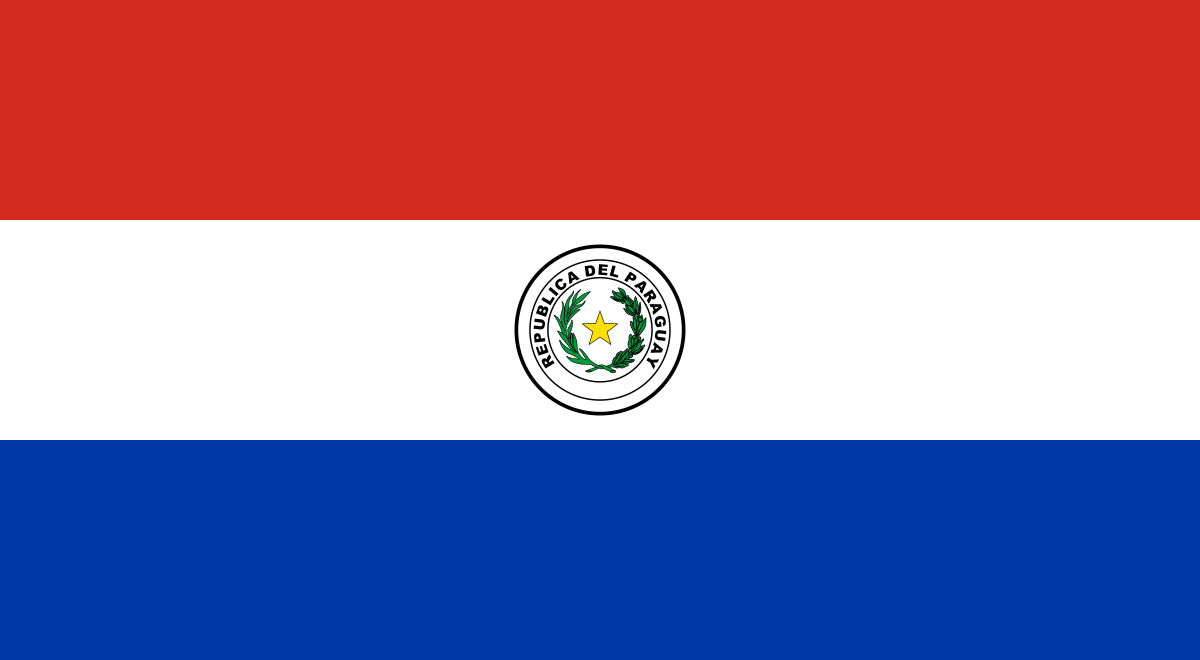
Paraguay
15 topics answered, 4 policies that cut across several of them, and 7 recorded exceptions that depend on where you are coming from.
- Region
- South America
- Currency
- PYG
- Language
- Spanish, Guarani
- Policies
- 4 active
- Last checked
- 2026-10-04
Where are you a citizen of?
Most rules on this page are the same for everyone. The ones that are not get marked for you.
Policy that cuts across topics
Affects 11 of the 15 topics on this page
Ley N° 6984/2022 replaced the migration law Paraguay had used since 1996, and it changed the single thing the country is best known for. Permanent residency is no longer something a newcomer can be granted on arrival: temporary residency, granted for up to two years, is now a prerequisite for it, and the only exemptions are investors under the SUACE business regime and the foreign family of a repatriated Paraguayan. The old law was repealed outright rather than amended, so guidance written before October 2022 describes procedures that no longer exist - including, on the revenue authority's own pages, the definition of who counts as a tax resident.
Affects 8 of the 15 topics on this page
Paraguay expresses migration fees and fines not in guaranies but in jornales - day-wage units tied to the legal minimum wage. A figure in guaranies is therefore only meaningful next to the jornal it was converted at and the date that conversion took effect. There is a second trap on top of it: the numbers written into article 100 of the migration law are not the numbers being charged. The law says permanent residency costs 15 jornales and temporary residency 10; the schedule in force since 1 July 2026 charges 25 for each.
Affects 7 of the 15 topics on this page
Paraguay's visa table answers two questions per country, and the second one decides whether the country is as easy as its reputation. Visiting is visa-free for most of Europe, the Americas, Japan, Australia and New Zealand. Extending that stay, applying for residency or carrying out any paid activity is a separate permission, and for most of those same nationalities the table says a visa is required. Four European countries - the Netherlands, Belgium, Switzerland and Liechtenstein - are exempt from both. Spain needs the visa but gets it free.
Affects 10 of the 15 topics on this page
Two different clocks, one of them made by the migration directorate rather than by the law. Permanent residency is lost after more than three years of unjustified absence, which is in the migration law itself. Temporary residency is cancelled after more than one year of absence without authorisation, which is not in the law at all: it comes from a 2026 directorate resolution that also sets up a procedure for asking permission to be away for longer. Cancellation is checked twice a year against the entry and exit register, and the directorate notifies the police, the Supreme Court and the revenue authority when it happens.
Topics
all 15 answered- Entering Paraguay as a Visitor
Paraguay admits visitors as an estadia transitoria for up to 90 consecutive days, extendable once and for no longer than the period already granted. The number is per admission and the law sets no annual pool, which makes Paraguay more forgiving than Peru or Colombia, where days accumulate inside a 365-day window. The catch is in the second column of the migration directorate's own visa table: for most nationalities the waiver covers the visit only, and extending the stay, applying for residency or taking up any paid activity requires a consular visa obtained before you travel. Overstaying is a fine, currently six jornales, rather than a ban.
Depends on your citizenship
1 recorded exception change this rule for some nationalities.
Verified with official sourceMonitor - can change - Living in Paraguay on Income You Do Not Earn Locally
Paraguay has no rentista visa, no investor-income category and no published income threshold. Since Ley 6984/2022 there is one route for almost everybody: temporary residency for up to two years, then a change of category to permanent. Temporary residency is granted on documents - identity, birth, civil status, police and Interpol certificates, two sworn declarations - and the migration directorate's own 2026 resolution states in terms that proof of economic solvency applies exclusively to permanent applications. When the money question does arrive, two years later, it is answered with evidence rather than an amount: a remote worker shows an employment certificate stating the income and how it is paid, a property owner shows a title registered at least two years earlier.
Depends on your citizenship
3 recorded exceptions change this rule for some nationalities.
Verified with official sourceMonitor - can change - Working in Paraguay as a Foreigner
There is no separate work visa. A foreigner who wants to work applies for the same temporary residency as everybody else, and may already work while the application is pending: the precarious residency card issued on filing expressly allows its holder to work and to study for ninety days. The law protects the job rather than licensing it - an authorised resident may not be discriminated against for being one, and the employer must notify the migration directorate and meet every labour obligation whatever the worker's status. Employment shows up again two years later as the easiest way to prove solvency for permanent residency, because a certificate of insurance with the social security institute is enough on its own.
Verified with official sourceMonitor - can change - When Paraguay Treats You as a Tax Resident
Paraguay does not decide individual tax residence by counting days. The regulation that defines the term says a natural person is resident for tax purposes if they hold permanent residency - a migration status, not a presence test - and it still does so by reference to Ley 978/1996, the migration law repealed by Ley 6984 in 2022. What follows from being resident is narrower than in most countries: personal income tax reaches Paraguayan-source income only, at 8, 9 or 10 per cent, and there is no charge at all on personal-service income below G 80,000,000 of gross receipts in the year. Non-residents are taxed at 15 per cent, withheld at source, on Paraguayan-source income.
Verified with official sourceMonitor - can change - Getting Healthcare in Paraguay
Two systems sit side by side and you reach them differently. The public network run by the health ministry is free by statute - consultations, procedures and the medicines on the national essential list - and the migration law forbids refusing care to any foreigner because their migration status is irregular. The contributory system run by the social security institute is reached through employment: the employer registers the worker, and for a foreign worker the institute asks for the migration card alongside the home-country identity document. Contributions are 9 per cent from the worker and 14 per cent from the employer, and family members are enrolled by the insured person rather than by themselves.
Verified with official sourceMonitor - can change - Mercosur Residency in Paraguay
Nationals of eight South American countries can use the Mercosur Residence Agreement, which Paraguay approved as Ley N° 3565/08, instead of the general route. It is a shorter list of documents - no consular visa, no Interpol certificate, no declaration of profession - and a lower fee. The trade-off is a deadline: the Mercosur temporary residency lasts two years and is expressly not renewable, and the application to convert it into permanent residency has to be filed in the ninety days before it expires, on pain of losing the right to continue under the Agreement at all. Economic solvency is tested at the permanent stage here exactly as it is on the general route.
Depends on your citizenship
2 recorded exceptions change this rule for some nationalities.
Verified with official sourceMonitor - can change - Retiring to Paraguay on a Pension
There is no pensionado visa. A pensioner applies for the same temporary residency as everyone else and, two years later, proves economic solvency as a jubilado o pensionado when converting to permanent residency. The evidence is one document - a certificate of the pension stating the amount received and the financial channel it is paid through, legalised or apostilled. No minimum is published, in the resolution or on the directorate's pages, and nothing requires the pension to be remitted to Paraguay.
Verified with official sourceMonitor - can change - Investor Residency and the One Shortcut in the Law
Investors are the only people the migration law exempts from serving two years of temporary residency first. Article 46 lets a foreigner who can demonstrate an investment in Paraguay under the SUACE one-stop business regime go straight to permanent residency, and the migration directorate runs a dedicated procedure for it. What the directorate does not publish is an amount: the document that opens the route is a certificate of investor status issued by the Viceministerio de Industria y Comercio, and the conditions for getting that certificate are set by that ministry rather than by the migration directorate. The law also lets an investor prove the investment with a bank deposit or an investment project approved by the competent bodies, but again without naming a sum.
Verified with official sourceMonitor - can change - Studying in Paraguay
There is no student visa either. A student takes the ordinary temporary residency and, at the permanent stage, proves solvency as a student - and the directorate says in bold that being a student is not by itself proof of solvency. Enrolment has to be shown for the whole two years of the temporary residency, by receipts for fees or school records, and on top of that the applicant must show either income of their own or documented support from a relative within defined degrees of kinship. Distance and online study count, including at an institution abroad, provided the certificate says so.
Verified with official sourceMonitor - can change - Moving to Paraguay with a Spouse
Marriage to a resident does not produce a residency of its own. A spouse applies for the same temporary residency as anyone else and, at the permanent stage, answers the solvency question as a dependant: the marriage certificate, legalised or apostilled, and a copy of the other spouse's Paraguayan identity card or residency card. The only marriage-based shortcut in the law is narrower than it first looks - it runs through a returning Paraguayan national, not through any Paraguayan spouse. Both spouses signing, and both holding or applying for residency at the same time, is also what the directorate asks when children are involved.
Verified with official sourceMonitor - can change - Paraguayan Family and What It Is Worth
Paraguay has no ancestry visa in the sense Italy or Spain mean it. What the migration law has is a route for the foreign family of a Paraguayan who emigrated and has come back: their spouse, children and grandchildren up to eighteen, and the spouse of their child, go directly to permanent residency with no temporary stage and no fee. The condition is the repatriation certificate, which means the route belongs to a returning emigrant rather than to any Paraguayan relative. Separately and more widely, the constitution treats children born abroad to a Paraguayan parent as Paraguayan by birth once they settle permanently in the country - a nationality question rather than a residency one.
Verified with official sourceMonitor - can change - Becoming Paraguayan by Naturalisation
The constitution asks for three years of settled residence, majority, the regular exercise of a profession, trade, science, art or industry in the country, and good conduct as defined by law. The Supreme Court, which grants the naturalisation letter, reads the three years as three years of permanent residency counted from the date of the decision granting it - not from arrival. Since permanent residency normally follows two years of temporary residency, the realistic minimum from first arriving is around five years. Naturalised Paraguayans lose the nationality after three years of unjustified absence declared by a court, and exercise citizenship, including the vote, only two years after obtaining it.
Verified with official sourceStable - Driving Licences for Foreign Residents
Driving licences in Paraguay are municipal, not national, so the answer depends on the municipality you live in - Asunción's rules are the ones set out here. A foreigner applies with a passport, a migration admission card, a certificate of life and residence, a blood group certificate and by passing the psychophysical, theory and practical tests; the applicant brings their own vehicle for the practical. A licence from your own country is asked for if you have one, and the municipality says the theory and practical tests are what you take if you do not. The only formal recognition arrangement we found is with Spain, under an agreement approved as Ley N° 3285/07, administered by the intermunicipal body OPACI rather than by any ministry.
Depends on your citizenship
1 recorded exception change this rule for some nationalities.
Verified with official sourceMonitor - can change - Bringing Your Belongings into Paraguay
Two separate regimes, and only one of them is fully published. The traveller's baggage regime exempts clothing and personal objects outright and gives a further allowance of US$ 500 arriving by air or river and US$ 300 at a land border; motor vehicles of every kind are excluded from it and can enter only under temporary admission, which requires proving residence in another country. The migration law separately gives admitted residents the right to bring in personal effects, family household goods and one family means of transport, with the import duties to be set by the customs authority - and we did not find those duties published.
Verified with official sourceMonitor - can change - The Only Account in This Set You May Open Before You Arrive
Paraguay's regulator permits a basic savings account to be opened on the sole presentation of an identity document, under the simplified due diligence regime, and says in terms that the whole procedure may be carried out remotely. No minimum to open, no minimum balance. That is the opposite of what the relocation guides say, which repeat that physical presence is compulsory and that no Paraguayan bank opens an account remotely; the reglamento permits what they call impossible. Two limits keep it honest. The account is in guaraníes only, and monthly credits are capped at whatever SEPRELAD sets for simplified due diligence - a figure the reglamento defers to rather than states, so we do not state it either. Above that ceiling you are sent to a conventional account and the full due diligence that goes with it.
Verified with official sourceMonitor - can change