
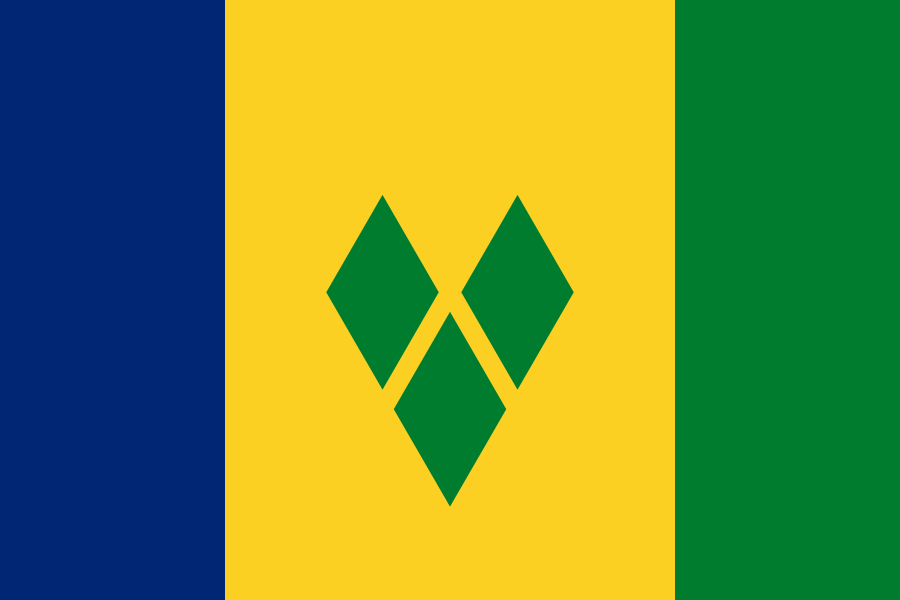
Saint Vincent and the Grenadines
15 topics answered, 3 policies that cut across several of them, and 14 recorded exceptions that depend on where you are coming from.
- Region
- Caribbean
- Currency
- XCD
- Language
- English
- Policies
- 3 active
- Last checked
- 2026-10-05
Where are you a citizen of?
Most rules on this page are the same for everyone. The ones that are not get marked for you.
Policy that cuts across topics
Affects 11 of the 15 topics on this page
Saint Vincent and the Grenadines publishes the fact of its laws and not their text. The Ministry of Legal Affairs puts every weekly Gazette online back to 2016, and each Gazette names the Acts and statutory rules and orders published that week - then says they can be purchased at the Government Printing Office at Campden Park. The House of Assembly publishes a table of every Act passed since 1993, with its long title, its short title, the dates of its readings, assent, publication and any proclamation, and its number. Neither publishes a section of an Act. The Immigration (Restriction) Act, the Immigration (Caribbean Community Skilled Nationals) Act, the Citizenship Act, the Employment of Foreign Nationals and Commonwealth Citizens Act and the Aliens (Land Holding Regulation) Act are all unreadable from outside the country, and every one of them governs something on this site.
Affects 2 of the 15 topics on this page
Saint Vincent and the Grenadines is the one independent member of the Organisation of Eastern Caribbean States that does not sell citizenship. That has been true throughout the period Parliament's own record covers: no Act establishing any such programme appears among the Acts passed between 1993 and 2025, and the Constitution's citizenship chapter has no economic or honourary limb. But on 2 December 2025, after a change of government, the Governor-General assigned the subjects of the Prime Minister's office and the list ends with "Citizenship by Investment Programmes". A subject of government now exists for something that has no statute.
Affects 3 of the 15 topics on this page
A non-national cannot simply buy land here. The Aliens (Land Holding Regulation) Act, Chapter 316, requires a licence, and the licence is not a registry formality: the Governor-General's assignment of portfolios lists "Alien's Landholding Licences" among the Prime Minister's own subjects, immediately after citizenship, residency and work permits. Parliament's record shows the Act amended in 1993, 1996, 2000 and most recently by Act No. 13 of 2022. None of those texts is published, so the fee, the conditions, any development obligation and any exemption for CARICOM or OECS nationals are all unknown.
Topics
all 15 answered- Entering Saint Vincent and the Grenadines as a Visitor
An entry permit is granted at the desk and how long it runs depends on where the passport is from: six months for CARICOM, British, Schengen and United States citizens, three months for everyone else. Citizens of the other Organisation of Eastern Caribbean States are not visitors at all - they are given indefinite stay - and since 1 October 2025 nationals of Barbados, Belize and Dominica are given it too. A short permit can be extended at EC$75 a month at the Immigration head office in Kingstown or at the ports in Bequia, Mustique, Canouan and Union Island. A visa is required in advance from citizens of ten named countries and from no one else, at EC$200. The Immigration (Restriction) Act, Chapter 114, is the statute behind all of it, and it is not published.
Depends on your citizenship
5 recorded exceptions change this rule for some nationalities.
Verified with official sourceMonitor - can change - Living in Saint Vincent and the Grenadines on Income from Elsewhere
There is no published residence category for someone living on income from abroad - no passive income visa, no rentier permit, no threshold. What there is, is a single undifferentiated permission: a non-national who wants to take up residence applies to the Prime Minister's Office, and residency sits in the Prime Minister's own portfolio. Nothing is published about what that application requires, what it costs, or how long it takes. The tax side, by contrast, is readable and favourable: a resident who is not ordinarily resident is charged on foreign income only as it is received here, and pensions are exempt to EC$20,000 a year.
Corroborated by multiple sourcesMonitor - can change - Retiring to Saint Vincent and the Grenadines
No retirement residence programme exists. There is no retiree visa, no minimum pension, no incentive scheme - the same single permission at the Prime Minister's Office applies to a retiree as to anyone else. Two things do exist and neither is an immigration route. Pension income is exempt from income tax up to EC$20,000 a year whether it was earned here or abroad, which is in the Act rather than in a scheme and therefore applies to any resident. And a Vincentian who has lived abroad for ten continuous years and is coming home to stay can bring household effects and tools of trade free of import duty, excise tax and VAT, and one vehicle per family at a 75% waiver.
Verified with official sourceStable - Working in Saint Vincent and the Grenadines
Employing a foreign national is regulated by an Act of 1973, the Employment of Foreign Nationals and Commonwealth Citizens Act, Chapter 208, amended in July 2025. Work permits are not handled by the Department of Labour: they sit in the Prime Minister's own portfolio, alongside citizenship, residency and alien's landholding licences, and applications for permission to reside and work are lodged at the Prime Minister's Office in the Financial Complex in Kingstown. Three groups do not need a permit: citizens of the other OECS Protocol states, holders of a CARICOM skills certificate, and since 1 October 2025 nationals of Barbados, Belize and Dominica. Every employee, whatever their nationality, must be registered with the National Insurance Services within seven days of starting.
Depends on your citizenship
5 recorded exceptions change this rule for some nationalities.
Verified with official sourceMonitor - can change - Investing Your Way into Saint Vincent and the Grenadines
Investment buys incentives here, not status. There is no investor residence permit and no citizenship by investment: the House of Assembly's record of every Act passed since 1993 contains neither. What a foreign investor does need is an alien's land holding licence, under the Aliens (Land Holding Regulation) Act, Chapter 316, amended four times since 1993 and most recently in October 2022. Like the work permit and the residence permission, the licence is decided in the Prime Minister's Office. The incentives are real and are described by the Government in prose rather than in a published schedule: income tax exemptions of ten to fifteen years by type and size of investment, with hotel developments above a hundred rooms singled out.
Corroborated by multiple sourcesMonitor - can change - Studying in Saint Vincent and the Grenadines
No student permit is published. A student from outside the region arrives on an ordinary entry permit - three months for most nationalities, six for CARICOM, British, Schengen and United States citizens - and extends it at EC$75 a month, or applies for the general residence permission at the Prime Minister's Office. The one thing that is clearly stated applies to children rather than to university students: a minor arriving with a national of Barbados, Belize or Dominica under full free movement registers with the Ministry of Education and may enter public primary or secondary education on the same basis as a Vincentian child.
Corroborated by multiple sourcesStable - Claiming Saint Vincent and the Grenadines Through a Parent
Through a parent, yes; through a grandparent, no. Section 92 of the Constitution makes a child born abroad a citizen at birth if a father or mother is a citizen otherwise than by descent, and those last words stop the chain at one generation: a parent who is themselves a citizen by descent cannot pass it on. There is no residence route for someone of Vincentian ancestry who falls outside that. A child under twenty-one who is the stepchild or adopted child of a citizen is entitled to be registered. Anything beyond the Constitution is in the Citizenship Act, Chapter 117, which was amended in September 2023 and is not published.
Verified with official sourceMonitor - can change - Marrying a Citizen of Saint Vincent and the Grenadines
The Constitution makes marriage to a citizen an entitlement to registration rather than an application a minister weighs, and it states no qualifying period at all: no two years of marriage, no residence, no interview appears in the text. It does it twice over, once for a wife in section 93(1)(a) and once for a husband in section 93(2)(a), a 1979 drafting shape that reaches the same result by two routes. A former spouse is covered too, provided the other person was a citizen at some time during the marriage. What the Constitution does not do is say how to apply: section 93(3) leaves the manner to be prescribed by or under an Act of Parliament, and that Act is Chapter 117, which is not published.
Verified with official sourceStable - Moving to Saint Vincent and the Grenadines Under CARICOM, the OECS or Full Free Movement
Three regimes overlap, and Saint Vincent is the only country in the records here that has legislated for all three - a claim that rests on an absence in Dominica's record, which Dominica's own record marks as possibly the publisher's gap rather than Parliament's. The CARICOM skills regime came first, as Act No. 4 of 1997, and still works by category: hold a recognised qualification, hold a skills certificate, enter. The OECS Economic Union came next: Act No. 22 of 2011 gave the Revised Treaty of Basseterre and its Protocol the force of law and was brought into operation by proclamation on 10 August 2011, so a citizen of another Protocol state is given indefinite stay at the desk. And since 1 October 2025 Saint Vincent has been one of four CARICOM states - with Barbados, Belize and Dominica - operating full free movement, which drops the skills condition entirely. No Dominican instrument for it appears in the published law collection; Saint Vincent's is on the record. Parliament passed two Acts and two statutory orders on 29 September 2025 and the Governor-General assented to them the next day, the day before the regime began.
Depends on your citizenship
3 recorded exceptions change this rule for some nationalities.
Verified with official sourceActively changing right now - Becoming a Citizen of Saint Vincent and the Grenadines
The Constitution does most of the work. Birth in the country makes a citizen; birth abroad to a Vincentian parent makes a citizen, but only for one generation. Marriage to a citizen is an entitlement to be registered rather than a discretion, and so is seven years of ordinary residence - but only for a Commonwealth citizen. For everyone else the Constitution says simply that Parliament shall provide, and what Parliament provided is the Citizenship Act, Chapter 117, which is not published. There is no citizenship by investment. The House of Assembly's own record of every Act passed since 1993 contains no such Act, and the Constitution's citizenship chapter has no economic or honourary limb anywhere in it. What there is, since December 2025, is a portfolio: the Governor-General's assignment of subjects to the new Prime Minister ends with the words "Citizenship by Investment Programmes".
Verified with official sourceActively changing right now - Tax Residency in Saint Vincent and the Grenadines
One hundred and eighty-three days in the basis period makes you resident, and so does keeping a permanent place of abode here and being physically present at all during the year. The two tests do not have the same consequence, and that is the part no guide carries. A resident is charged on income from all sources, in or out of the country - but a person who is resident without being ordinarily resident is charged on foreign income only to the extent it is received here. "Ordinarily resident" is defined by the permanent-abode limb alone, so someone who qualifies purely by counting days is on a remittance basis. Pensions, wherever earned, are exempt up to EC$20,000 a year. The rates printed in the Act are those of 1 January 2009 and three of them have since moved.
Verified with official sourceMonitor - can change - Opening a Bank Account in Saint Vincent and the Grenadines
The rules are the Anti-Money Laundering and Terrorist Financing Regulations of 2014, and they are more accommodating than the reputation of a small offshore jurisdiction suggests. Customer due diligence has to be applied before a business relationship is established - but regulation 11(4) lets a bank open an account first and verify afterwards, provided the account is not closed and no money moves until verification is done. Due diligence has to be repeated at least once every five years and whenever a customer's identification information changes, which includes a change of address: moving here is itself a trigger. A bank that cannot complete it must refuse the relationship, and one that fails to apply the measures commits an offence carrying a fine of $100,000.
Verified with official sourceStable - Healthcare in Saint Vincent and the Grenadines
The National Insurance Services is the contributory scheme, and it pays cash benefits - sickness, maternity, invalidity, age, funeral, survivors' and employment injury - rather than paying for treatment. Registration is compulsory for every employee within seven days of starting work and carries no nationality condition, so a foreign worker is inside it from the first week. What the system does not publish is any statement of what a non-national pays at a public hospital: the Ministry of Health's own site could not be read. The one group whose position is stated plainly is nationals of Barbados, Belize and Dominica, who since October 2025 have the right to emergency and primary health care on the same basis as a Vincentian.
Depends on your citizenship
1 recorded exception change this rule for some nationalities.
Corroborated by multiple sourcesMonitor - can change - Driving in Saint Vincent and the Grenadines
Driving licences are an Inland Revenue Department matter here, not a police or transport one. A visitor with a valid foreign licence buys a temporary driver's permit for EC$125, which runs six months from the date of issue - the same price as a one-year local permit, which is an oddity worth noticing. Requirements are light: the foreign licence and one form of identification. Since October 2025 a national of Barbados, Belize or Dominica coming here under full free movement is exempted from buying one altogether, provided they are over seventeen and a half, and lodges the home licence at the Traffic Department at Central Police Station in Kingstown for verification instead.
Verified with official sourceStable - Bringing Your Belongings to Saint Vincent and the Grenadines
For an ordinary arrival the allowance is small and old-fashioned: a quart of wine or spirits, half a pound of tobacco or fifty cigars or two hundred cigarettes, and a declaration for currency over EC$10,000. Beyond that, duty is payable. Two groups do better. A Vincentian coming home after ten continuous years abroad can import household and personal effects and tools of trade free of import duty, excise tax and VAT, plus one vehicle per family at a 75% waiver - but has to apply, be interviewed, finish within a year, and keep the vehicle four years. And since October 2025 a national of Barbados, Belize or Dominica exercising full free movement may import tools of trade, within six months of being granted indefinite stay.
Verified with official sourceStable