Where you can go as a visitor if your passport is from Liechtenstein
One question, every country, with your nationality already applied. In 7 of them something is written that changes the answer for you; in the other 66 the general rule is what you get, and that is the answer rather than a gap. Every line is that country’s own record.
Where it changes for you
7
Where it does not
66
Blocs you are in
2
Where your nationality changes the answer
EstoniaVerified with official sourceMonitor - can change2026-10-10
A Passport or an Identity Card, and Nothing to Register Until Three Months Have Passed
reaches you through Nationals of the Union and the wider Economic Area
The general rule it sits on
Who needs a visa is Regulation (EU) 2018/1806 and not Estonian law. What Estonia adds is a national restatement of the measure that most member states leave to the Union text: section 44(2) of the Välismaalaste seadus says in terms that a national released from the visa requirement may stay in the Schengen member states, Estonia included, for up to 90 days in any 180-day period. Section 43(1) then lists the eleven things that can make a short stay lawful, from an Estonian visa to another member state's residence permit. Two duties sit on other people rather than on the traveller, and they are lighter than Croatia's: an accommodation establishment must produce the visitor card when the Police and Border Guard Board or the Security Police asks for it, with no deadline running from your arrival, and anyone who gives a foreigner a dwelling or signs a lease with one must check that the stay is lawful. A health insurance contract covering treatment costs is required of a foreigner staying temporarily, and extending a short stay is refused as a rule: section 46(2) allows up to 90 more days only where a circumstance has arisen that the traveller did not know of before arriving.
FranceVerified with official sourceMonitor - can change2026-10-10
A Different Book of the Code Applies, and It Asks for Nothing for Three Months
reaches you through Nationals of the Union and the wider Economic Area
The general rule it sits on
Whether a short visit needs a visa is decided by Regulation (EU) 2018/1806 and not by French law: Annex I nationals need one, Annex II nationals do not, and the exemption runs for 90 days in any 180-day period. The CESEDA opens by saying it applies subject to Union law and to international conventions, and then builds its own layer on top. Article L. 311-1 lists what every foreigner must carry to enter: the visas required by the Schengen Borders Code where they are not exempt, proof of accommodation where it is asked for, documents on the purpose and conditions of the stay, means of subsistence, medical and hospital cover taken out with an approved insurer, and guarantees of repatriation. Article L. 312-1 measures a short stay in a different unit from the Union: it speaks of a stay not exceeding three months, where the Regulation counts ninety days across a rolling window. And the proof of accommodation is a French institution of its own - the attestation d'accueil, signed by the person putting you up, validated by the mayor of the commune, and carrying the host's undertaking to pay your costs in France for the validity of the visa or for three months.
IcelandVerified with official sourceMonitor - can change2026-10-11
Three Months on an Identity Card, Six If You Are Looking for Work, and Nordic Time Is Not Counted Against You
reaches you through Nationals of the Union and the wider Economic Area
The general rule it sits on
Iceland is not in the European Union, so Regulation (EU) 2018/1806 does not reach it as Union law. It reaches it as a development of the Schengen acquis under the 1999 association agreement between the Council of the European Union and Iceland and Norway, which recital 35 of the Regulation says in terms. On 12 May 2026 a new Act, logum vegabrefsaritanir nr. 37/2026, took the visa provisions out of the Aliens Act and put them in a statute of their own under the Minister for Foreign Affairs. Article 4 of that Act states the rule in eleven words - a foreigner needs a visa to come to the country, subject to article 8 - and article 8 exempts Nordic citizens, nationals of the other Schengen states, holders of a residence permit issued by a Schengen state, and family members of EEA, EFTA and Icelandic nationals who hold a valid residence card. The list of nationalities is in neither article: article 21 says the Act implements Regulation (EC) 810/2009 and Regulation (EC) 767/2008 and names no visa-list instrument at all, and article 8(4) leaves further exemptions to a ministerial regulation. For the length of a free stay the Aliens Act and the Visa Act disagree in form: the Visa Act defines a visa as up to 90 days in any 180-day period from first entry to the Schengen area, while section 49 of the Aliens Act says simply that other foreigners may not stay longer than 90 days from arrival, with time in any other Schengen state counted as time here.
JapanVerified with official sourceMonitor - can change2026-10-11
Nationals of Liechtenstein: an arrangement of six months, but ninety days at the border
written for your nationality by name
The general rule it sits on
Japan admits visitors under one of twenty-nine statuses of residence, the one for tourism being Temporary Visitor. The Immigration Control and Refugee Recognition Act requires a valid passport carrying a Japanese visa, and lifts that requirement for nationals of countries with which Japan has a visa exemption arrangement - 74 countries and regions, on the Foreign Ministry's own count. The permission granted at the border is ninety days, thirty days or fifteen days, and which of the three you get is set by the arrangement with your country rather than by anything you do at the counter. Paid work is not among the activities a Temporary Visitor may carry out.
MaltaVerified with official sourceStable2026-10-10
A Union Citizen Enters on an Identity Card - and Then Has One Month to Tell the Police Where They Are, Unless They Paid for the Bed
reaches you through Nationals of the Union and the wider Economic Area
The general rule it sits on
Whether a traveller needs a visa for Malta is settled by Regulation (EU) 2018/1806 and not by Maltese law: Annex I nationals need one, Annex II nationals do not for stays of no more than 90 days in any 180-day period. What Maltese law adds is a measure of its own that has never been brought into line. Regulation 11(1) of the Immigration Regulations permits a third-country national to enter "for a visit the duration of which shall not exceed three months", with a visa "as required by the Common Consular Instructions" - the Union instrument the Visa Code replaced in April 2010, named in a regulation still in force. Regulation 11(4) gives the visa-exempt traveller three months as well, and adds something the Union measure does not have: the Principal Immigration Officer may extend a visit beyond three months. The Immigration Act counts in months too. Under article 6(2) leave to land and remain is deemed to have been granted for three calendar months unless the officer specifies otherwise, and leave to land alone for twenty-four hours. Three calendar months is not 90 days in any 180-day period: one is a single block measured forward from arrival, the other is a rolling allowance measured backwards. Separately, the Act puts a register duty on whoever sells you a bed: article 31 applies to any premises where lodging or sleeping accommodation is provided for reward, and the keeper must record every guest who is not an exempt person.
MontenegroVerified with official sourceActively changing right nowlast checked 2026-10-11
An Identity Card Is Enough, For Thirty Days
reaches you through Nationals of the Union and the wider Economic Area
The general rule it sits on
Two instruments answer a visitor's question and they do different jobs. The Zakon o strancima sets the length: article 34 allows a stay of up to 90 days in any 180, counted from the day of first entry, either on a short-stay visa (viza C) or without a visa under the decree the Government makes under article 14(2), and a visitor who has used the 90 days may re-enter only once the 180-day period has run. The Uredba o viznom rezimu is the list. Its article 1 names the nationalities that may enter for up to 90 days without a visa on a travel document; article 2 lets nationals of the European Union member states and of thirteen other named states come for 30 days on an identity card alone; article 4 says everyone not named in articles 1, 1a, 2 and 3 needs a visa. What makes this topic unusual is the direction of travel. The decree has been amended eleven times since 2019 and the amendments of the last twelve months have been removals: Azerbaijan, Bahrain, Qatar, Kuwait and Turkey off the 90-day list, Vanuatu off it in 2025, Croatia, Bulgaria and Romania out of the holder-of-a-visa provision. The amendment published on 24 July 2026 went further and put a date on the rest. Saudi Arabia and Turkey keep a 30-day visa-free entry under article 1a only until 31 October 2026; the Chinese tour-group and business-passport arrangement in article 6 is limited to the same day; a new article 3a gives Belarus and the Russian Federation 30 days under bilateral travel treaties, also only until 31 October 2026; and a new article 12c says that from 31 October 2026 exemption from the visa requirement may not be regulated by separate acts of the Government at all, with seasonal exemptions ending on 1 October 2026.
NorwayVerified with official sourceMonitor - can change2026-10-11
You Are Not Visiting on Anyone's Visa Rules: Three Months on an Identity Card, and Six if You Are Looking for Work
reaches you through Nationals of the Union and the wider Economic Area
The general rule it sits on
Norway is not in the European Union, so Regulation (EU) 2018/1806 does not bind it as Union law. It reaches Norway twice over instead. The Regulation's own preamble says it is a development of the Schengen acquis within the meaning of the 1999 agreement associating Iceland and Norway with that acquis, and that agreement says acts building on the acquis are to be accepted, implemented and applied by Iceland and Norway. Norway then writes it into its own law: the Immigration Regulation exempts anyone whose nationality the Regulation exempts, with later amendments to it that apply to Norway, and reproduces the resulting list of visa-free states as an annex stated to be accurate at 14 August 2025. The free stay is 90 days in any 180-day period - but that number is in the regulation, not in the Act. The Immigration Act's own words, in the paragraph the regulation is made under, are still three months in any six months, the formula Schengen replaced in October 2013, and the same old wording stands in the section giving a right to a Schengen visa.
Where the general rule applies to you unchanged
Nothing is recorded in these that treats a citizen of Liechtenstein differently on this question, so what follows is what everyone gets.
Antigua and Barbuda, The Bahamas, Barbados, Belize, Dominica, Grenada, Jamaica, Montserrat, Saint Christopher and Nevis, Saint Lucia, St. Vincent and the Grenadines, Suriname, Trinidad and Tobago

 EstoniaVerified with official sourceMonitor - can change2026-10-10
 France
 Iceland
 Japan
Japan Malta
Malta Montenegro
 Norway
 Antigua and Barbuda
 Argentina
 Australia
 Austria
 Barbados
 Belgium
 Belize
 Bolivia
 Brazil
 Bulgaria
 Canada
 Chile
Chile Colombia
 Costa Rica
 Croatia
 Cuba
Cuba Cyprus
 Czechia
 Denmark
 Dominica
 Dominican Republic
 Ecuador
 El Salvador
 Finland
 Georgia
 Germany
 Greece
 Grenada
 Guatemala
 Guyana
 Haiti
Haiti Honduras
 Hungary
 Ireland
 Italy
Italy Jamaica
 Latvia
 Lithuania
 Luxembourg
 Mexico
 Netherlands
 New Zealand
 Nicaragua
 Panama
 Paraguay
 Peru
Peru Poland
 Portugal
 Romania
 Saint Kitts and Nevis
 Saint Lucia
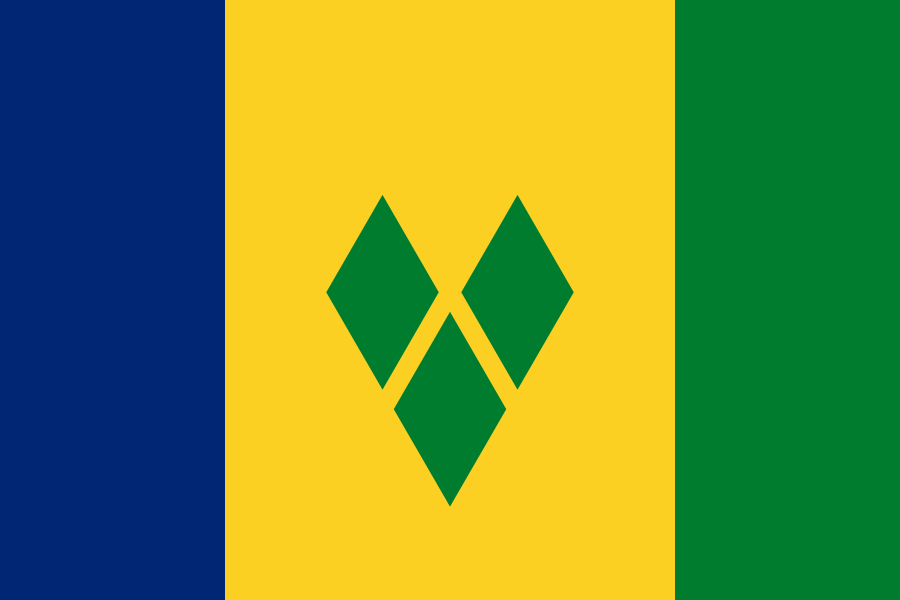 Saint Vincent and the Grenadines
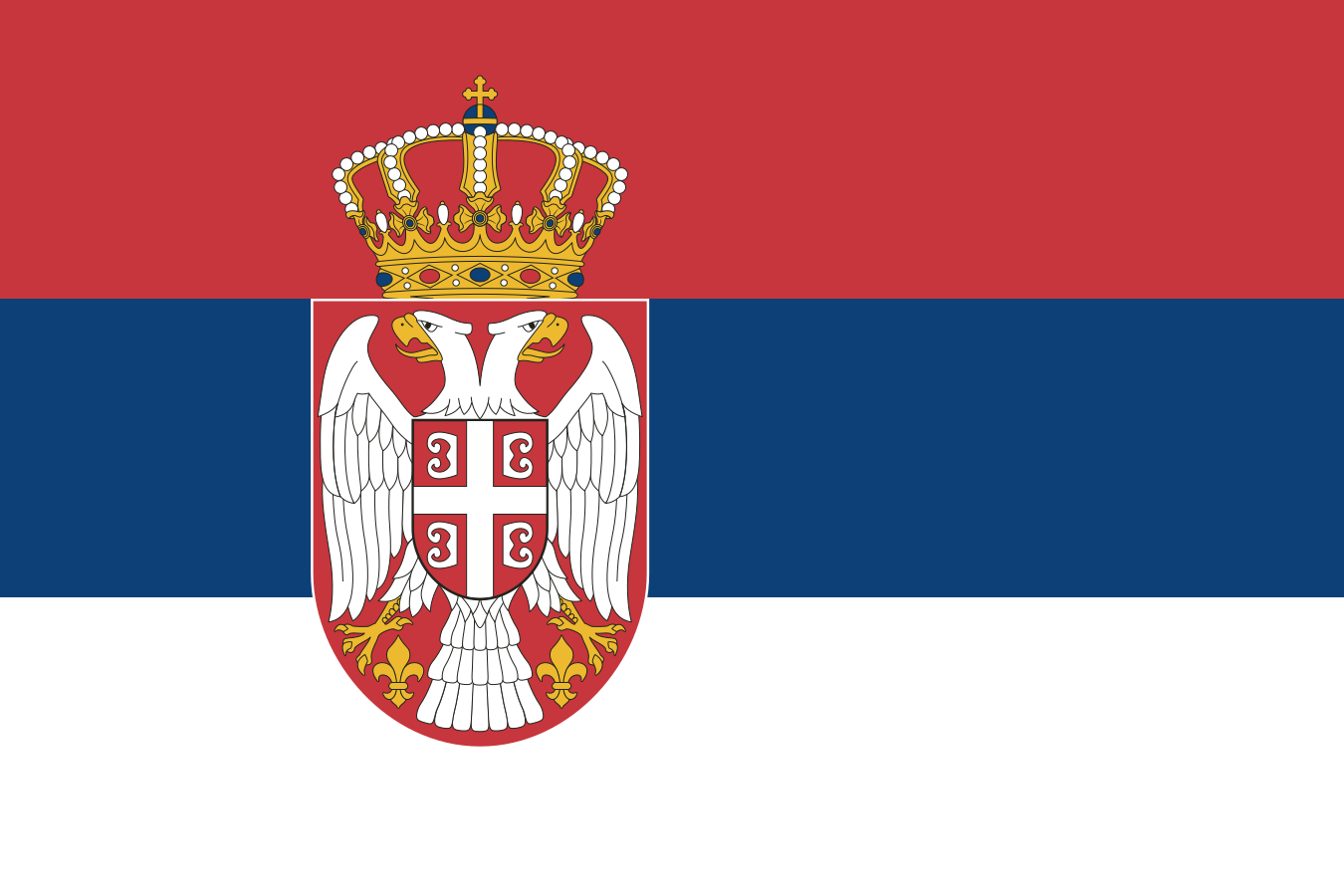 Serbia
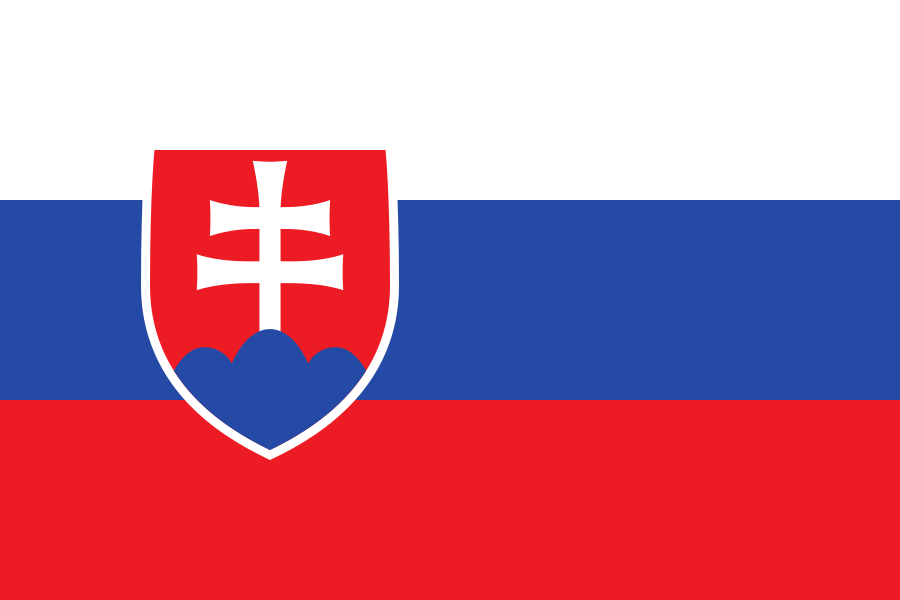 Slovakia
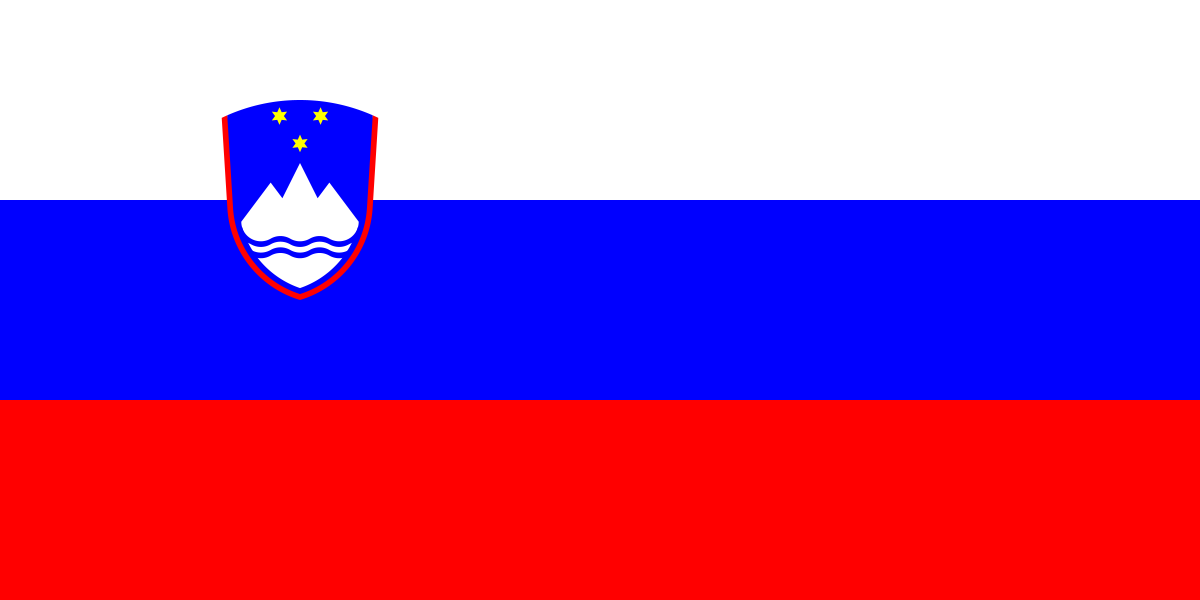 Slovenia
 South Korea
 Spain
Spain Suriname
 Sweden
 Switzerland
 The Bahamas
 Trinidad and Tobago
 United Kingdom
 United States
 Uruguay
 Venezuela