
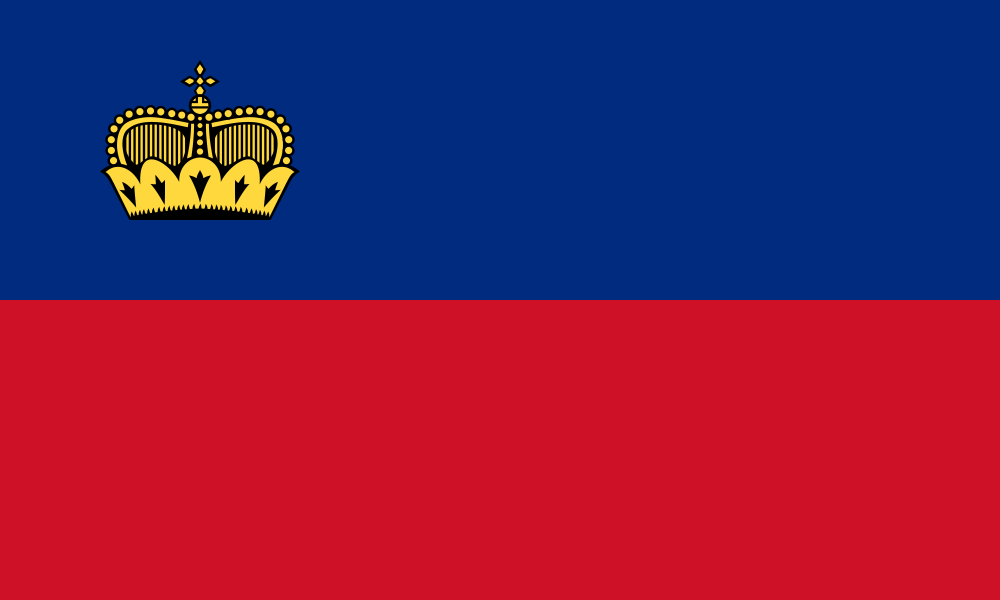
Liechtenstein
15 topics answered, 1 policy that cuts across several of them, and 2 recorded exceptions that depend on where you are coming from.
- Region
- Western Europe
- Currency
- Swiss franc (CHF)
- Language
- German
- Policies
- 1 active
- Last checked
- 2026-10-11
Where are you a citizen of?
Most rules on this page are the same for everyone. The ones that are not get marked for you.
Policy that cuts across topics
Affects 10 of the 15 topics on this page
Everything quoted in Liechtenstein’s records comes from Lilex, the consolidated law database of the government’s legal service at gesetze.li. Lilex says what it is: the consolidated provisions serve information only and have no legal effect. The authoritative text is elsewhere, and the Publication Act says exactly where - only the version of a provision published in the Landesgesetzblatt and electronically signed is massgebend, and for treaties and decisions of international organisations it is the texts designated authentic in them. That is a third answer to a question this corpus has now asked of three neighbours: Switzerland’s consolidations are themselves authoritative, Iceland’s gazette prevails over its code, and Liechtenstein separates the two the way Iceland does while publishing both at the same address.
Topics
all 15 answered- The One EEA State That Rations Free Movement, by Treaty and by Lottery
Liechtenstein is a full party to the EEA Agreement, and it is the only one of the thirty where a national of another member state has no right simply to move in. The sectoral adaptations to Annexes VIII and V of the Agreement say that nationals of the other EEA states may settle in Liechtenstein only with the authorities’ permission; they have a legal claim to that permission, but only within a yearly number. That number is set as a net increase of at least 1.75 per cent of the stock of permits held on 1 January 1998 for people in work, with a further 0.5 per cent of the same base for people who are not, and half of the increase must be handed out by a procedure that gives every applicant an equal chance. Liechtenstein runs that procedure as a two-stage draw. The derogation is not transitional and never expired: Protocol 15 ran out, the review it required concluded that Liechtenstein’s geographical situation justified keeping conditions, and Joint Committee Decision No 191/1999 wrote them into the Annexes, where they are now reviewed every five years rather than ending on a date.
Verified with official sourceMonitor - can change - Schengen by Accession to Switzerland’s Association, With a Three-Month Rule of Its Own
Liechtenstein is in neither the European Union nor Schengen as a member: it is in Schengen because it acceded, by a protocol of 28 February 2008, to the association agreement Switzerland had already made with the Union. The acquis was put into effect for Liechtenstein on 19 December 2011. A visitor therefore meets the Union’s visa list and the Schengen Borders Code at the border, and the ordinance made under the Aliens Act says so directly: entry conditions for a short stay are those of article 6 of the Borders Code, and the ordinance itself applies only so far as the Schengen acquis has no diverging provision. Alongside the Code’s ninety days in any 180, the Aliens Act keeps a national measure: within six months of first entry a permit-free stay may not exceed three months, and where a visa states a shorter period that period prevails. There is no visa-free residence either: any gainful activity needs a permit from the first day, whatever the nationality and however short the work.
Verified with official sourceStable - A Job Is Not Enough: Two Laws, a Quota and a Test of Whether You Could Commute
Working in Liechtenstein needs a permit from the first day, for everybody, however short the work. Which law decides is a question of nationality. An EEA or Swiss national applies under the Personenfreizügigkeitsgesetz and needs an employment contract of more than one year at an adequate level of employment, or the trade-law conditions for self-employment - and, in both cases, that commuting across the border is not reasonable. A third-country national applies under the Ausländergesetz, where the bar is higher in kind rather than in degree: the post must be in the economic interest of the country, the applicant must be a manager, a specialist or a qualified worker with a completed apprenticeship or long experience, a 50 or 80 per cent level of employment is required depending on the permit, no suitable worker may have been found on the permit-free labour market, and there must be a suitable dwelling. Both tracks run into a number: the government may cap residence permits for employment, and for EEA nationals half of the yearly increase is given out by lottery.
Depends on your citizenship
1 recorded exception change this rule for some nationalities.
Verified with official sourceMonitor - can change - Living On Your Own Money Is Possible for an EEA National, by Lottery; for Anyone Else, Only by Being of Special Interest
There is a route to residence without work, and for an EEA national it is a real one: means enough not to need social assistance, sickness insurance covering every risk, and that is the whole of the substantive test. What there is not is a way to be sure of getting it. The non-active share of the quota is 0.5 per cent of the 1998 base under the EEA Agreement, the Ausländer- und Passamt puts the number actually drawn at eight a year, and the draw is the route: applicants without work form their own group, and a person who wins in that group may not take any work in Liechtenstein at all, though work abroad is allowed. For a third-country national there is no income route of this shape. The Aliens Act allows a permit without work only to persons of special interest to the country, which the ordinance defines as foreign nationals of significant cultural, scientific or economic standing, and it requires the means to be guaranteed by a bank established in Liechtenstein.
Depends on your citizenship
1 recorded exception change this rule for some nationalities.
Verified with official sourceMonitor - can change - Family Reunification Is the Door the Quota Does Not Guard
A person who already holds a Liechtenstein residence permit may bring their family, and for an EEA or Swiss national the free-movement act says they may do so "at any time" - there is no draw, no waiting list and no quota in the family chapter. The family member who arrives this way may work. Under the aliens act the family route is narrower and slower: it covers only the spouse or registered partner and common unmarried children under eighteen, the sponsor must show a stable job or means guaranteed by a bank established in Liechtenstein and a dwelling with room for everyone, the spouse living abroad must have basic German, and the application has to be made within three years of the permit or of the marriage. A sponsor who themselves came by family reunification must wait four years before bringing anyone.
Verified with official sourceStable - A Permit for One Semester at a Time, and It Ends With the Course
A student is not given a residence permit in Liechtenstein. Under the free-movement act an EEA or Swiss national studying here gets a short-stay permit for a semester or an academic year, renewable, on three conditions: the institution confirms they may begin or continue, there is money enough that no social assistance is drawn, and there is sickness insurance covering every risk. Study must be the main purpose of the stay, the permit stops being granted once the normal length of the course is clearly exceeded without objective reason, and it lapses the moment the course is abandoned or finished - at which point the student has to leave. A third-country national applies instead under the aliens act, where the same conditions appear with four more: the language skills the teaching requires, a suitable dwelling, no convictions, and a departure that appears assured.
Verified with official sourceStable - Pensioners Are a Category in the Lottery, Not a Route of Their Own
Liechtenstein has no retirement visa. A pensioner from an EEA state applies on exactly the terms anyone without work applies on - means enough not to need social assistance and sickness insurance covering every risk - and the ordinance then names them explicitly as part of the group drawn in the lottery for people not in gainful activity. That group shares the 0.5 per cent quota the EEA Agreement provides for the non-active, and the agency puts the number drawn at eight a year. What does exist, and is worth separating from the route in, is a right to stay on: an EEA national who reaches pension age while employed in Liechtenstein, having worked there the last twelve months and lived there three years, is entitled to a permanent residence permit before the usual five years are up. A third-country pensioner has no corresponding route at all, only the special-interest permit of article 20 of the aliens act.
Verified with official sourceMonitor - can change - Six Months Makes You Resident, and the Wealth Tax Arrives as Income
A natural person is taxable in Liechtenstein on their whole wealth and whole earnings if they have their domicile or habitual abode in the country. Domicile is where a person stays with the intention of remaining; habitual abode is where they stay other than temporarily, and the Act fixes it: a continuous stay of more than six months always counts as habitual abode, and counts from the beginning, with short interruptions disregarded. Attending an educational institution, being in a care or health establishment, and a cure or holiday stay of up to twelve months create neither. The structure of the tax is unusual. There is no separate wealth tax bill: wealth is converted into a deemed return - fixed in the Act at 4 per cent - and taxed as earnings. The national tariff runs from zero below a basic allowance to 8 per cent, and every municipality adds a surcharge set each year by its council, which may not be below 150 or above 250 per cent of the national tax. And the Act offers taxation on expenditure to a newcomer without Liechtenstein citizenship who does no gainful work here and lives on their wealth or on income from abroad.
Verified with official sourceMonitor - can change - Insurance Is Compulsory for Residence or for Work, and the Patient Pays the First CHF 500
Health insurance in Liechtenstein is compulsory, and the trigger is either of two things: having one’s civil-law domicile in the country, or pursuing a gainful activity there. The second limb matters because of who it catches - a cross-border worker who lives in Austria or Switzerland and works in Liechtenstein is inside the compulsory scheme for medical care. Cover is bought from a recognised sickness fund rather than from the state, and the Amt für Gesundheit supervises registration and will assign a person to a fund where necessary. The insured person pays a share of the cost: a fixed CHF 500 a year plus 20 per cent of the costs above it. Nobody under twenty pays anything. A person who has reached ordinary pension age pays no fixed amount - the state covers it - and their coinsurance is halved to 10 per cent. Residence law comes at it from the other side: every permit route in both the free-movement act and the aliens act requires proof of insurance covering all risks in Liechtenstein before the permit is granted.
Verified with official sourceMonitor - can change - Thirty Years, or Ten With a Municipality’s Consent - and You Give Up What You Have
Liechtenstein naturalisation runs on two tracks and both are long. In the facilitated procedure a foreign national has a right to be admitted after thirty years of ordinary residence, with years before the age of twenty counted double, provided the last five years were continuous. A spouse of a Liechtenstein citizen has the same right after ten years of residence, with years after the marriage counted double, and at least five years of a subsisting marriage. In the ordinary procedure the requirement is ten years of ordinary residence plus something no amount of waiting supplies: proof that a Liechtenstein municipality has assured admission to its Heimatverband. Across both tracks three conditions recur - German, a civics test, and a declaration renouncing the existing nationality, or proof that renunciation would be ineffective under the law of the home state. A residence permit kept under a Beibehalt while living abroad does not count towards any of the periods.
Verified with official sourceStable - Your Belongings Clear Swiss Customs, Because the Border Is Swiss
Liechtenstein has no customs law of its own on this subject. The Customs Treaty of 29 March 1923 attached the territory of the Principality to the Swiss customs area and made it a part of it, and article 4 applies the whole of Swiss customs legislation in Liechtenstein in the same way as in Switzerland. Which Swiss instruments those are is published in Liechtenstein, in a notice of the government listing them by their Swiss SR numbers: the current one is of 15 September 2026 and it names the Zollgesetz of 2005 and the Zollverordnung of 2006 as applicable. So the rule on household removal goods is the Swiss one, and it is generous and specific: removal goods of a person taking up residence are duty-free, provided the things were used abroad by that person for at least six months for private life or for a trade or profession and are intended for their own continued use, and provided they are imported in temporal connection with the change of residence, with anything to follow declared at the first import.
Verified with official sourceMonitor - can change - An EEA Licence Needs Only Registering; Everyone Else Drives a Control Drive
Liechtenstein’s traffic ordinance is built on the Swiss one and reaches a different answer on the question that matters most to a newcomer. The general rule is the familiar one: a driver from abroad needs a Liechtenstein licence once they have lived in Liechtenstein for twelve months without being continuously abroad for more than three months of that time. But the next paragraph takes holders of a licence issued by an EEA member state out of that rule entirely - they keep driving on it, and all they must do is hand a copy to the Ausländer- und Passamt or the Amt für Strassenverkehr for registration when they register their arrival. Anyone who does want a Liechtenstein licence, or who must have one, exchanges it by passing a control drive proving they know the traffic rules and can drive safely; the control drive cannot be repeated, and failing it means the foreign licence is withdrawn as well. Holders of an EEA or Swiss licence exchange without any test at all.
Verified with official sourceStable - A Statutory Right to a Basic Account, for Anyone Lawfully in the EEA
Liechtenstein gives consumers a right to a bank account, and the right is broader than residence: a consumer lawfully resident anywhere in the European Economic Area may open and use a basic account at a bank in Liechtenstein, irrespective of where they live, provided they can show a genuine interest in it. The right extends to a consumer with no fixed address, to refugees and asylum seekers, and to a person with no right of residence who cannot be removed. A bank may refuse only on one of six listed grounds - no genuine interest, an existing account at a Liechtenstein bank, a criminal case or conviction against the bank or its people, a conflict with due-diligence, sanctions or market-abuse legislation, a framework contract the bank lawfully terminated within the past year, or a refusal to sign the declaration about existing accounts - and must give written reasons and tell the applicant how to challenge the refusal. The account must be opened within ten business days.
Verified with official sourceStable - No Investor Route, and Property Is Not the Way In Either
Neither of Liechtenstein’s two residence statutes has an investment category. The free-movement act lists five kinds of permit and grants them for employment, self-employment, study, tourism, family or residence without work; the aliens act admits a third-country national for employment, education, family reunification, cross-border work or because they are of special interest to the country, and nothing in either turns on a sum of money brought in. The nearest thing is the special-interest permit, and the ordinance defines special interest as significant cultural, scientific or economic standing rather than as capital. Buying property is not an alternative route: every acquisition of land needs approval, approval needs a legitimate interest, and the clearest legitimate interest - covering an existing domestic housing need - requires the buyer to be domiciled in the country, which for the purposes of that Act a foreign national is not until their authorised residence has lasted ten uninterrupted years.
Verified with official sourceStable - Descent Gives Citizenship at Birth and Nothing Afterwards
Liechtenstein has no residence route based on having a Liechtenstein ancestor. Descent operates once, at birth: a child has national citizenship by birth where the father or the mother is a Liechtenstein citizen, and an adopted child under ten acquires it on adoption by a Liechtenstein parent. After that the citizenship law offers nothing to a descendant, and neither residence statute has an ancestry category - the free-movement act grants its five permits for work, self-employment, study, tourism, family or residence without work, and the aliens act admits a third-country national for employment, education, family reunification, cross-border work or special interest. The route that does exist for a relative is family reunification, and it depends on a relative who lives in Liechtenstein now rather than on one who did.
Verified with official sourceStable