One question, 33answers, each one the country’s own record. The labels below are the ones its own instruments use rather than a vocabulary we imposed on them: where one country’s law has no equivalent of another’s test, the row is simply absent, because an empty cell would invent a comparison nobody made. Every line opens onto the law it rests on.
There is no residence permit by descent, and the citizenship that descent gives runs exactly one generation. Section 113(b) of the Constitution makes a person born outside Antigua and Barbuda a citizen at birth if, at the date of their birth, either parent is a citizen by virtue of section 112 or by virtue of being born here. A grandparent only counts once, under section 112(b), which was a commencement provision: it made a citizen on 1 November 1981 of a person born outside Antigua if any one of their grandparents was born there. That door closed on the day it opened. A person born abroad to a parent who was themselves born abroad is not a citizen, and the route left to them is ordinary registration or naturalisation on the residence periods everyone else serves.
Generations of descent
One
Grandparent route
Spent on 1 November 1981
Residence route by ancestry
None in the Immigration and Passport Act 2014
Registration for a Commonwealth citizen
7 years of lawful ordinary residence plus domicile
Dual citizenship
Protected at constitutional level
ArgentinaSouth AmericaVerified with official sourceMonitor - can change2026-09-27
Argentine ancestry reaches exactly one generation. A person born abroad to an Argentine parent is recognised as a permanent resident - recognised, not granted it after a waiting period - and the parent may be Argentine by birth, by naturalisation or by option. Past that the trail goes cold: the migration law does not use the words grandchild, grandparent, ancestor or descendant anywhere, so a grandparent from Salta is not a claim on Argentina the way one from Palermo is a claim on Italy. Descent also opens a second and quite separate door, to Argentine nationality itself, and that one is narrower still: it asks that the Argentine parent be Argentine by birth.
How far ancestry reaches
One generation - a parent, and no further
What it gets you
Permanent residence
Qualifying parent
Argentine by birth, by naturalisation or by option
Grandchildren of Argentines
No route
Nationality by descent
Only where the Argentine parent is Argentine by birth
Government fee
50 UMSM Mercosur, 100 UMSM extra-Mercosuras of 2026-09-27
What ends it
1 year of continuous absenceas of 2026-09-27
Legal basis
Ley 25.871 art. 22, as substituted by Decreto 366/2025 art. 5
Different by nationality:Italy · Spain (closed)Read them
BarbadosCaribbeanVerified with official sourceStable2026-10-05
Barbadian descent runs one generation and no further, and it runs in an asymmetric way. Under the Constitution a person born outside Barbados is a citizen at birth if their father was a citizen otherwise than by descent, and - by an amendment of 2000 - if at least one parent was a citizen who was born in Barbados. A grandchild of a Barbadian is not a citizen by descent on either limb. The Immigration Act runs the relationship the other way: a person who is the parent or grandparent of a citizen residing in Barbados, and for whom that citizen is willing and able to provide, may be granted immigrant status. So a Barbadian can bring a parent or a grandparent, but a Barbadian's grandchild abroad has no claim. Those are two different rules pointing in opposite directions, and they are often described as one.
Generations reached by descent
One. A parent, not a grandparent
Condition on the parent
Under the 2000 limb, the parent must be a citizen who was born in Barbados
Ascending route in the Immigration Act
Parent or grandparent of a citizen residing in Barbados may be granted immigrant status
Fee for a descent application, as the Department charges
$300.00 on application, $1500.00 on approval
BelizeCentral AmericaVerified with official sourceStable2026-10-05
Belize has no residence category based on ancestry. What it has is citizenship by descent, and the reach of that depends on which generation you are counting and when you were born. A parent works at any date: anyone born outside Belize on or after Independence Day is a citizen by descent if their father or mother was a citizen at the time of their birth. A grandparent works only for a closed cohort - people born outside Belize before 21 September 1981, whose grandparent became a citizen on Independence Day. If you were born on or after that date, the grandparent does nothing for you. Great-grandparents never did.
Residence category based on descent
None
Citizenship by descent through a parent
Available, with no cut-off date
Citizenship by descent through a grandparent
Only if you were born outside Belize before 21 September 1981
Generations beyond a grandparent
Not reached
Citizenship by descent is automatic
No - it must be claimed and certified by the Minister
BoliviaSouth AmericaVerified with official sourceStable2026-09-27
Bolivia has no ancestry visa, and for the closest relatives it does not need one: a child born abroad to a Bolivian mother or father is Bolivian, and the step is registration rather than application. Beyond that, descent gives nothing of its own. A grandchild of Bolivians is a foreigner like any other, and the route that fits is the family ground, which reaches blood relatives of a Bolivian living in Bolivia - a sibling or a child, not an ancestor several generations back.
Ancestry visa
None
Child of a Bolivian parent
Bolivian - registered, not naturalised
Where registration is done
The civil registry service, or a Bolivian consulate up to age 18
Grandchild of Bolivians
No entitlement of its own
Blood relatives the family ground names
Brother, sister, son, daughter - and for a foreign resident also father and mother
BrazilSouth AmericaVerified with official sourceStable2026-09-27
Brazil has no ancestry visa in the sense Italy or Spain use the phrase. What it has instead is a family-reunion ground that reaches two degrees in both directions: a parent or grandparent of a Brazilian, and a child or grandchild of a Brazilian, can be granted residence on that relationship alone. Where the Brazilian relative is a citizen the residence is granted for an indefinite term. A person born abroad to a Brazilian parent does not need this at all - the Constitution makes them Brazilian by birth once they are registered at a Brazilian consulate, or once they come to live in Brazil and opt for the nationality after reaching majority.
Ascendants covered
Up to the second degree
Descendants covered
Up to the second degree
Siblings
Covered, with economic dependence required above eighteen
Term where the relative holds indefinite residence
Indefinite
Work
Any activity, including paid work, on equal terms with Brazilians
Great-grandparents
Not covered
ChileSouth AmericaVerified with official sourceStable2026-09-27
Chile has no residence permit based on having a Chilean parent, grandparent or great-grandparent. The migration law lists thirteen situations the subcategory decree must cover and the decree lists sixteen subcategories; descent appears in neither. Where Chilean ancestry does count is one step further on, in nationality: a relative of a Chilean by blood to the second degree - which reaches grandparents and grandchildren - can apply for naturalisation after two years as a permanent resident instead of five. The ancestry itself buys no entry; it shortens the wait once you are already settled.
Residence permit based on descent
None in the migration law or the subcategory decree
Where ancestry does count
Naturalisation, after permanent residency has been obtained
How far the naturalisation tie reaches
Blood relatives of a Chilean to the second degree inclusive, and those adopted by Chileans
Effect of that tie
2 years of continuous residence, against the ordinary rule
The reverse case
The foreign parent of a Chilean does have a residence route - family reunification
Ascendants of someone who reaches permanent residency
May be granted permanent residency themselves if in that person's care or support
ColombiaSouth AmericaVerified with official sourceStable2026-09-21
A child of a Colombian parent born abroad is a Colombian national by birth - but not automatically. The constitution attaches a condition: you must either take up domicile in Colombia or register at a Colombian consulate. Do one of those and the question of residency disappears entirely, because you are not a foreigner. Colombia also does not take nationality away for acquiring another one.
Who qualifies
Children of a Colombian father or mother, born abroad
The condition
Domicile in Colombia, or consular registration
Generational limit
None stated in article 96
Dual nationality
Permitted
Who decides
Registraduría Nacional del Estado Civil
Costa RicaCentral AmericaVerified with official sourceStable2026-10-04
Costa Rica has no ancestry visa. Nothing in the migration law's list of temporary-residency subcategories, and nothing in its special categories, is opened by having a Costa Rican grandparent or great-grandparent. What exists is narrower and wider at once. Narrower: permanent residency for a foreigner with a first-degree blood tie to a Costa Rican, which the law defines as parents, minor children or adult children with a disability, and minor siblings or siblings with a disability - no grandchildren, and no adult child without a disability. Wider: the Constitution treats a child born abroad to a Costa Rican mother or father by birth as Costa Rican by birth, provided they are registered, which is a claim on nationality rather than on residence.
Residency route based on descent
None
Nearest route
Permanent residency for a first-degree blood relative of a Costa Rican
Who that covers
Parents, minor children or adult children with a disability, minor siblings or siblings with a disability
Grandchildren of a Costa Rican
Not covered by any residency category we found
Child born abroad to a Costa Rican parent by birth
Costa Rican by birth on registration, claimable by the child up to 25
CubaCaribbeanVerified with official sourceActively changing right nowlast checked 2026-10-06
Cuba has no residence category for the descendant of a Cuban, and it does not need one: descent is dealt with as citizenship rather than as immigration. A person born abroad is a Cuban citizen by birth if their birth is registered in the Cuban Civil Registry and they are the child of Cuban parents born in Cuba, or the grandchild of a Cuban born in Cuba where the parent is a Cuban by birth born abroad. That reaches two generations, which is further than most of the region's residence-by-descent routes reach. The residence side runs in the opposite direction: the only family-line ground for permanent residence is being the parent of a Cuban by birth, not the child or grandchild of one.
Residence route by descent
None
Citizenship by descent
Child of Cuban parents born in Cuba
Grandchild
Qualifies for citizenship, if the parent is a Cuban by birth born abroad
Great-grandchild
Not provided for
Precondition
Birth registered in the Cuban Civil Registry
Parent of a Cuban by birth
May apply for permanent residence
Adult child of a Cuban
No residence ground of their own
DominicaCaribbeanVerified with official sourceMonitor - can change2026-10-05
Descent reaches citizenship here, not residence - and for the generation after that, it reaches citizenship only while the child is under eighteen. There is no ancestry visa and no grandparent rule we could find. The Constitution makes every person born in Dominica a citizen, subject to two narrow exceptions, so a parent born on the island passes something on; but the provision that says what, section 99 of the Constitution, is missing from the stored reading of the published text and we do not state its terms. What we can state is the route for a minor: section 100(1)(c) of the Constitution entitles a child under eighteen who is the child, stepchild or adopted child of a Dominican citizen by birth to be registered, and section 6(b) of the Citizenship Act gives the Minister a parallel power where the constitutional entitlement does not apply, on three years' residence.
Ancestry residence route
None
Born in Dominica
Citizen at birth
Child under 18 of a citizen by birth
Entitled to be registered
Child under 18 not entitled under the Constitution
3 years' residence, at the Minister's discretion
Adult child or grandchild of a citizen
No route identified
Citizenship by descent
Not stated here
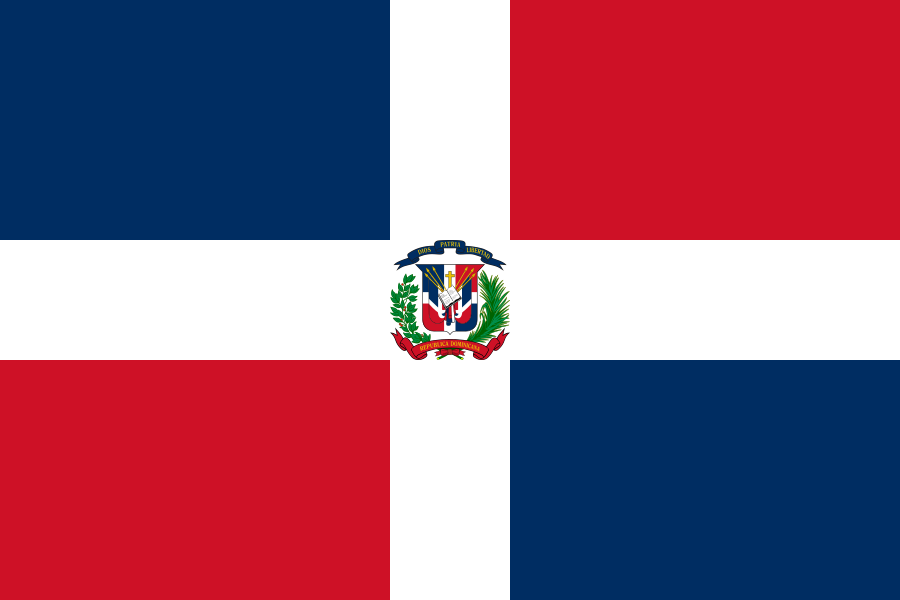
Dominican RepublicCaribbeanVerified with official sourceStable2026-10-06
There is no Dominican residence category for someone with a Dominican parent or grandparent, and the reason is that the Constitution hands that person nationality rather than a permit. A child of a Dominican mother or father is Dominican, wherever born. So is a direct descendant of a Dominican living abroad - a clause with no stated generational limit, which on its face reaches a grandchild. Anyone in either position does not need residence; anyone outside them has no ancestry route at all, because the permanent-resident list has four entries and the temporary-resident list has nine, the regulation says in terms that the temporary list is closed, and none of the thirteen is descent. The nearest thing is the family limb, which reaches the spouse and the minor or unmarried children of a Dominican and stops there.
Residence category by descent
None
Nationality by a Dominican parent
Automatic
Born abroad to a Dominican parent
Dominican, with a choice at 18
Direct descendants of Dominicans abroad
Dominican
Permanent-resident categories
4CALC (calculated by us, not published)
Temporary-resident subcategories
9
Family limb reaches
Spouse, minor or unmarried children
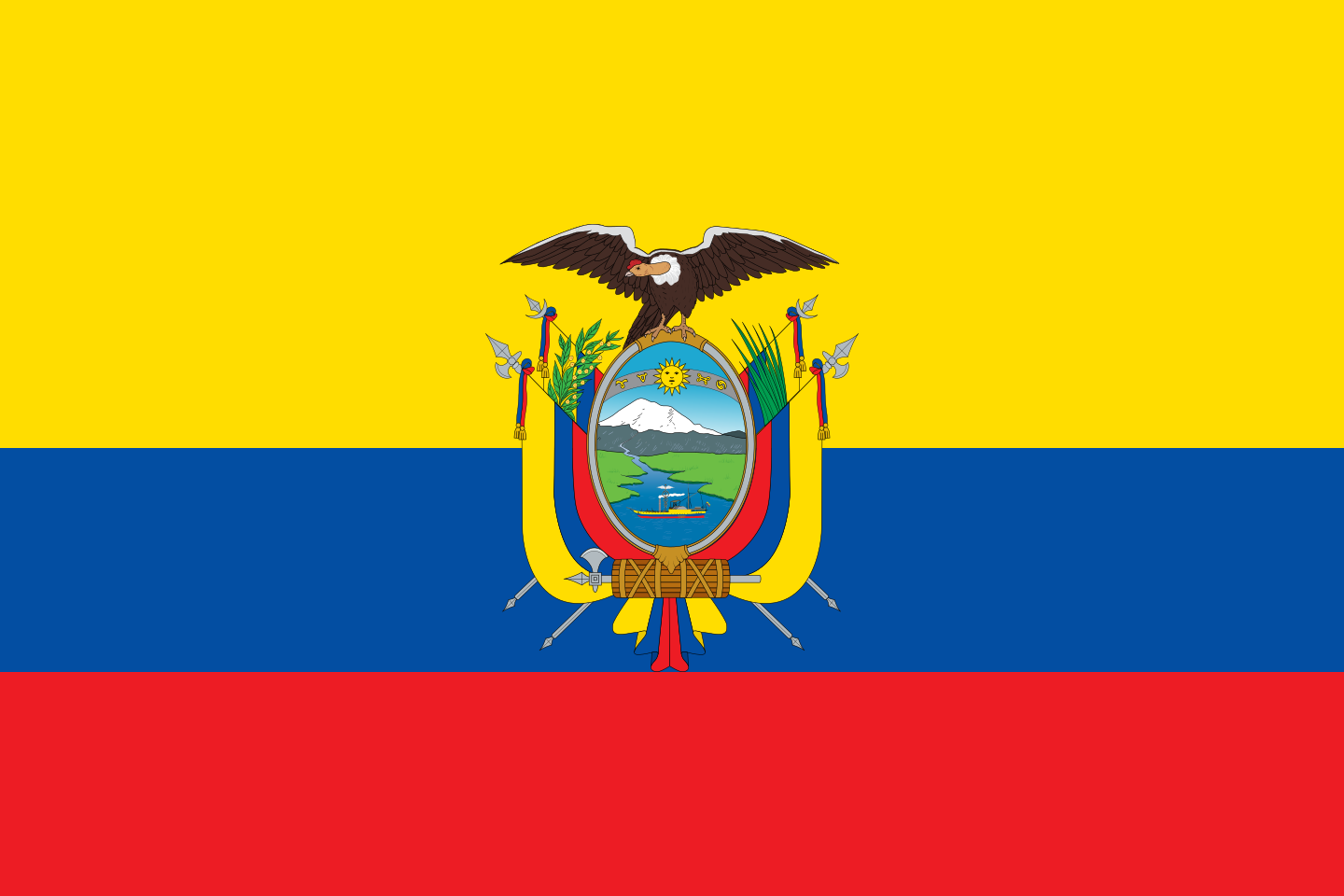
EcuadorSouth AmericaVerified with official sourceStable2026-09-21
Ecuador has no ancestry visa in the European sense, but it has something that does much of the same work and is faster: a relative up to the second degree of consanguinity or affinity of an Ecuadorian citizen goes straight to permanent residence, with no waiting period and no temporary stage. Second degree reaches parents, children, grandparents, grandchildren and siblings, and by affinity the equivalents through a spouse. What is asked for is documentary proof of the relationship; the Ecuadorian relative shows lawful means and, for adult dependants beyond the first degree, USD 250 of extra monthly income each.
Status granted
Permanent residence, directly
Waiting period
None - there is no temporary stage to serve first
Degree of kinship
Up to the second degree of consanguinity or affinity
Who the relative can be
An Ecuadorian citizen, or a foreigner with permanent residence in Ecuador
Extra income per dependant
USD 250 a month, beyond the first degree
Chaining
Not allowed - a person admitted this way cannot in turn sponsor their own relatives
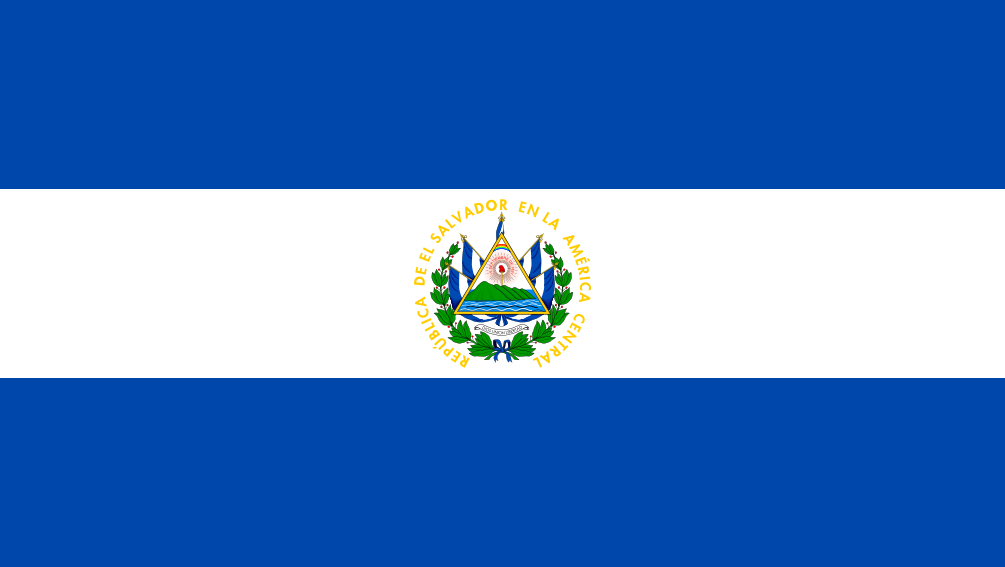
El SalvadorCentral AmericaVerified with official sourceStable2026-10-04
El Salvador has no residence category based on descent from a Salvadoran, and reading the two closed lists in the migration law is what shows it: twenty-three grounds for temporary residence in article 109, thirteen for permanent residence in article 152, and none of them is descent. The reason is that the Constitution already puts descent one level higher. Anyone born abroad to a Salvadoran father or mother is Salvadoran by birth - not eligible to become Salvadoran, but Salvadoran - and the migration law gives them a right of entry as a national on documentary proof of the parent's nationality and of the filiation, even where the birth was never registered in the country. So the question a would-be applicant should be asking is not which visa a Salvadoran parent unlocks but how to register a birth. The line stops at one generation in the constitutional text: article 90 reaches the child of a Salvadoran and says nothing about a grandchild.
Route by descent
None
Temporary residence grounds in the law
23
Permanent residence grounds in the law
13
Child of a Salvadoran born abroad
Salvadoran by birth
Grandchild
Not reached by the constitutional text
Dual nationality for Salvadorans by birth
A constitutional right
Reacquiring the nationality
Permanent residence while it is pending
GrenadaCaribbeanVerified with official sourceMonitor - can change2026-10-05
Grenada is one of the few countries in this comparison to have written a grandparent route into statute, and it did so recently and deliberately. The Constitution already gave citizenship at birth to anyone born outside Grenada with a Grenadian father or mother, and stopped there - a descent citizen cannot pass descent on. In 2016 Parliament filled the next generation in: section 5A of the Citizenship Act lets a person born abroad to parents who were never Grenadian citizens be registered if they have a grandparent who is or was a citizen. It is registration at the Minister's discretion rather than an entitlement, it carries an oath and a condition about service to the State, and it has one unusual consequence - the spouse of such a citizen does not get the ordinary marriage route.
Citizenship by descent from a parent
Automatic at birth
Generations the descent rule reaches
One
Grandparent route
Registration at the Minister's discretion
Parents' status for the grandparent route
Must never have been Grenadian citizens
Great-grandparent route
None
Spouse of a person registered under the grandparent route
Not entitled to register through the marriage
Deprivation
Available, unlike for citizens by birth or descent
GuatemalaCentral AmericaVerified with official sourceStable2026-10-04
Guatemala has no residence category built on an ancestor's nationality in the way Italy or Spain do, and it does not need one at the first level: the Constitution makes the child of a Guatemalan father or mother a Guatemalan of origin wherever they were born, so that person does not apply for residence at all. Beyond that, what exists is a permanent residence for relatives of a Guatemalan "within the degrees of law", granted on documentary proof of the relationship with no waiting period and no prior temporary stage. The phrase that decides how far the route reaches - "dentro de los grados de ley" - is used by the Migration Code and by the residence regulation and defined by neither.
Status granted
Permanent residence, directly
Prior residence required
None
Child of a Guatemalan parent
Guatemalan of origin, not a resident
How far the relationship reaches
"Within the degrees of law", undefined in both instruments
Visa effect of being a Guatemalan's child
Treated as visa-exempt
Residence fee
USD 700.00
A grandparent's nationality on its own
No route of its own
GuyanaSouth AmericaVerified with official sourceStable2026-10-06
Guyana has no residence route for people with Guyanese roots, because for the first generation it does not need one: article 44 of the Constitution makes a person born outside Guyana a citizen at birth if either parent was a citizen at that date, and either parent means either, with no requirement that the parent was born in Guyana. What article 44 also says is that the parent must be a citizen "otherwise than by virtue of this article", which stops the chain dead at one generation: a grandchild of a Guyanese, born abroad to a parent who was also born abroad, is not a citizen and has no claim. There is no registration route for a grandchild either. The practical consequence is binary. If a parent was Guyanese you are already Guyanese and the question is documentary; if only a grandparent was, you are in the same position as anyone else and your route is the ordinary permit followed by naturalisation.
Generations reached by descent
One. A parent, not a grandparent
Which parent
Either. The father or the mother
Condition on the parent
The parent must be a citizen otherwise than by virtue of article 44, so a parent who was themselves a citizen by descent cannot transmit
Requirement that the parent was born in Guyana
None
Residence route based on ancestry
None found
Birth in Guyana
Citizenship at birth, with two exceptions - a child of a foreign envoy where neither parent is a citizen, and a child of an enemy alien born in occupied territory
HaitiCaribbeanVerified with official sourceStable2026-10-06
Haiti's ancestry route is not a residence permit. It is a statutory exemption from needing one. The law of 12 August 2002 on privileges granted to Haitians of origin enjoying another nationality and to their descendants dispenses them from the Haitian visa to enter or leave, from the formalities and taxes of the residence permit, from the work permit and the employment permit and their taxes, and from the foreigners' licence; makes them eligible for the public service and the employment market except where the Constitution expressly forbids it; removes the Ministry of Justice authorisation otherwise needed to acquire immovable property; and allows them to acquire urban property up to 3 ha 87, which the law itself glosses as three carreaux of land. The exemption reaches descendants, not only the person who left. It is the widest ancestry provision in this comparison and it was passed because, as its own recitals say, Haitians who had fled in the sixties, seventies and eighties were on return being made to obtain the residence permit required of any foreigner.
Visa to enter or leave Haiti
Not required
Residence permit
Not required, and no related taxes
Work permit and employment permit
Not required, and no related taxes
Reach of the exemption
The person and their descendants
Urban property ceiling
3 ha 87, which the law glosses as three carreaux
Ministry of Justice authorisation for property
Not required
Procedure
None stated
HondurasCentral AmericaVerified with official sourceStable2026-10-04
Honduras has a family residence route and it points the opposite way from the European ancestry schemes people arrive expecting. The grandparents, parents and siblings of a Honduran by birth may apply for residence; the grandchild of a Honduran may not. The eight-item list of who can be a resident contains nothing that reaches a descendant. What Honduran descent does give, where it exists in the right form, is nationality rather than residence: a child born abroad to a Honduran father or mother by birth is Honduran by birth, which is a registry question and not a migration one. Since July 2025 a child born abroad to Honduran parents who cannot make out that claim is named in a ministerial instrument as a case the ministry may consider under its discretionary residence.
Residence by descent
No such category
Reaches a grandparent, parent or sibling of a Honduran
Yes
Reaches a child or grandchild of a Honduran
No
Residence categories in the law
8
Family-link residence fee
USD 200
Child born abroad to a Honduran by birth
Honduran by birth
Discretionary route for a child born abroad
120 days of continuous lawful stayas of 2025-07-29
JamaicaCaribbeanVerified with official sourceStable2026-10-06
Jamaica does not give descendants a residence permit; it gives them citizenship, and it does so automatically. Section 3C of the Constitution says that every person born outside Jamaica becomes a citizen on the date of their birth if at that date their father or mother is a citizen of Jamaica by birth, descent or registration by virtue of marriage. Because descent is itself one of the three qualifying parental modes, the chain does not stop at one generation: a child of a citizen by descent is themselves a citizen by descent, and so on indefinitely. That is the kernel of truth in the widely repeated claim that Jamaican descent is unlimited. What the claim leaves out is the limit that does exist, and it is a real one: a parent who became Jamaican by naturalisation, or by any registration other than one by virtue of marriage, does not transmit under section 3C at all. The question is not how many generations back, but how your parent became Jamaican.
Generations reached
No limit in the text
Parent by naturalisation
Does not pass citizenship on
Parent registered otherwise than by marriage
Does not pass citizenship on
Born abroad before independence
A separate route, which took effect on 1 March 1993
Fee, application in Jamaica
JMD$10,000.00 regular, JMD$15,000.00 expeditedas of 2026-10-06
Fee, application through a mission
USD$100.00; CAD$110.00; GBP£60.00; EUR€74.00as of 2026-10-06
Processing time the Agency publishes
25 working days on one page, 90 working days on anotheras of 2026-10-06
MexicoNorth AmericaVerified with official sourceStable2026-10-04
For a child of a Mexican the question is not residence at all: the Constitution makes anyone born abroad to a Mexican parent a Mexican by birth, so the route is registration rather than immigration. Beyond that, descent does open residence. The regulation of the migration law lets a visitor or temporary resident change to permanent residence if they are the grandparent, parent, child or grandchild of a Mexican by birth - a wider list than the family-unity article of the law itself. And for a grandchild who holds no other nationality, naturalisation drops its residence requirement entirely.
Child of a Mexican born abroad
Mexican by birth, not an immigration question
Grandparent, parent, child or grandchild of a Mexican by birth
May change to permanent residence from inside Mexico
Naturalisation as a direct-line descendant
2 years of residence instead of 5
Grandchild with no other nationality
Exempt from the residence requirement altogether
What proves residence for naturalisation
A temporary or permanent resident card - nothing else
Change-of-status fee
MXN 1,847.13
Permanent resident card fee
MXN 13,578.96as of 2025-11-07
NicaraguaCentral AmericaVerified with official sourceStable2026-10-05
Nicaragua has no residence route by descent, and for most people who would want one it does not need it. A child of a Nicaraguan father or mother is a Nicaraguan national outright, and someone born abroad to a parent who was originally Nicaraguan can claim nationality on application after reaching majority - so the question of residence never arises for the first generation. Beyond that there is nothing. The two closed lists that govern admission - eleven temporary subcategories in article 25 of the law, eight permanent ones in article 30 - contain no category of descent, ancestry or former nationality. The family link that does exist runs the other way: a foreign spouse, parent or minor child of a Nicaraguan can get permanent residence, which reaches a parent but not an adult grandchild.
A residence route by descent
None
Child of a Nicaraguan parent
Is a national, so needs no residence
Born abroad to a formerly Nicaraguan parent
May claim nationality after majority
Grandchild of a Nicaraguan
No route
Foreign parent of a Nicaraguan
Permanent residence on the family link
Closed lists this rests on
Eleven temporary subcategories and eight permanent ones
PanamaCentral AmericaVerified with official sourceStable2026-10-04
Panama has no residence category for the descendant of a Panamanian. The demographic chapter of the migration regulation contains exactly three routes - marriage to a Panamanian, dependants of a resident or national, and a foreigner adopted by a Panamanian - and the dependant route reaches the parents of a Panamanian but not an adult child or a grandchild. What Panamanian ancestry does give, where it exists in the right form, is nationality itself rather than residence: a child born abroad to a Panamanian-born parent is Panamanian by birth once they establish domicile in the country, and no visa is involved.
Residence by descent
No such category
Demographic routes in the regulation
3
Reaches a parent
Yes, as a dependant
Reaches an adult child or grandchild
No
Child born abroad to a Panamanian-born parent
Panamanian by birth
Child born abroad to a naturalised Panamanian
Must elect within a year of majority
ParaguaySouth AmericaVerified with official sourceMonitor - can change2026-09-21
Paraguay has no ancestry visa in the sense Italy or Spain mean it. What the migration law has is a route for the foreign family of a Paraguayan who emigrated and has come back: their spouse, children and grandchildren up to eighteen, and the spouse of their child, go directly to permanent residency with no temporary stage and no fee. The condition is the repatriation certificate, which means the route belongs to a returning emigrant rather than to any Paraguayan relative. Separately and more widely, the constitution treats children born abroad to a Paraguayan parent as Paraguayan by birth once they settle permanently in the country - a nationality question rather than a residency one.
Temporary residency stage
Not required on this route
Fees
Exempt
Grandchildren
Covered only up to the age of eighteen
Condition
A repatriation certificate for the Paraguayan relative
Children born abroad to a Paraguayan parent
Paraguayan by birth once they settle permanently in the country
PeruSouth AmericaVerified with official sourceMonitor - can change2026-09-21
Peru has no residence category based on descent from a Peruvian. The eighteen residence categories listed in article 80 of the Reglamento do not include one, and the nearest thing, Familiar Residente, takes its scope from article 38 of Decreto Legislativo 1350, which defines a family nucleus rather than a line of descent. The asymmetry is the finding: the parent of a Peruvian qualifies as a first-degree ascendant, while the adult child of a Peruvian does not unless they are under 28, unmarried and still studying, and a grandchild never qualifies at all. Guides that place Peru alongside Argentina or Italy as a country reachable through a grandparent are describing a route that is not in either instrument.
Descent reaches exactly one generation outside the Federation and then stops. A person born abroad is a citizen at birth only if a parent was, at the date of that birth, a citizen by having been born in Saint Christopher and Nevis - or a citizen serving the Government abroad. A grandchild has nothing: the grandparent provision in section 90(f) of the Constitution applied only to people who were already British citizens or British Dependent Territories citizens immediately before 19 September 1983, and that cohort closed on independence day. There is no residence category for a descendant either. What an adult grandchild of a Kittitian actually has is the ordinary route: fourteen years.
Citizenship by descent abroad
One generation
Grandparent route
Closed on 19 September 1983
Residence category for descendants
None
Fallback for an adult descendant
14 years of residence
Saint LuciaCaribbeanVerified with official sourceMonitor - can change2026-10-05
On 27 June 2024 Saint Lucia extended citizenship by descent from parents to grandparents. The Citizenship of Saint Lucia (Amendment) Act, No. 7 of 2024, rewrote three sections and added a fourth: a person born outside Saint Lucia is a citizen at birth if a father, mother, grandfather or grandmother is a citizen by birth, and a new section 5A sets out how to apply, with a list of documents down to the size of the photographs. This is the single most consequential change to Saint Lucian nationality law in forty years and it is not in the revised edition, which still prints the 1979 Act reaching only to a parent. Two drafting problems sit inside it and a reader should know about both: the substituted section 5 is expressed to apply to a person born after the commencement of the amending Act, which on its face leaves everyone born between 1979 and 2024 outside it; and the substituted section 4(2)(a) reverses the exclusion it replaced, so that the diplomatic-child exception now reads as though it bites when a parent or grandparent is a citizen rather than when none is.
Through a parent, yes; through a grandparent, no. Section 92 of the Constitution makes a child born abroad a citizen at birth if a father or mother is a citizen otherwise than by descent, and those last words stop the chain at one generation: a parent who is themselves a citizen by descent cannot pass it on. There is no residence route for someone of Vincentian ancestry who falls outside that. A child under twenty-one who is the stepchild or adopted child of a citizen is entitled to be registered. Anything beyond the Constitution is in the Citizenship Act, Chapter 117, which was amended in September 2023 and is not published.
Generations of descent
One
Grandparent route
None in the Constitution
Stepchildren and adopted children
Entitled to registration if under twenty-one
Returning national customs concession and descent
Available to a citizen by descent only if they have formerly resided here
Most recent amendment to the Citizenship Act
Act No. 19 of 2023
SurinameSouth AmericaVerified with official sourceMonitor - can change2026-10-06
No other country in the records here has a standalone Act for its diaspora; what the others have, where they have anything, is a returning-resident customs scheme. The Wet PSA of 2014 creates the status of Persoon van Surinaamse Afkomst for anyone who is not a Surinamese national and was born in Suriname, or has at least one parent born in Suriname, or at least one grandparent born in Suriname. The status is activated by asking for it at an embassy, consulate or the Ministry of Foreign Affairs; what comes back is a PSA document valid for five years. A holder who is not resident may travel to Suriname from anywhere in the world on the document without a tourist card or any other admission document, stay six months, extend by six at the aliens department, register as a resident at any point inside those windows, and - this is the striking part - work during the stay without the work permit an alien needs. Registering as a resident produces a PSA card, which the Act calls the valid proof of residence, and with it indefinite stay until the holder deregisters on leaving. Family members who have no claim of their own get a document of their own for as long as the family relationship lasts. Alongside it the aliens department operates a separate administrative category of alien of Surinamese origin under a 2016 ministerial instruction.
How far descent reaches
Grandparent
PSA document validity
Five years
Stay without registering
Six months, extendable by six
Work permit
Not required during the stay
Residence
Indefinite once registered, until deregistration on leaving
Voting
Still requires Surinamese nationality
Family members with no claim
Covered by a family document for as long as the family relationship lasts
Separate administrative category
Alien of Surinamese origin
The BahamasCaribbeanVerified with official sourceMonitor - can change2026-10-08
The Bahamas has no general ancestry route. What it has is section 30A, inserted in 2015, which creates a resident belonger permit for three precisely drawn groups, each of them a person the Constitution leaves with an entitlement to citizenship that cannot be exercised yet or at all: a person born here to non-Bahamian parents who may register under Article 7 and is permanently resident; a person born legitimately outside The Bahamas to a Bahamian mother married to a non-Bahamian father, which is Article 9; and a person born outside The Bahamas to a Bahamian father who is himself a citizen by registration or by descent and married to a non-Bahamian, which Articles 3(2) and 8 exclude from citizenship at birth. The permit entitles the holder to reside and to work for its term, costs $300 a year, and expressly does not prejudice the right to apply for registration as a citizen. There is no route for a grandchild, and none for an adult child of a Bahamian who falls outside those three descriptions.
Statutory basis: Immigration Act s. 30A
Inserted in 2015
What the permit gives
The right to reside and to engage in gainful occupation for the term of the permit
Fee
$300 a year, for each of the three classes
Grandparent route
None
Effect on citizenship
None; the permit does not prejudice an application for registration
Descent gives citizenship outright, not residence, and it reaches two generations before it stops. Section 17(3) of the Constitution makes a person born outside the country a citizen at the date of birth if either parent was then a citizen otherwise than by descent - so the child of a Trinidadian born in Trinidad is a citizen automatically, wherever they were born, with no application and no deadline. The grandchild is different. Section 5 of the Citizenship Act lets the Minister grant a certificate of citizenship to a child born outside the country of a citizen by descent, but only on an application made by a parent or guardian before the child comes of age, or by the child within one year of attaining majority. Miss that window and the route is gone. Section 5(2) then closes the line: nothing in it applies to the child of a person who became a citizen by reason of that subsection, so the great-grandchild of the emigrant has nothing. Dual citizenship is not an obstacle - since 1988 a citizen by birth or by descent does not lose citizenship by acquiring another.
Generations reached
Two
Deadline for the second generation
Before full age, or within one year of attaining majority
Third generation
Excluded, by the closing words of the descent provision
Mother's line before 1962
Covered
Dual citizenship
Permitted for citizens by birth and by descent
Residence by ancestry
None as such
UruguaySouth AmericaVerified with official sourceStable2026-09-27
A child of a Uruguayan parent is a natural citizen wherever they were born - which matters more here than anywhere else on this site, because natural citizenship is the category Uruguay's own constitution separates from the legal citizenship a foreigner can acquire. The two conditions are settling in the country and registering in the Civic Register.
Who qualifies
Children of a Uruguayan father or mother
Place of birth
Irrelevant
The conditions
Settling in the country and registering in the Civic Register
Category obtained
Natural citizenship
Generational limit
None stated in article 74
VenezuelaSouth AmericaVerified with official sourceStable2026-10-06
There is no residence category for descent. The catalogue of visas names twelve classes and none of them is granted because a grandparent or a parent was Venezuelan. What descent gives you is the nationality itself, directly: a child born abroad to a Venezuelan parent is Venezuelan by birth under the Constitution, on conditions that depend on whether the parent was Venezuelan by birth or by naturalisation. The nearest thing to an ancestry visa runs the other way - the family visa reaches the parents of a Venezuelan, not their adult children.
Residence route by descent
None
Nationality by descent
Yes, under the Constitution
Where one parent is Venezuelan by birth
Residence in Venezuela, or a declaration of the wish to take the nationality

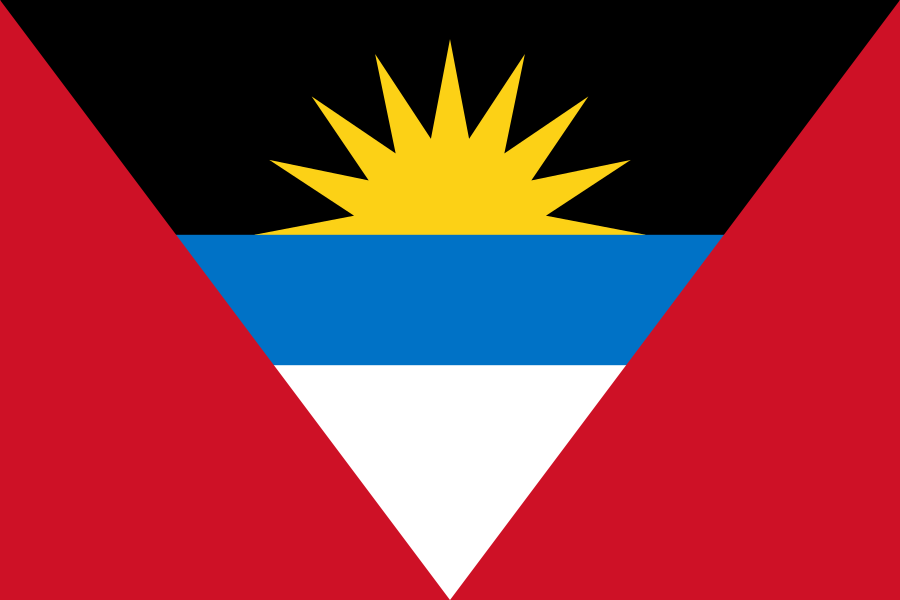 Antigua and Barbuda
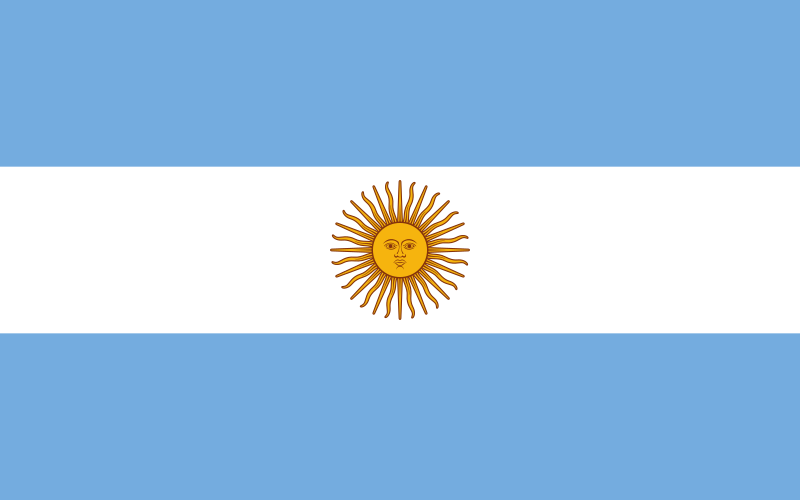 Argentina
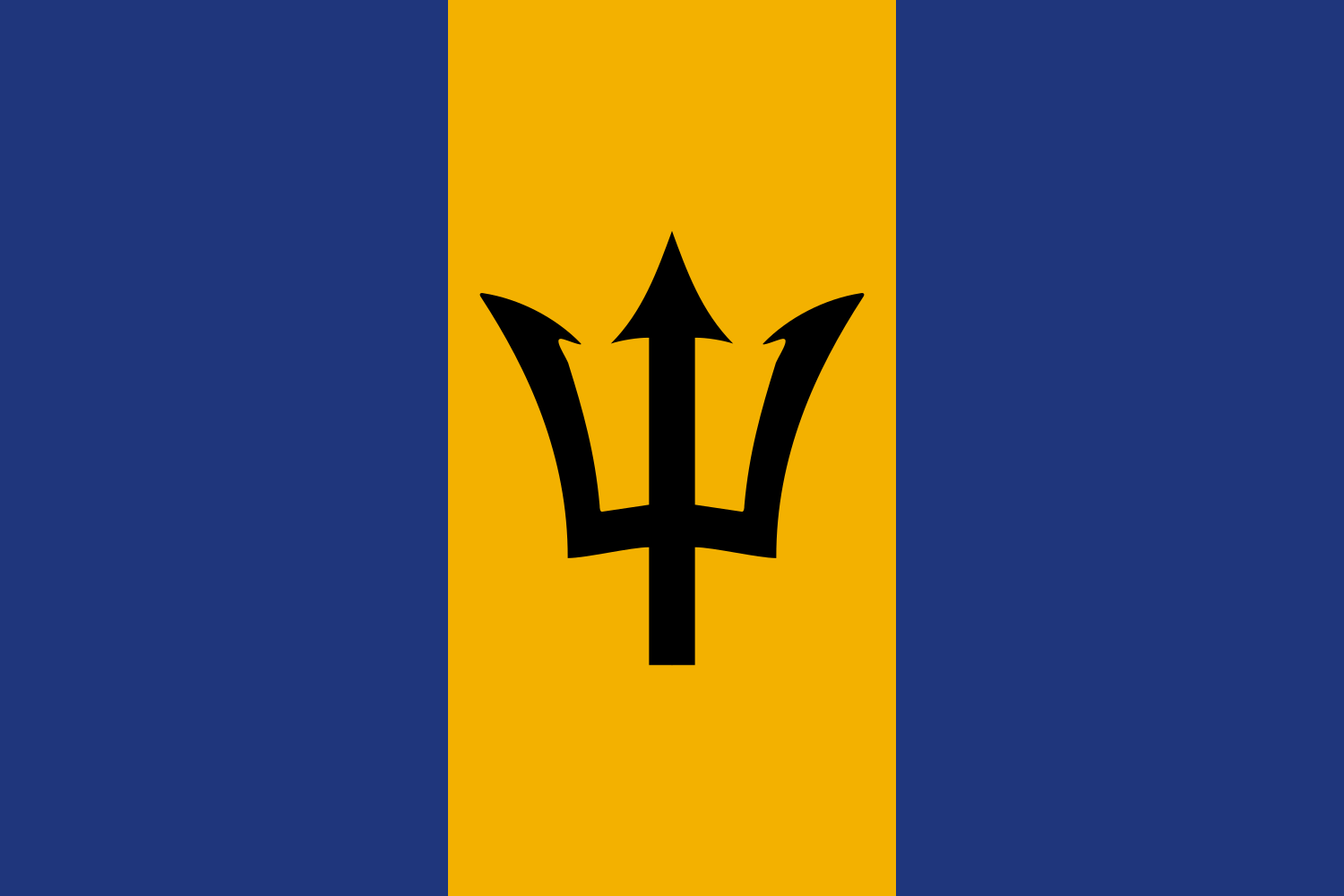 Barbados
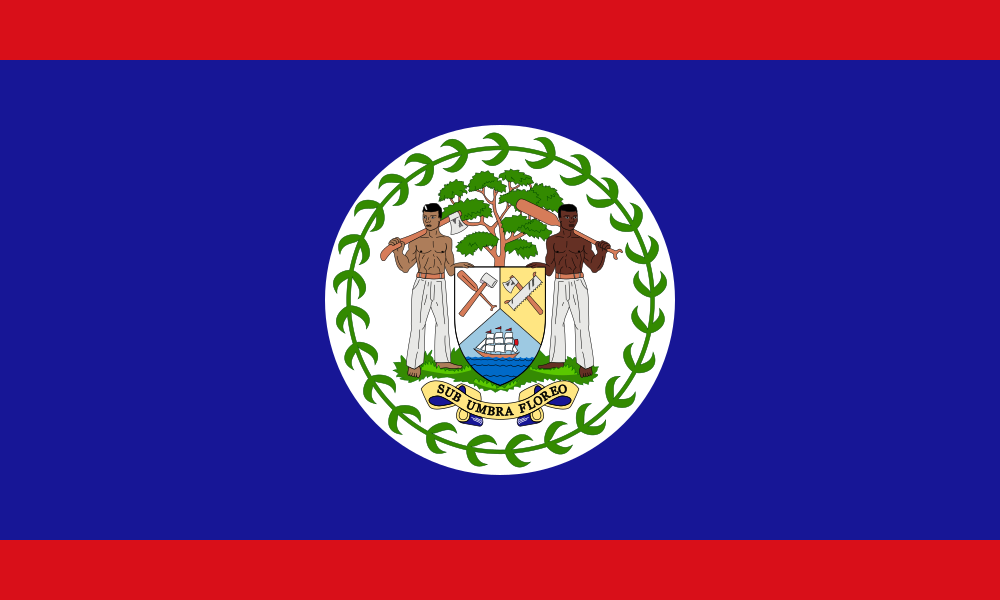 Belize
 Bolivia
 Brazil
 Chile
Chile Colombia
 Costa Rica
 Cuba
Cuba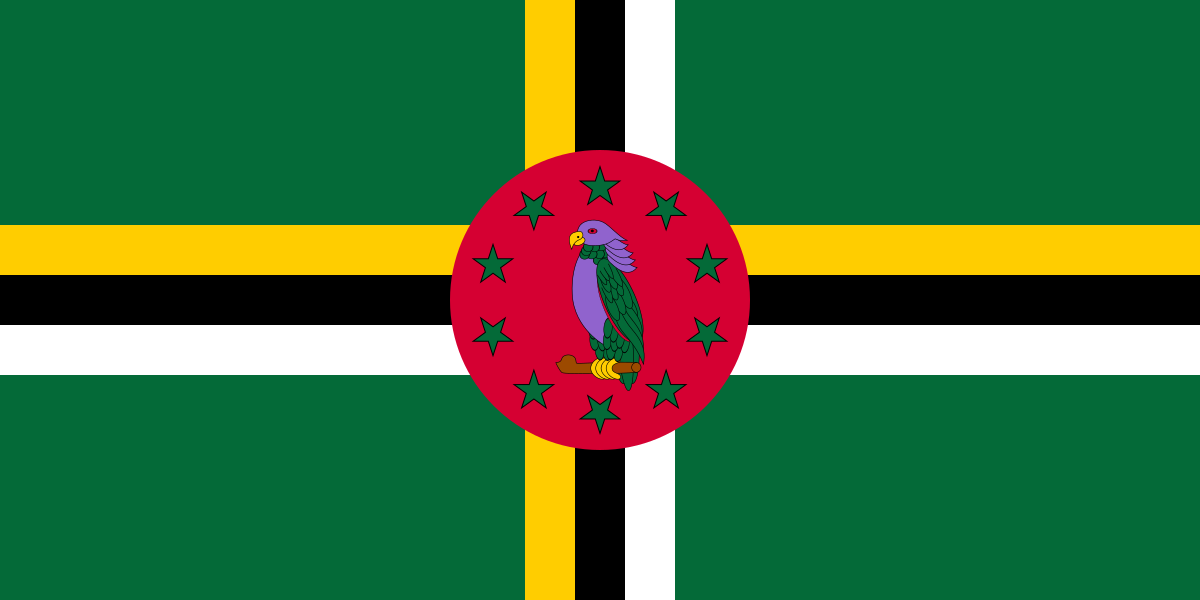 Dominica
 Dominican Republic
 Ecuador
 El Salvador
 Grenada
 Guatemala
 Guyana
 Haiti
Haiti Honduras
 Jamaica
 Mexico
 Nicaragua
 Panama
 Paraguay
 Peru
Peru Saint Kitts and Nevis
 Saint Lucia
 Saint Vincent and the Grenadines
 Suriname
 The Bahamas
 Trinidad and Tobago
 Uruguay
 Venezuela