One question, 33answers, each one the country’s own record. The labels below are the ones its own instruments use rather than a vocabulary we imposed on them: where one country’s law has no equivalent of another’s test, the row is simply absent, because an empty cell would invent a comparison nobody made. Every line opens onto the law it rests on.
Division 3 of Part III of the Immigration and Passport Act 2014 is one of the most developed student regimes in this comparison, and the obligations run both ways. A non-immigrant student may not attend an educational institution without a valid student permit, and an institution that enrols one without the permit commits an offence punishable by a fine of up to fifty thousand dollars. The permit is valid for a school year, renews on a report from the institution covering attendance, diligence and deportment, is tied to the named institution, and forbids gainful occupation - and unpaid occupation too, except unpaid student work connected to the course. The matters the Chief Immigration Officer weighs include the applicant's ability in English and whether there is information about their departure at the end of their studies.
Student permit validity
One school year
Renewal deadline
Not less than one month before expiry
Right to work
None, paid or unpaid
Address notification
Annually, and within 30 days of a change
Penalty on the institution
Up to $50,000
English language
A matter the officer takes into account
Child of a residence permit holder
May be granted a student permit on application
ArgentinaSouth AmericaVerified with official sourceMonitor - can change2026-09-21
Enrolment as a regular student at a recognised institution is the core of it, and the category is wider than a degree course: interns on an international agreement between an educational body abroad and one in Argentina, or a company or state body here, are covered by the same route.
Who qualifies
Regular students in the official education system
Level
Secondary, tertiary, university or postgraduate
Also covered
Interns under an international agreement
Proof of study
Electronic enrolment certificate
BarbadosCaribbeanVerified with official sourceStable2026-10-05
A student must obtain a student visa before entering Barbados, not after arriving. The Immigration (Students) Regulations, 1979 require an application in Form H-2 accompanied by a certificate from the head of the institution and written evidence that the student can pay the tuition and keep himself. The visa runs for one year and is renewed annually on a progress report from the institution. Changing course or institution needs permission first, and failing to ask can cost the visa. The regulation that matters most is the last substantive one: time spent in Barbados studying must not be taken into consideration when the student later applies for citizenship or permanent resident status. A degree in Barbados does not shorten the road to staying in Barbados.
Student visa validity
1 year, renewable at the end of each year on a progress report
Longest period a student entrant may be permitted under the Act
3 years in the first instance
Address reporting
Every 3 months, whether or not the address has changed
Does study count towards permanent residence or citizenship
No. Time spent studying must not be taken into consideration
Fee for a student visa, as the Regulations prescribe
$200.00
BelizeCentral AmericaVerified with official sourceStable2026-10-05
A student's permit is one of the eight temporary permits in the Immigration Act, and the test in the Act is short: the Director must be satisfied that you have been accepted by a training establishment in Belize and that suitable arrangements have been made for your accommodation. Everything else is in the Department's procedure - a letter from the institution, a letter of financial support carrying a BZ$1.50 stamp and signed by a Justice of the Peace, a police-free dossier of birth certificate, passport and photographs, and for a tertiary student from outside the region a one-year return ticket. Primary and secondary permits run a school year; tertiary permits run a semester. The fee the Department publishes for most nationalities is twice what the fee schedule prescribes.
Permit length, primary and secondary
One school year
Permit length, tertiary
One semester
Fee in the schedule, all nationalities other than the PRC
BZ$100.00
Fee published by the Immigration Department, all other nationals
BZ$200.00
Minimum age
Children over 5 years of age
Where you apply
At an Immigration Office in Belize, processed on submission
BoliviaSouth AmericaVerified with official sourceStable2026-09-27
A student visa runs 60 days and is the doorway to a temporary stay of up to three years, renewable in three-year blocks until the course ends. It is the longest first permit Bolivia grants on any ordinary ground - and it is a dead end by design: the regulation says twice, once for the transitory stay and once for the temporary one, that permanent residence cannot be obtained through study. Exchange students on a state agreement get 180 days and pay nothing.
Student visa validity
60 calendar days
Temporary stay it leads to
Up to 3 years, renewable in periods of up to 3 years until studies end
Exchange with a state agreement
180 days, free
Exchange without a state agreement
180 days, USD 50 at the consulate
Student visa fee
USD 50as of 2026-09-27
Temporary stay fee, one year
510 UFVas of 2026-09-27
Temporary stay fee, three years
1110 UFVas of 2026-09-27
Leads to permanent residence
No
BrazilSouth AmericaVerified with official sourceStable2026-09-27
A student residence runs one year at a time and may be renewed until the course finishes, against proof of enrolment, satisfactory progress and means of support. It is tied to a named institution, and leaving that institution is something the institution itself has to report to the Federal Police within thirty days. The useful part is that it is not a study-only permit: paid work is allowed as long as it fits around the study hours.
Initial term
Up to one year
Renewal
Until the course is completed
Paid work
Allowed, if compatible with the study hours
Changing institution
Permitted, with notice to the Federal Police
Processing fee
R$ 168,13
Residence card fee
R$ 204,77
ChileSouth AmericaVerified with official sourceMonitor - can change2026-09-27
The student permit is built around a formalised enrolment at a state-recognised institution plus proof that you can pay for the stay. Its distinguishing feature is the work allowance written straight into the decree: up to 30 hours a week of any lawful paid work, for any employer, with no separate authorisation - and doing it cannot be used against your student status, unless you go over the 30 hours. The permit runs up to two years and leads on to permanent residency.
Initial grant
Up to 2 years
Paid work
Up to 30 hours a week
Separate work authorisation
Not required
Who you may work for
Your institution or any other employer
Consequence of working
Cannot itself cost you student status, unless you exceed 30 hours
Duty to report work
Yes - send the migration service a copy of the contract
Where you apply
From abroad
Counts towards permanent residency
Yes
Losing student status
Grounds for revocation, subject to force majeure
ColombiaSouth AmericaVerified with official sourceMonitor - can change2026-09-21
The category is wide - it covers trades and arts, school at every level, vocational training and higher education, and it explicitly includes online and distance study. And there is a carve-out worth knowing before applying for anything: holders of passports from visa-exempt countries need no student visa at all if the stay stays under 180 days.
Covers
Trades and arts, preschool to secondary, vocational, higher education
Online and distance study
Expressly included
Visa-exempt nationalities
No student visa under 180 days
Health policy
Required
Counts towards permanent residency
No
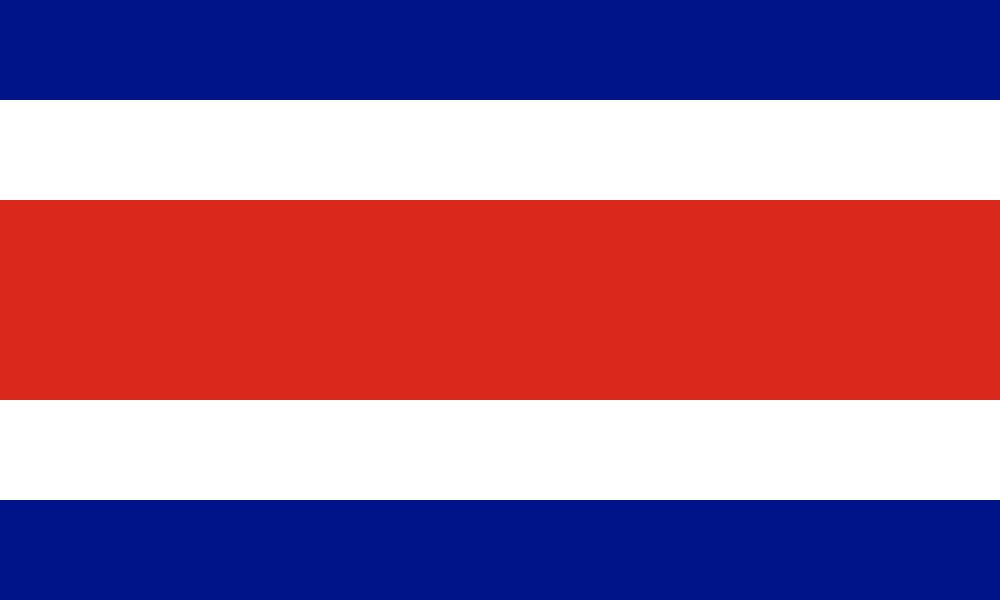
Costa RicaCentral AmericaVerified with official sourceMonitor - can change2026-10-04
Foreign students are not residents. They fall into the law's special categories, which article 95 says generate no right to permanent residency at all, so years spent studying do not count towards settling. The statute allows a stay of up to two years at a time, renewable while the course continues and capped by the length of the course; the regulation that implements it grants one year renewable. Paid work is prohibited outright unless the directorate authorises it in a justified case, and the only money test is a certified public accountant's statement of where the student's means come from - or, for a scholarship holder, the awarding institution's certificate of the amount, the term and what it covers.
Period granted by the regulation
1 year, renewable
Period the statute allows
Up to 2 years, renewable for equal periods
Overall limit
Not beyond the total length of the course or programme
Paid work
Prohibited, unless the directorate authorises it in a justified case
Counts towards permanent residency?
No - special categories generate no right to permanent residency
Means test
A certified public accountant's statement of the source of funds; no amount is published
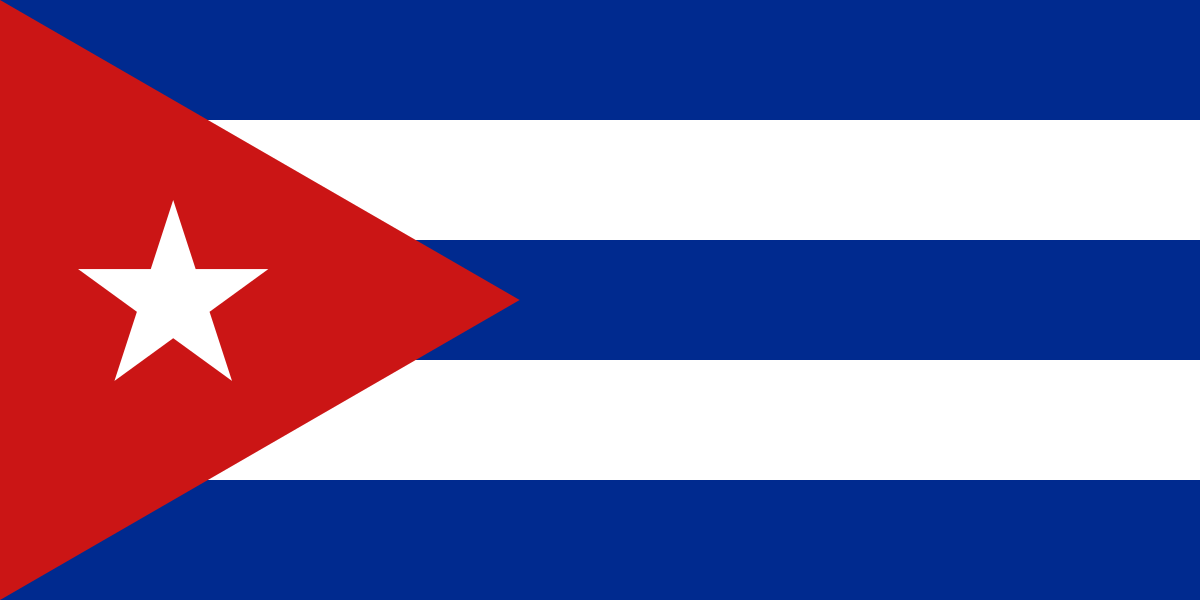
CubaCaribbeanVerified with official sourceMonitor - can change2026-10-06
A student is a temporary resident, not a separate category, and the regulation's definition splits students in two. One group arrives in the charge of a Cuban study, research or training centre under an exchange or co-operation programme; the other is admitted to study self-financed or on other paid terms. Both sit in the same subclassification, both are governed by the five-year ceiling on temporary residence, and both are applied for by the institution rather than by the student. One small benefit attaches to the status alone: foreign scholarship holders resident in Cuba import goods for their own use free of customs duty while they hold it.
Status
Temporary resident, student and scholarship subclassification
Self-financed study
Expressly covered
Maximum temporary residence
5 years
Decision on temporary residence
90 working days
Register within
10 natural days of entry
Customs
Goods for personal use are duty free while the scholarship status lasts
Identity card, document tax
CUP 250.00
DominicaCaribbeanVerified with official sourceMonitor - can change2026-10-05
There is no student permit in Dominican immigration law. The Immigration and Passport Act has one residence instrument, the section 9 permit, and the only place in the whole statute where study is mentioned is a form: the declaration a visitor signs to be exempted from the passport requirement, in which he promises not to remain beyond six months and not to accept employment. A student therefore arrives as a visitor - which in Dominica means up to twelve months on a single permit, longer than most countries give a student visa in one grant - and converts to a section 9 permit if he needs to stay beyond that. Where study does appear with precision is in the citizenship by investment Regulations, which treat a child between eighteen and thirty in full-time higher education as a dependant.
Student visa or student permit
None
Longest stay available without converting status
12 months from entry
Right to work while studying
Not addressed
Student dependant age range for citizenship by investment
18 to 30, in higher educationas of 2024-06-28
Published student fee or threshold
None found
Dominican RepublicCaribbeanVerified with official sourceStable2026-10-06
A foreign student in the Dominican Republic is a non-resident, and the distinction is not bookkeeping. The migration law puts students in its non-resident list alongside tourists and ship's crew; the regulation gives them a one-year stay, extendable; the migration service issues a one-year student permit renewable to a maximum of six. Years spent on it do not count towards permanent residence, because permanent residence is reached from temporary residence and the student never holds one. A student may not take paid work beyond the activity he was admitted for. What the permit does require, uniquely among the short-stay categories, is medical insurance valid in the Dominican Republic approved by the migration service and lasting the whole course.
Migration category
Non-resident
Permit length
1 year
Maximum total
6 years
Counts towards permanent residence
No
Paid work
Only the activity admitted for
Health insurance
Required, approved by the migration service
Passport validity in the regulation
18 months
EcuadorSouth AmericaVerified with official sourceStable2026-09-21
The student category runs from basic schooling to postgraduate study and covers professional internships as well as classroom study, including language schools teaching Ecuador's official languages. The visa is cut to the length of the programme, with a floor of six months in the statute and a ceiling of two years in the regulation, so a longer degree is renewed rather than granted in one piece. Proof of means may come from a parent for students up to 21, or from a scholarship letter covering tuition and living costs.
Visa length
The length of the programme, capped at 2 years
Statutory floor
The visa may not be shorter than six months
What counts as study
Basic, secondary, undergraduate and postgraduate study, official-language schools, and pre-professional or professional internships
Means of support
May be shown by parents up to age 21, or by a scholarship letter
Route to permanent residence
21 continuous months as a resident, on the same terms as any other category
El SalvadorCentral AmericaVerified with official sourceStable2026-10-04
One year at a time, renewable, for technical, university or specialised study at an institution recognised by the Ministry of Education, or for unpaid research. Two things set it apart from the student routes elsewhere in the region. It permits paid work - part-time, or for the duration of a contract presented - as long as that does not undercut the student status, which most countries either forbid outright or hedge with a weekly hour limit. And it is a dead end by design: the law says in terms that this kind of residence does not enable permanent residence, and that the holder must leave once the purpose of the stay is finished unless they change category. The study institution is made to report enrolment and withdrawal to the directorate and to the Ministry of Education within thirty days.
Grant
Up to 1 year, renewable, multiple entry
Paid work
Permitted, part-time or per contract
Leads to permanent residence
No
Reporting by the study centre
30 days from enrolment or withdrawal
Maximum total temporary stay
5 years
Fee, non-Central American, one year
USD 140
GrenadaCaribbeanVerified with official sourceMonitor - can change2026-10-05
Grenada has no student visa and no student permit. The Immigration Act runs from section 1 to section 39 with no study category anywhere in it, and the one place students are named in the whole of the immigration legislation is an exemption from a fee: St George's University students and faculty do not pay the monthly charge for extending a stay. In practice a student enters as a visitor, which in Grenada means a permit of up to twelve months - long enough for an academic year, and the reason no separate status was ever needed. Working while studying is a different matter: that needs a work permit like anybody else, and the Ministry of Labour runs a Students and Trainees permit category for internships that the statute does not contain.
Student visa or permit
None
Status a student actually holds
Visitor permit, up to 12 months
Extension fee for a St George's University student
Nil
Extension fee for any other student
EC$75 per month
Working while studying
Work permit required
Internship permit category
Administrative, not statutory
GuatemalaCentral AmericaVerified with official sourceStable2026-10-04
The student residence is the one temporary status in Guatemala that is not capped at five years. Every other category has to convert to permanent residence to go past five; a student may keep renewing for as long as the studies last. The term granted matches the school cycle or the length of the university courses rather than being a number of years chosen by the applicant, and what has to be shown is an enrolment or acceptance letter from an officially recognised institution plus proof that someone - the student, a sponsor, a scholarship or an institutional funder - will pay for it. Children of someone applying for any temporary residence can get student status on a parent's declaration alone, and may attend school while it is being processed.
Term granted
The school cycle or the length of the university courses
Five-year ceiling
Does not apply to students
Residence fee
USD 100.00 per year of residence granted
Children of other temporary residents
Student status on a parent's declaration
Attending school while the application runs
Allowed, on a document from the migration institute
Renewal application
30 days before the residence expires
GuyanaSouth AmericaVerified with official sourceMonitor - can change2026-10-06
Section 12(1A) of the Immigration Act lists the six purposes a permit may be granted for, and study is not one of them; a student arrives on the residual sixth, a purpose of a temporary nature. Everything else is administrative. The Ministry of Home Affairs runs a Student Visa on Arrival and a Landing Permit for Student Status, both of which put the paperwork on the institution: the school, not the student, must send the Ministry the acceptance letter, the address where the student will live and the institution's own business registration, income tax and National Insurance receipts. The Ministry of Foreign Affairs grants a student visa for three years at US$140. The more interesting provision is constitutional and it is not about visas at all: article 149H entitles every child - not every citizen - to free primary and secondary education in schools owned or funded by the State, and it sits inside the part of the Constitution the High Court can enforce.
Study as a purpose in the Immigration Act
Not listed. A student permit falls under "any other purpose of a temporary nature"
Student visa period
Three years, renewable for three years at a timeas of 2026-10-06
Student visa fee
US$140.00, and US$140.00 for each three-year renewalas of 2026-10-06
Who files the application
The registered or accredited institution, before the student arrivesas of 2026-10-06
Police clearance and medical report
Required only for applicants aged eighteen and overas of 2026-10-06
Free State schooling
Every child is entitled to free primary and secondary education in schools owned or funded by the State
Free education to university
A right of citizens
HaitiCaribbeanCorroborated by multiple sourcesMonitor - can change2026-10-06
There is no student residence category in Haitian law as we read it, and there is a student fee. The immigration law creates a single permis de séjour without categories; students are named only among the kinds of people who have to get it. But the fee table the United States embassy publishes for the Direction de l'Immigration et de l'Émigration charges a student 1,250 gourdes where a first issue costs 5,000 and a renewal 2,500 - a quarter of the ordinary first-issue price. So the agency recognises a student as a kind of applicant for pricing while the law does not recognise studying as a route. Nothing we read sets out what proof of enrolment is required, which institution must issue it, or whether a student permit allows any work; the Labour Code's foreign labour chapter has no student exemption.
Student residence category
None
Student residence permit fee
1,250 gourdesas of 2026-10-06
Work on a student permit
No exemption found
HondurasCentral AmericaVerified with official sourceStable2026-10-04
Students get a special permanence permit rather than a residence, issued for the length of the course or the internship. The permit category is capped at five years like every other, but the law adds that where studies run longer the permit may be extended for as long as it takes to finish them - which makes studying the one ground on which the five-year ceiling bends. The card itself, unusually, is issued for one year at a time rather than the five the law allows for everyone else, and each renewal needs the institution to confirm both that last year's courses were passed and that the student is enrolled for the next.
What you get
A special permanence permit
Length
The length of the course or internship
Category ceiling
5 years
Card validity
1 year
Annual permit fee
USD 50
Renewal test
Passed last year's courses and enrolled for the next
Lost by absence
6 consecutive months abroad
JamaicaCaribbeanVerified with official sourceStable2026-10-06
Jamaica issues no student visa. A student arrives as a visitor and then has the stay extended, and the Agency asks for that to happen within two weeks of arrival rather than when the landing stamp runs out. What is produced is a letter of registration from an institution registered with the Ministry of Education, addressed to the Agency's chief executive, together with a return ticket valid for a year. The alternative, for someone who qualifies for it, is Unconditional Landing, which the Agency describes as letting the holder attend school without a student visa and work without a work permit - it is granted on birth, descent, naturalisation or a Caribbean Community skills certificate, not on enrolment.
Student visa
None - the stay is extended insteadas of 2026-10-06
Deadline to present yourself
2 weeks from arrivalas of 2026-10-06
Return ticket
Valid for one yearas of 2026-10-06
Extension of stay processing fee
JM$10,000.00as of 2026-10-06
MexicoNorth AmericaVerified with official sourceMonitor - can change2026-10-04
A student gets temporary residence as a student, renewable each year until the course ends. The money test is the lowest of any residence route - 220 days of the UMA a month, or 2,290 days in savings, and it can be met by a parent, a guardian, a scholarship letter or a bank's financing certificate. One rule catches people out: this status cannot be reached from inside Mexico. Someone who arrives as a visitor and then enrols has to leave and apply at a consulate, because the guidelines say in terms that the change cannot be made in national territory.
Status
Temporary resident student
Card validity
365 calendar days, renewable until the course ends
Income test
Above 220 days of UMA a month for the last 3 monthsas of 2025-08-09
Savings test
An average monthly balance of 2,290 days of UMA over the last 3 monthsas of 2025-08-09
Income test in pesos
MXN 25,808.20 a monthCALC (calculated by us, not published)as of 2026-02-01
Mexican government scholarship holders
Exempt from the money test
Can it be obtained inside Mexico
No - the visa must be obtained at a consulate before travelling
Work
Allowed with a separate permission, and only in work related to the field of study
Family
The student's family can apply for temporary residence visas alongside
NicaraguaCentral AmericaVerified with official sourceStable2026-10-05
A student is a temporary-resident subcategory rather than a visa of its own, and the card issued carries the third of the regulation's three conditions: to study. The documentary burden is light by Nicaraguan standards - a pre-enrolment certificate from the institution showing the course and the period, and a notarised declaration either of where the student's own money comes from or of who is maintaining them. The migration directorate adds a degree, school-leaving certificate or transcript, apostilled. The fee is the halved one, because students are numeral 4 of article 25 and the directorate's reduced line covers that numeral. Nothing in the law or the regulation lets a student work, and article 13 makes carrying on an unauthorised activity a ground for expulsion.
Status
Temporary residence, student subcategory
Card condition
To study - no right to work
Term
One to three years, renewable
Annual fee
C$ 3,662.43
Application form
C$ 109.87
Decision time
30 working days
Means test
A notarised declaration, with no sum attached
PanamaCentral AmericaVerified with official sourceStable2026-10-04
A study permit in Panama is a temporary residence for full-time study at an institution recognised by the Ministerio de Educación, and it is one of only two categories a foreigner may apply for from outside the country, at a Panamanian consulate, rather than through a lawyer in Panama. It is also one of the narrowest: the regulation requires every subject on the term's syllabus to be enrolled, in daytime hours unless the programme itself runs at night, and it bans work outright except for the placements and internships the course itself requires. Students are exempt from the repatriation deposit the decree-law otherwise charges.
Work
Prohibited
Enrolment
Every subject on the term's syllabus
Hours
Daytime, unless the programme is certified as an evening one
Treasury fee
B/.250
Repatriation deposit
Not charged to students
Where you can apply
At a Panamanian consulate abroad, or in Panama
Permit term
1 year
Maximum on a study permit
6 years
Renewal
Annual, on passing credits
ParaguaySouth AmericaVerified with official sourceMonitor - can change2026-09-21
There is no student visa either. A student takes the ordinary temporary residency and, at the permanent stage, proves solvency as a student - and the directorate says in bold that being a student is not by itself proof of solvency. Enrolment has to be shown for the whole two years of the temporary residency, by receipts for fees or school records, and on top of that the applicant must show either income of their own or documented support from a relative within defined degrees of kinship. Distance and online study count, including at an institution abroad, provided the certificate says so.
Dedicated student visa
None
Student status alone
Not sufficient to prove solvency
Period enrolment must cover
The two years of the temporary residency
Distance and online study
Accepted, including at an institution abroad
Supporting relatives accepted
Parents and grandparents, siblings, uncles and aunts
Applicants under 18
Exempt from proving solvency
PeruSouth AmericaVerified with official sourceStable2026-09-21
A year of renewable residency for study at a recognised institution, and the category is wide: school, technical and vocational training, undergraduate and postgraduate university study, work-based training schemes and student exchanges all sit inside it. The condition that catches people is duration - whatever you enrol on must be documented as running a year or more. Study does not permit work, but Peru answers that with an instrument the other countries here do not have: an extraordinary work permit that, for students, runs for the whole residence period and allows half-time work.
Length of permission
365 days, extendable for the same period
Minimum course duration
1 year
Financial test
A sworn declaration of means, with no amount named
Work
Not permitted without an extraordinary work permit
Extraordinary work permit for students
Granted for the whole approved residence period, half-time work
A student is not a resident here: the Immigration Act handles study through the permitted-entrant machinery rather than through a status. Paragraph 2 of Part I of the Second Schedule names people entering to attend an approved educational or training institution, or a university or college authorised by law to confer degrees, and section 14 lets an officer admit them for up to six months at a time. That is shorter than a degree, so study depends entirely on extension - which section 14(4) allows, with the Minister's approval, up to six years from the date of entry. Six years is almost exactly a medical degree, and Saint Kitts hosts one of the Caribbean's larger offshore medical schools, so the ceiling is not accidental.
Status granted to a student
A permit, not residence
Maximum period at one admission
6 months
Maximum total period
6 years from entry
Which institutions count
Ministerially approved, or degree-granting by law
Right to work while studying
None
Time counting towards citizenship
Not established by anything we read
Saint LuciaCaribbeanVerified with official sourceStable2026-10-05
There is no student permit. The Immigration Act's seven permit purposes do not include study, so a student arrives on the residual paragraph - any other purpose of a temporary nature - and runs into the same ceiling as everyone else: six months from the officer, a year from entry in total, and then Cabinet. For a three-year degree at one of the island's offshore medical schools that is a structural problem rather than a paperwork one, and the Act offers no answer to it. The exceptions are regional. A Caribbean Community national holding a skills certificate enters for an indefinite period, and an Associate's degree is enough to get one since 2019. A citizen of an Eastern Caribbean Protocol member state has freedom of movement and needs nothing. Everyone else is on an officer's discretion renewed inside a twelve-month box.
Student permit category
None
Longest stay without a Cabinet decision
One year from entry
Qualification that gets a Caribbean Community skills certificate
An Associate's degree is enoughas of 2019-06-17
Dependant child of a citizenship-by-investment applicant
Up to 30 if fully supportedas of 2025-11-10
Compulsory school age
5 to 15
Tuition at a public school
Free, unless the Minister prescribes a fee for non-OECS nationals
Different by nationality:OECS Protocol member statesRead them
No student permit is published. A student from outside the region arrives on an ordinary entry permit - three months for most nationalities, six for CARICOM, British, Schengen and United States citizens - and extends it at EC$75 a month, or applies for the general residence permission at the Prime Minister's Office. The one thing that is clearly stated applies to children rather than to university students: a minor arriving with a national of Barbados, Belize or Dominica under full free movement registers with the Ministry of Education and may enter public primary or secondary education on the same basis as a Vincentian child.
Student permit
None published
Ordinary permit a student would arrive on
3 months, or 6 for CARICOM, UK, Schengen and US citizens
Extension
EC$75.00 per month or part thereof
School places for dependants under full free movement
Public primary and secondary education, on registration with the Ministry of Education
Working while studying
Not addressed anywhere published
SurinameSouth AmericaVerified with official sourceStable2026-10-06
There is no student residence permit in Surinamese law, because the Vreemdelingenwet 1991 creates no categories. A student applies for the ordinary residence permit of at most two years, with study written onto it as the purpose under article 11(3). What is specific to students is at the border rather than in the permit: the Ministry of Foreign Affairs states that people travelling for an internship, business or work-related purposes remain subject to the visa requirement, so the unilateral waiver that covers tourism and family visits does not cover them. For a stay longer than three months the authorisation for short stay must be obtained at a Surinamese mission before travelling, or through the contractor's online short-stay application, and registration with the aliens police follows within eight days of arrival and the residence application within fourteen.
Student permit
None; study is a purpose written onto the ordinary permit
Permit length
At most two years, renewable
Visa
Required for an internship, whatever the tourist waiver says
Right to work
Not conferred; an employer still needs a work permit
The BahamasCaribbeanVerified with official sourceStable2026-10-08
There is no student visa in Bahamian law. A student holds the ordinary residence permit of section 30(1)(a) - permission to remain otherwise than for the purpose of engaging in gainful occupation - and the only thing that distinguishes it is the fee. The Department's schedule charges $300 a year for a residence permit for a person attending an institution of higher learning in The Bahamas on a full-time basis, or as a trainee, on the certification of the Minister responsible for education, against $3,000 for anyone else. That certification is the only student-specific condition we found in any instrument, and the reduced fee is not a student concession: in the Schedule to the Immigration (Fees) Regulations the student, the dependant, the spouse of a Bahamian citizen and that spouse's child are all charged the same, and that figure is $25 rather than $300. Students are one of only two categories the Department's Permit to Reside page recognises as eligible at all, which makes study the clearest published way into a Bahamian residence permit. A student who wants to work needs a separate permit under section 30(1)(b); nothing in the Act or in the fee schedule creates a right to work part-time while studying.
Student residence permit fee
$300 for each year or part of a year
Ordinary residence permit fee
$3,000 for each year or part of a year
Condition for the reduced fee
Full-time attendance at an institution of higher learning, or trainee status, certified by the Minister responsible for education
Right to work while studying
None without a separate permit
Who else pays the reduced rate
The dependant, the spouse of a Bahamian citizen and that spouse's child
Students are permitted entrants, not residents. Section 9(1) of the Immigration Act has two separate student paragraphs: paragraph (f) for people entering to attend, and after entry actually attending, a university or college authorised by statute or charter to confer degrees, and paragraph (g) for people accepted by an educational or training establishment recognised by the Permanent Secretary or the Chief Immigration Officer. Both depend on actual attendance, so the status falls away when the attendance does. The Immigration Division issues a student permit online and charges TT$400, halved to TT$200 for a CARICOM national - which is exactly what the Fourth Schedule to the Immigration Regulations prescribes since 1 January 2026, so the agency and the instrument agree. The Division adds one thing the Regulations do not: full-time registered students of the St Augustine campus of the University of the West Indies do not require student permits at all. Time as a student counts towards the five years section 6(1)(a) needs, because a student is a permitted entrant and only time under a Minister's permit is excluded.
Student permit fee
TT$400as of 2026-01-01
Student permit fee for a CARICOM national
TT$200as of 2026-01-01
UWI St Augustine full-time students
No student permit required
Duration
The full duration of study
Passport validity required
At least one year
Does student time count towards residence
Yes
Different by nationality:CARICOM Member StatesRead them
UruguaySouth AmericaVerified with official sourceMonitor - can change2026-09-21
Students get temporary residency for up to a year at a time, renewable, but capped at two years in total for the whole course - which is shorter than most degrees. The financial test is means of support sufficient for your maintenance, and it may be somebody else's money provided the relationship and the transfers are certified.
Grant
Up to 1 year, renewable
Total cap
2 years for the whole course
Financial test
Means sufficient for maintenance
Third-party support
Allowed, with the relationship proved
VenezuelaSouth AmericaVerified with official sourceStable2026-10-06
The student visa, TR-E, covers higher technical or university study, specialisation and internships in your field. It runs a year with multiple entries and a year of stay, and is extended at the interior ministry's discretion on proof that the studies continue. The letter that matters is from the institution: it has to say what financial means you will have in Venezuela. The student visa is not on the list of visas that lead to Resident status.
Visa validity and stay
One year, multiple entries, one year of stay
Extension
At the interior ministry's discretion, on proof the studies continue
Notice for the extension
At least two months
Does it lead to Resident status
No
Covers
Higher technical or university study, specialisation, and internships in your field

 Antigua and Barbuda
 Argentina
 Barbados
 Belize
 Bolivia
 Brazil
 Chile
Chile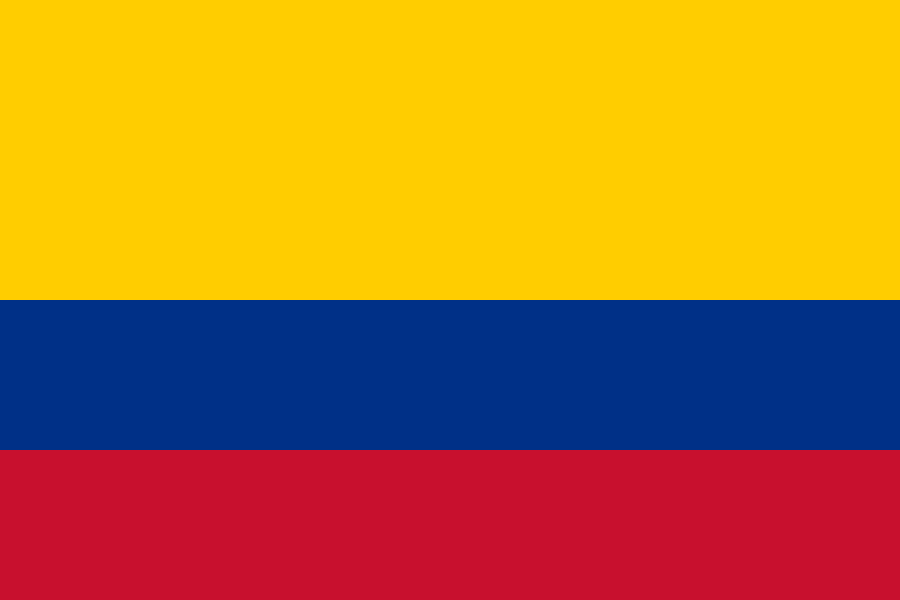 Colombia
 Costa Rica
 Cuba
Cuba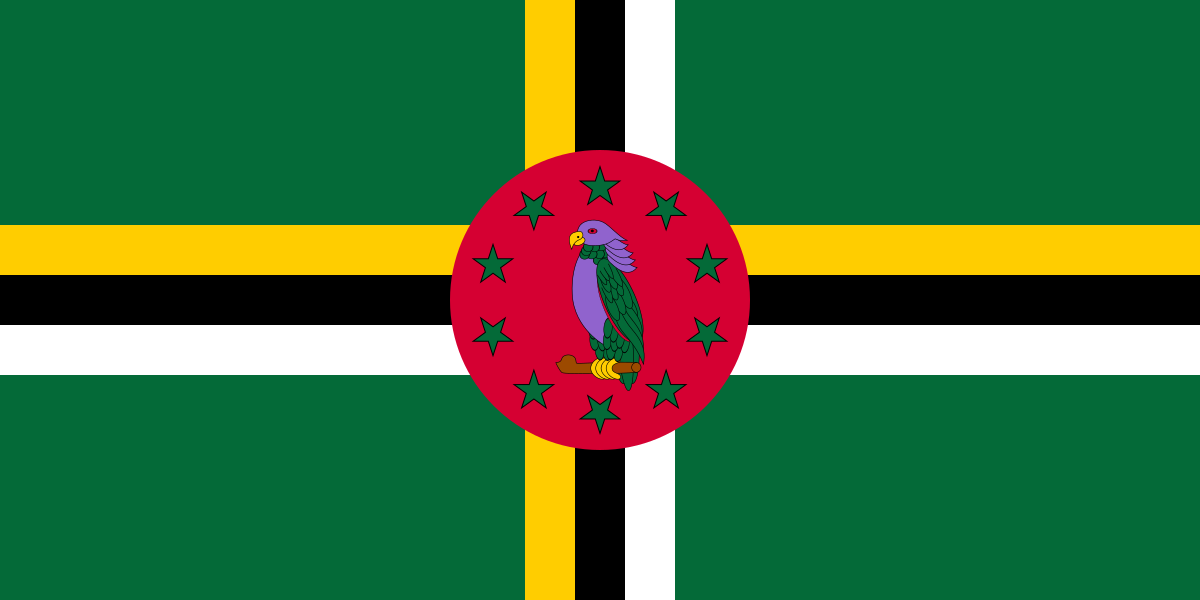 Dominica
 Dominican Republic
 Ecuador
 El Salvador
 Grenada
 Guatemala
 Guyana
 Haiti
Haiti Honduras
 Jamaica
 Mexico
 Nicaragua
 Panama
 Paraguay
 Peru
Peru Saint Kitts and Nevis
 Saint Lucia
 Saint Vincent and the Grenadines
 Suriname
 The Bahamas
 Trinidad and Tobago
 Uruguay
 Venezuela